


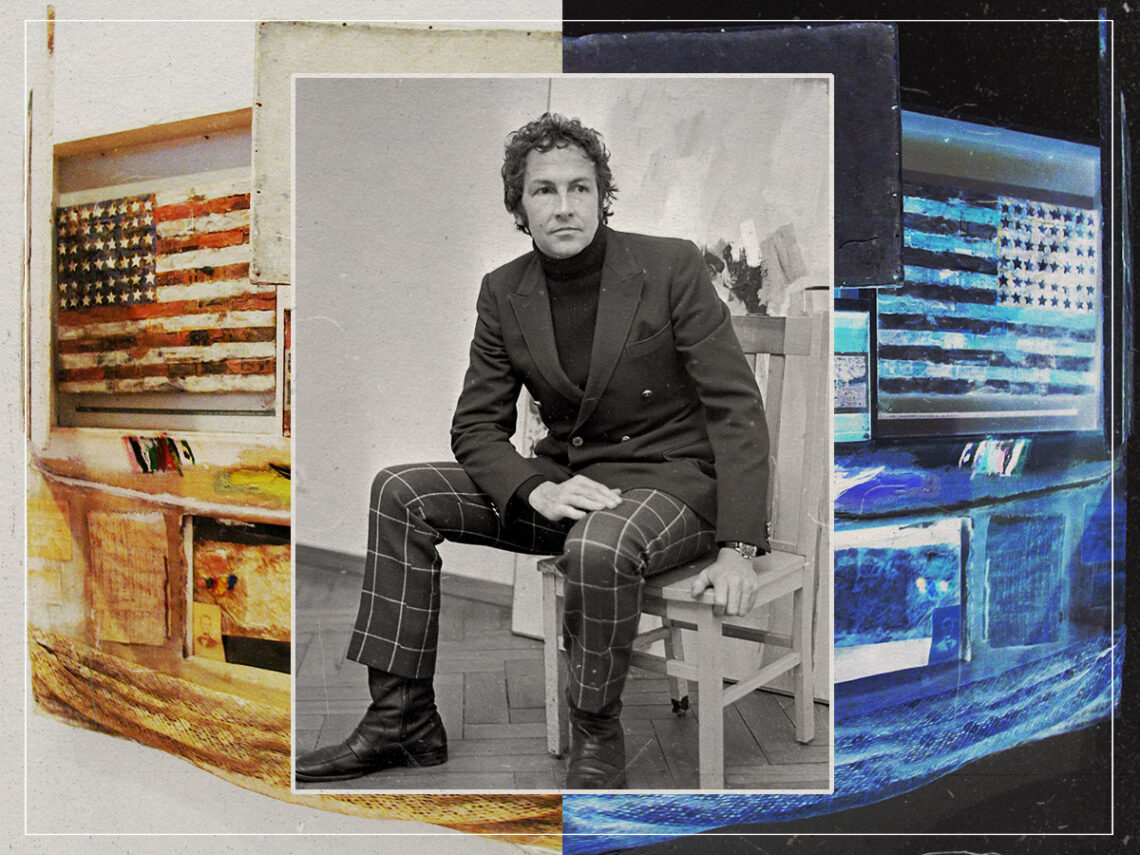
Robert Rauschenberg’s goat-stuffed “combines”

When Robert Rauschenberg was 18, he dropped out of a pharmacology course because he refused to dissect a frog. Decades later, he became famous for his “combines”, the multi-media art pieces that featured stuffed eagles and goats. While the animals were the headline element, what Rauschenberg was doing was far more intentionally poetic, blending painting and found objects in a joyous three-dimensional scrapbook. To that end, he has become one of the most celebrated post-war artists to emerge from the American pop art scene.
Eclectic as it is, his work falls under many umbrellas: Neo-Dadaist and Abstract Expressionist are often applicable. However, his combines were so singular that any art they informed is best referred to as Rauschenbergian. One central element of work inspired by him, and likely the reason he is so closely associated with pop art, is his embrace of commonplace images.
Much like Andy Warhol, he saw them as having untapped opportunities that the art world largely ignored because of the commercial element. “I really feel sorry for people who think things like soap dishes or mirrors or Coke bottles are ugly,” he once remarked. “Because they’re surrounded by things like that all day long, and it must make them miserable.”
He could often be found rooting through the rubbish lining New York’s streets, dragging cardboard, mirrors, and newspapers back to his studio to be incorporated into his work. Again, much like pop art, it fused high and low art, forcing everyday objects into a totally new context by his hand, layering them until he arrived at something between a painting and a sculpture.
Combines dominated his output from the mid-1950s onwards, and he was a meticulous collector of found objects throughout his entire career. Before coining the term, he’s been toying with textiles in his series of Red Paintings, the natural progression being 1955’s Bed, in which Rauschenberg smeared bright pigments over a bed sheet he hung on a wall much like a framed painting.
Monogram remains his most famous Combine piece, likely because of the inclusion of a huge Angora goat. Again, he plays with contexts, stuffing the already stuffed goat inside a tire. He’d seen the goat in a secondhand furniture store, bought it for $15 and spent the next three years perfecting its execution.
Though it gave way to many lofty theories surrounding its intended meaning, Rauschenberg said simply: “A stuffed goat is special in the way that a stuffed goat is special.” It was also a rare instance he hadn’t found an object – or, indeed, animal – but instead bought it. He soon rectified that with Canyon, which featured a stuffed golden eagle he inexplicably found in a rubbish bin.
