


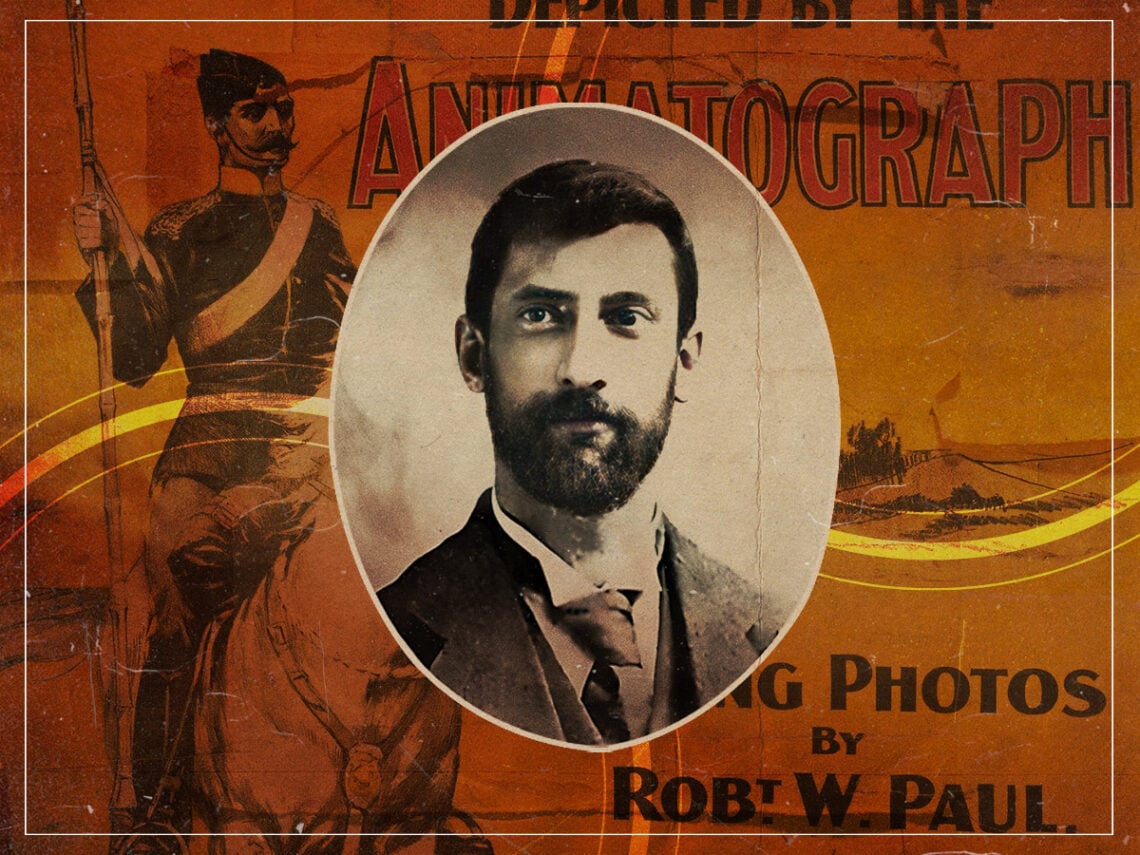
Robert Paul: The forgotten pioneer of British cinema

The race to go down in the history books as one of the founding figures in any emerging medium is one that doesn’t declare its podium-placing winners until long after the fact, something that’s seen Robert Paul go overlooked as one of the most important names in the entirety of cinema’s existence.
Among his many accomplishments is the creator of the United Kingdom’s – and quite possibly the world’s – first fictional film, 1896’s The Soldier’s Courtship. In addition, 1898’s Come Along, Do! was the first two-shot film, he screened one of the first-ever colour films after painstakingly hand-colouring a black-and-white negative, captured the 1896 Epsom Derby in an early example of newsreel footage, and utilised the first known example of panning after creating a special camera for the purpose of shooting Queen Victoria’s Diamond Jubilee procession.
An early adopter of intertitles as far back as 1898, Paul’s 1901 credit Scrooge, or Marley’s Ghost is the first known live-action adaptation of Charles Dickens’ bibliography, while The Magic Sword and The Motorist featured techniques referred to as ‘trick photography’, the forebear to special effects. Paul made 779 films in the space of 14 years but didn’t even consider the world of cinema to be his true calling.
Instead, that distinction fell to his career as an electrical engineer and maker of scientific instruments. However, that didn’t prevent him from earning the moniker ‘Father of the British Film Industry’, an accolade that was truly deserved no matter how much he deemed it as little more than a hobby.
Born in October 1869, Paul had barely left his 20s by the time he lent a massive helping hand to a fast-growing industry, one that somehow conspired to leave his name behind as its development rapidly accelerated.
The National Science and Media Museum’s film curator, Toni Booth, recalled how he got his foot in the door: “In 1894, two Greek entrepreneurs knocked on his door and said ‘Can you make replicas of Edison’s Kinetoscope machine for us please?'” Befitting his reputation, Edison ended up suing the Greeks when he caught wind of how popular Paul’s invention was becoming, but he managed to avoid the litigation.
He would then partner with photographer Birt Acres to design, build, and test Britain’s maiden 35mm camera in the space of just six weeks. Wanting to take his idea further, Paul sought to maximize the potential earning power of his latest invention after the duo parted ways.
His Theatrograph projector was demonstrated for the first time on the same day the Lumières were showcasing their own version, but according to Booth, by the end of 1896, “they both start putting on cinema shows as part of larger entertainments in theatres in Leicester Square.”
Spending two years screening his ‘moving picture shows’ and ‘animated photographs’ in Leicester Square, Paul also developed a business model that made him the first person in the industry to sell the equipment necessary to screen films to anyone who could afford to buy it, with one of his customers being Georges Méliès.
He’d also build an outdoor studio at a time when virtually every production was filmed in natural daylight, which was followed by an indoor studio powered by electric lights as the medium evolved, and used his expertise in ‘trick photography’ to craft an immersive viewing experience not entirely dissimilar to the late 19th-century version of 4D. After a revolutionary decade and a half, it appears as though he decided he’d had enough, deciding to step away from the burgeoning business and never return.
Giving it all up at the dawn of the 1910s might help explain why Paul isn’t regularly mentioned in the same breath as several of cinema’s other pioneers, but his list of accomplishments is nonetheless comparable to every single one of them.
