


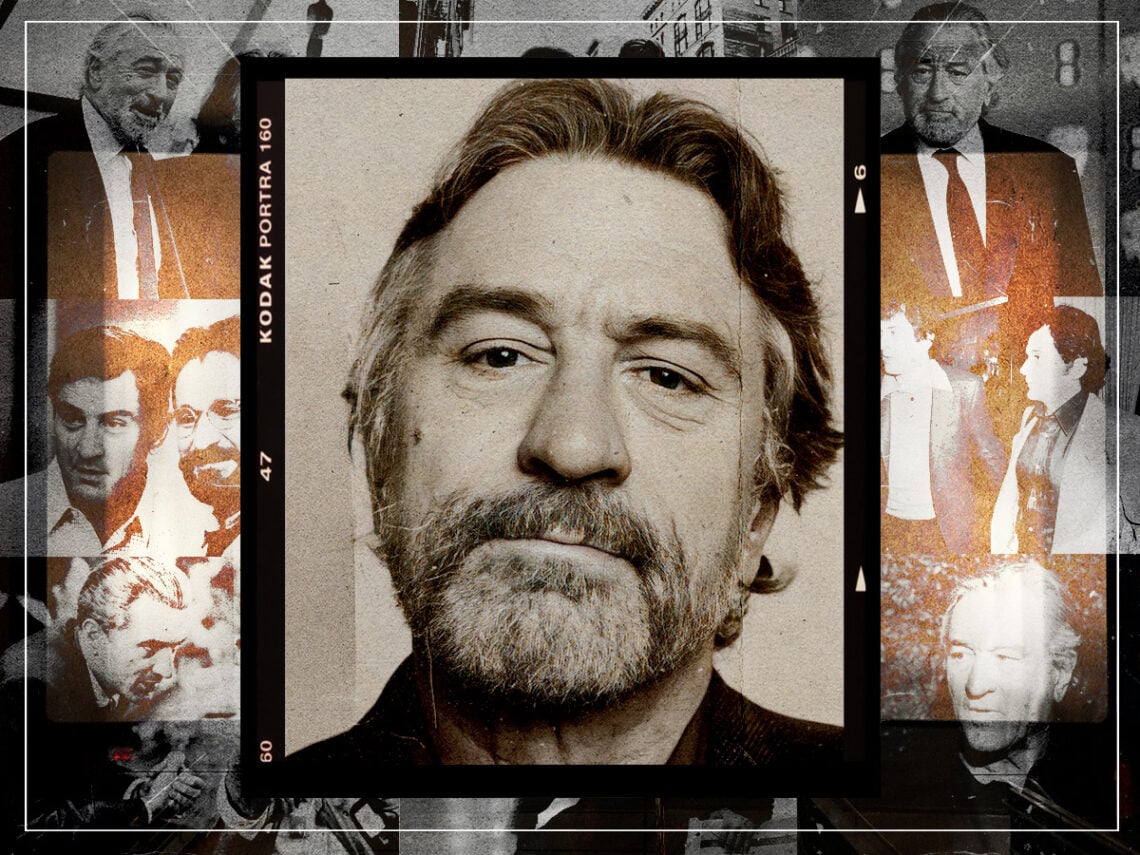
Robert De Niro at 80: The career of an indelible movie icon

Method acting has gotten a bad rap in contemporary Hollywood, largely thanks to the curious antics of the likes of Jared Leto, who believe that the strenuous performance technique revolves around being as ‘crazy’ as possible. It is indeed easy to forget that some of cinema’s most timeless performers succeeded whilst using this method for decades, with Robert De Niro becoming an icon in his own right throughout the 20th century, redefining the parameters of what critics believe film performance can be.
After rising to public consciousness in the 1970s, De Niro has occupied a space at the very pinnacle of Hollywood ever since, magnetising adulation from fans for his radiant style and on-screen charisma. Forming a strong bond with filmmaker Martin Scorsese, with the pair collaborating on some of cinema’s most feverous crime dramas, De Niro has also worked with some of the craft’s most pertinent names, including Francis Ford Coppola, Sergio Leone and Quentin Tarantino.
With eight Academy Awards to his name and wins for his roles in Scorsese’s Raging Bull and Coppola’s Godfather: Part II, De Niro has become a titan of the silver screen, still impressing even decades after his time in the industry limelight. Going through physical and psychological transformations for each and every role he took on, De Niro reinvented the art of acting for the next generation of burgeoning performers.
Tracking his time as an enthusiastic apprentice to a 21st-century master, we chronicle the life of one of Hollywood’s most endearing figures.
Robert De Niro: A career retrospective:
1960s – The Brian De Palma years
Seeing performance as an outlet for his own self-confessed shyness, De Niro pursued a career in the industry, inspired by the likes of Montgomery Clift, Marlon Brando, James Dean and Greta Garbo, among others. He took to the industry in 1965 and, at the mere age of 22, appeared in back-to-back minor roles in Marcel Carné’s double-bill of Three Rooms in Manhattan and Young Wolves.
It was the fateful arrival of yet another up-and-coming artist that would spark De Niro’s career into life, however, with the filmmaker Brian De Palma just starting out in the industry when he hired the actor for a major role in his sophomore film, Greetings in 1968. Following his success on the project, he immediately collaborated with De Palma again on The Wedding Party and Hi, Mom!, where he was able to build his identity as a performer.
In the early 1970s, he used his time to transition slowly into the industry, taking parts in middling dramas like Jennifer on My Mind, Ivan Passer’s Born to Win, and the comedy flick The Gang That Couldn’t Shoot Straight before De Palma himself would introduce him to another ambitious filmmaker, a 31-year-old Martin Scorsese.
De Niro offers “versatility, imagination, and tons of choices, which is what you want,” Scorsese stated in an old interview with Dick Cavett, with the following decade proving such as fact.
1970s – Resolute critical triumph
In 1973, De Niro would collaborate with Scorsese for the very first time, engaging in a working relationship that would continue for decades following the release of Mean Streets in 1973. Offered a choice of roles for the movie, Scorsese eventually decided that De Niro should play the role of ‘Johnny Boy’ in the movie, handing the actor his very first role as an unhinged criminal, an archetype he would grow incredibly proficient at playing.
Debuting at the Cannes Film Festival, De Niro’s performance was met with great critical praise, being compared to Dustin Hoffman in Midnight Cowboy and many other successful peers of the time. Whilst Scorsese went off to make the documentary Italianamerican and the unlikely romance hit Alice Doesn’t Live Here Anymore, De Niro moved onto pastures new, teaming up with a filmmaker at the height of his powers, Francis Ford Coppola.
Having just come off the back of the phenomenal ‘Best Picture’ winner The Godfather, as well as his intense, albeit more low-key follow-up The Conversation, Coppola returned to the fold in 1974 for a sequel to his gangster movie. De Niro was the individual deemed magnetising and powerful enough to take on a younger version of the character Don Vito Corleone, a role occupied by the actor’s idol, Marlon Brando, in the first film.
Earning his first Academy Award for his phenomenal performance in the movie, De Niro brought a maturity to Coppola’s film, building from the character he had created for Scorsese’s Mean Streets years prior.
Speaking about the impact of the role on his career, De Niro stated in an interview with Cigar Aficionado: “Getting the part changed my career, or revved it up, if you will. Then winning the Academy Award, you’re kind of guaranteed that you’re going to work again as an actor. The way I remember it, the movies that were becoming the blockbuster type films, Godfather Part I, was the first one that I remember in my lifetime as a young man. Then there was Jaws, then there was Godfather II, so these movies started coming out that were huge…Luckily, Francis wanted me to do it”.
Understandably, the filmmaker saw De Niro as a powerful potential collaborator for years to come, offering him a role in 1979’s Vietnam War epic Apocalypse Now, but De Niro had already committed to returning to Scorsese and an intense ‘drama of the times’ in the form of 1974’s Taxi Driver.
Still tackling the Vietnam conflict, yet from a very different angle, De Niro played the role of Travis Bickle in Scorsese’s film, a troubled veteran who stalks the streets of New York in a taxi cab, experiencing the city’s moral values slip away along with his own sanity. Preparing for the role, De Niro went to great lengths to embody the mind of the character, losing 30 pounds and even attaining a cab driver’s licence where he would work 12-hour days for a month.
His performance in the film has since been considered a significant landmark in the history of Hollywood, delivering a character who trembled with tension and tweaked with underlying fear and anxiety. Improvising “You talkin’ to me?” during one of the film’s most iconic scenes, in which he performs a version of his consciousness in front of the mirror, De Niro forever elevated his game, offering a character who was in equal measure terrifying and oddly sympathetic.
As if he hadn’t offered up the entirety of his acting capabilities already, De Niro saw out the decade with a number of challenging roles, collaborating with Bernardo Bertolucci for 1900 in 1976, Scorsese for New York, New York in 1977 and finally Michael Cimino for 1978’s The Deer Hunter.
Whilst his collaborations with Bertolucci and Scorsese failed to catch light, The Deer Hunter proved to be one of De Niro’s greatest-ever successes, adding to his fascinating filmography of anti-Vietnam movies that started way back with De Palma’s satire Greetings in 1968. The ‘Best Picture’ winner told the story of a group of friends from small-town Pennsylvania whose lives are irreparably damaged by the physical and psychological toll of the Vietnam conflict. One of the very first films to criticise the war following its end in 1975, the release of The Deer Hunter was a powerful statement that placed De Niro as a titan of the industry who led many of its most powerful and pertinent projects.
1980s – Eclectic creative choices
Having almost ‘completed’ cinema in the 1970s, De Niro surely approached the following decade with something of a ‘what now?’ mentality. Ever the ambitious professional, the 1980s began with perhaps his greatest-ever performance in Scorsese’s boxing movie Raging Bull, a story based on the life of the real-life professional athlete Jake LaMotta, whose life was marred by violence out of the ring.
Something of a passion project for De Niro, the actor explained, “I remember I used to see Jake LaMotta; he used to work in a kind of strip place right on 7th Avenue in the 1940s. He’d be standing right out there, and I’d be on the sidewalk, and he was overweight and this and that. I said, ‘Jesus, look what happened to him from then to now’…And I thought just the graphic difference of being out of shape and being a young fighter, that was interesting to me…I thought, ‘I’d like to see if I could gain that weight and do it’”.
His efforts indeed paid off, earning him the Academy Award for ‘Best Leading Actor’ for a performance that rivalled the emotional density of Taxi Driver’s Travis Bickle, embodying a truly troubled, conflicted character whose ego overwhelmed him.
Yet, following the release of Raging Bull, De Niro took on a number of more eclectic roles to expand his repertoire, appearing as a conniving funnyman in Scorsese’s satire The King of Comedy in 1982, Sergio Leone’s crime epic Once Upon a Time in America in 1984, Ulu Grosbard’s romance Falling in Love in 1984 and Terry Gilliam’s vibrant sci-fi thriller Brazil in 1985.
His unpredictable career matched that of the industry at the time, which had entered a new era of commercial success thanks to such franchises as Star Wars, The Terminator and Ghostbusters that were effortlessly shifting merchandise. Appropriately, De Niro began leaning to more consumable products, such as the intriguing 1987 horror flick Angel Heart by director Alan Parker, the role of Al Capone in De Palma’s big-budget prohibition crime tale The Untouchables and one of his very first comedy gigs in Martin Brest’s Midnight Run.
1990s – Considered reinvention
De Niro’s grip on his own career was fastened by the return of Scorsese in 1990, with the duo releasing Goodfellas, an influential gangster drama that would come to define the frenetic style and pace of filmmaking in the final decade of the 20th century. An adaptation of the 1985 non-fiction book Wiseguy by Nicholas Pileggi, De Niro starred in the movie as James Conway, an Irish carjacker who mentors a young aspiring criminal, Henry Hill (Ray Liotta).
The perfect summation of his most iconic characters to date, including Raging Bull’s Jake LaMotta, Taxi Driver’s Travis Bickle and Once Upon a Time in America’s ‘Noodle’, Goodfellas sparked De Niro’s career back to life, reinstating his identity as one of Hollywood’s most potent movie stars.
If the 1960s and 1970s were years of formative construction and self-realisation for De Niro, then the 1990s was a decade of considered reinvention, collaborating with some of the era’s most prominent talents to boost his own value in the industry.
Although he had never retired his method acting sensibilities, De Niro dedicated himself fully to the practice once more in 1991 with the release of Scorsese’s Cape Fear. Playing the nasty role of the rapist Max Cady, who is released from jail and immediately sets his sights on his former defendant, De Niro spent $5,000 to have his teeth ground down, sharpened and deformed to physically prepare for the menacing character.
Clever collaborations followed, teaming up with the beloved comic Bill Murray for Mad Dog and Glory, a young Leonardo DiCaprio for This Boy’s Life, all whilst helming his directorial debut of A Bronx Tale in the very same year of 1993. Something of a Scorsese-lite crime drama, A Bronx Tale was an astute choice of projects for De Niro, thriving off the back of his previous success with a film that still pulsated with quality.
Another tally on his Scorsese chart followed two years later with the release of 1995’s Casino before he continued his shrewd collaborations, teaming up with fellow classy action star Al Pacino for Heat in 1995, the young heartthrob Brad Pitt for 1996’s Sleepers and the beloved filmmaker Quentin Tarantino in 1997, starring in Jackie Brown, a film that would establish the director as more than just a juvenile lover of pulpy gore-fests.
Yet, perhaps De Niro’s most fateful role of the decade would be in the 1999 comedy Analyze This, which would set the actor up for several years of career hardship.
2000s/2010s – From crime icon to comedian
The generation born in and around the 21st century had little base knowledge of Robert De Niro. They grew up with the aforementioned likes of Leonardo DiCaprio whipping his blonde hair in James Cameron’s Titanic, Brad Pitt flexing his muscles in Ridley Scott’s Thelma and Louise and Keanu Reeves transforming the action genre forever in the Wachowski sisters’ The Matrix.
Indeed, for the younger generation, it appeared as though De Niro was little more than an industry comedian and has-been, appearing in movies such as 2000’s The Adventures of Rocky & Bullwinkle, 2004’s Shark Tale, and Jay Roach’s Meet the Fockers, that each paled in comparison to the classics that were gathering dust on the DVD shelves of family homes across the world.
De Niro had experienced something of a professional identity crisis before, but this one seemed to be more deep-rooted, with his appearance on Ricky Gervais’ TV comedy Extras suggesting that he had become a parody of himself.
Speaking about his sudden turn to comedy and family entertainment, he told Cigar Aficionado: “It didn’t bother me, and I never thought about it. Billy Crystal asked me, with Analyze This, and I just said ‘Let’s have a reading of this.’ Actually, Pacino got me on that, because he liked to have readings too. He was influential in that. So you have a table reading to just kind of lift it off the page a little bit…Sometimes you see you have to work on it more, or you say let’s get it ready and do it”.
Seeing the career turn as a challenge and something of a cash-grab, De Niro failed to truly thrive in the early 21st century, hitting the odd high point with such movies as 2007’s fantasy drama Stardust, 2011’s crime flick Limitless and David O. Russell’s Oscar-winner Silver Linings Playbook, in amongst endless cinematic fodder.
As if he had finally given in to the commercial temptations of the industry, De Niro floundered with roles in such terrible contemporary flicks as 2011’s New Year’s Eve and 2013’s The Family, whilst his critical stock plummeted.
2020s – Modern renaissance?
Many are suggesting that the 2020s have provided a career renaissance for De Niro, yet we’re yet to see this truly materialise. Suggestions of such began in 2019, when he took a supporting role in the Todd Phillips superhero flick Joker, starring alongside Joaquin Phoenix in a film that was itself produced by Scorsese and inspired by such movies as Taxi Driver and The King of Comedy.
“There’s a connection, obviously, with the whole thing,” De Niro, who indeed effortlessly slipped into the movie, said of the link between the films, “It’s not as a direct connection as the character I’m playing being Rupert many years later as a host”. Echoing the quality of De Niro from a bygone era, the film was a financial success and reintroduced the actor into the contemporary sphere shortly before the release of The Irishman, Scorsese’s own gangster revival flick.
Yet, just like how Joker had merely reminded audiences of De Niro’s bygone quality, The Irishman did much the same, de-ageing the actor alongside Al Pacino and Joe Pesci in a strange carnival act that didn’t quite pay off for the creative band of filmmakers.
But, there were certainly flashes of brilliance from De Niro, showing off the vibrant spontaneity he showcased in his early career, which will hopefully flourish once more with the release of Scorsese’s Killers of the Flower Moon in 2023.
Enjoying almost seven decades of industry prominence, De Niro remains an icon of cinema, standing as an exemplary performer to every burgeoning actor on how to embody a character, execute their intricacies and keep the audience on their toes.
