


‘Riotsville, U.S.A.’ Review: Sierra Pettengill’s essential civil rights documentary

The USA during the 1960s was a land fraught with racial tension thanks to the ever-growing economic divide that formed between middle-class white people and black Americans, many of whom lived below the poverty line. In the years immediately following the end of WWII in 1945, black Americans came from the South of the country to the inner cities of the North and West, creating pockets where unemployment and poverty were rife and tensions slowly grew.
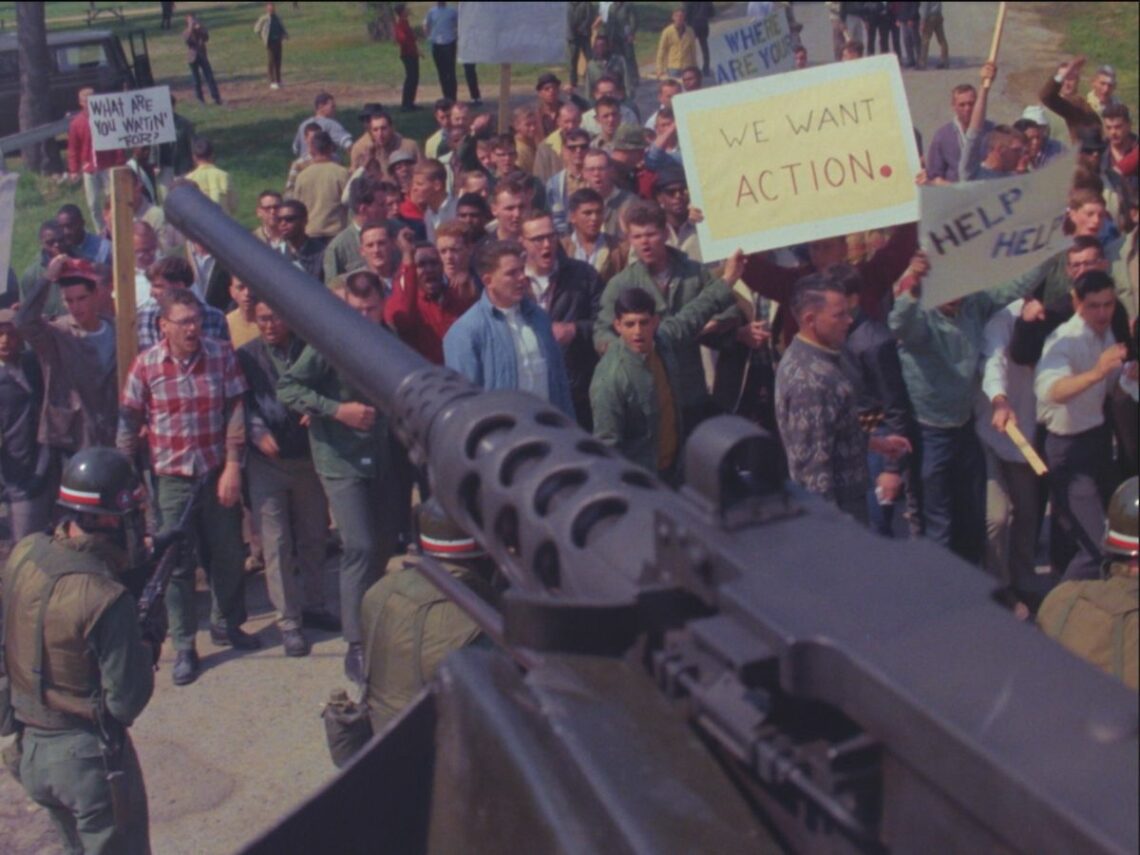
Such is the subject of Sierra Pettengill’s documentary, Riotsville, U.S.A., a poetic study that reflects on how the contemporary structures of power worked to create their own narrative about the race riots of the time, skewing the facts to push a racist agenda. Such fiction was partly created within the constructed borders of the surreal life-size dioramas of ‘Riotsville’, a fake town used to train military and police forces to respond to domestic civil disorder.
Named after a slave labour camp called Belvoir Plantation, the site of the first Riotsville complex, Fort Belvoir, is a bizarre thing to comprehend, with large wooden facades recreating the high streets of a typical American city. Liquor shops, appliance centres and city halls are erected and painted in bright primary colours, like the toy town of a children’s play area where any surreal story can take place and bizarre ideals can be fostered.
Consisting entirely of archival footage released either through the US military or broadcast television, the documentary itself is a clever construction, with Pettengill presenting the objective facts surrounding the race riots of the ‘60s without actually showing much of the physical conflict at all. Instead, the filmmaker is much more interested in the undoubtedly fascinating debates that were being conducted on air, largely on the left-leaning TV station PBL.
Led only by the voiceover of Charlene Modeste and the occasional flashes of rather dense text, Riotsville U.S.A. envelops its viewer in the politics and cultural turbulence of the time with ease, presenting information as if you were an American bystander of the conflict. Frequently compelling, when the film isn’t burdening you with too much information to chow down on, Pettengill’s documentary is one of the most quietly impressive of modern cinema, suggesting something more sinister simmering beneath the surface of 20th-century America that hasn’t been fully eradicated since.
A thorough deconstruction of Lyndon B. Johnson’s administration, highlighting his efforts to drastically increase police funding amid increasing levels of poverty among black Americans, Riotsville USA lacks firepower when it comes to painting a larger picture of the times, largely thanks to its rather restrictive use of archive footage. Though footage of TV debates and small-scale rallies is compelling, you can’t help but feel like you’re missing out on a considerable slice of the bigger picture.
Despite this, as a previously underreported flex of sinister governmental control, Pettengill’s story of Riotsville stands as an essential piece in the modern history of the civil rights movement. Drawing disturbing parallels between the police brutality of the 1960s and contemporary treatment towards black people in Western societies, Riotsville U.S.A. is an essential history lesson that speaks to the disturbing manipulation of institutional powers.
