


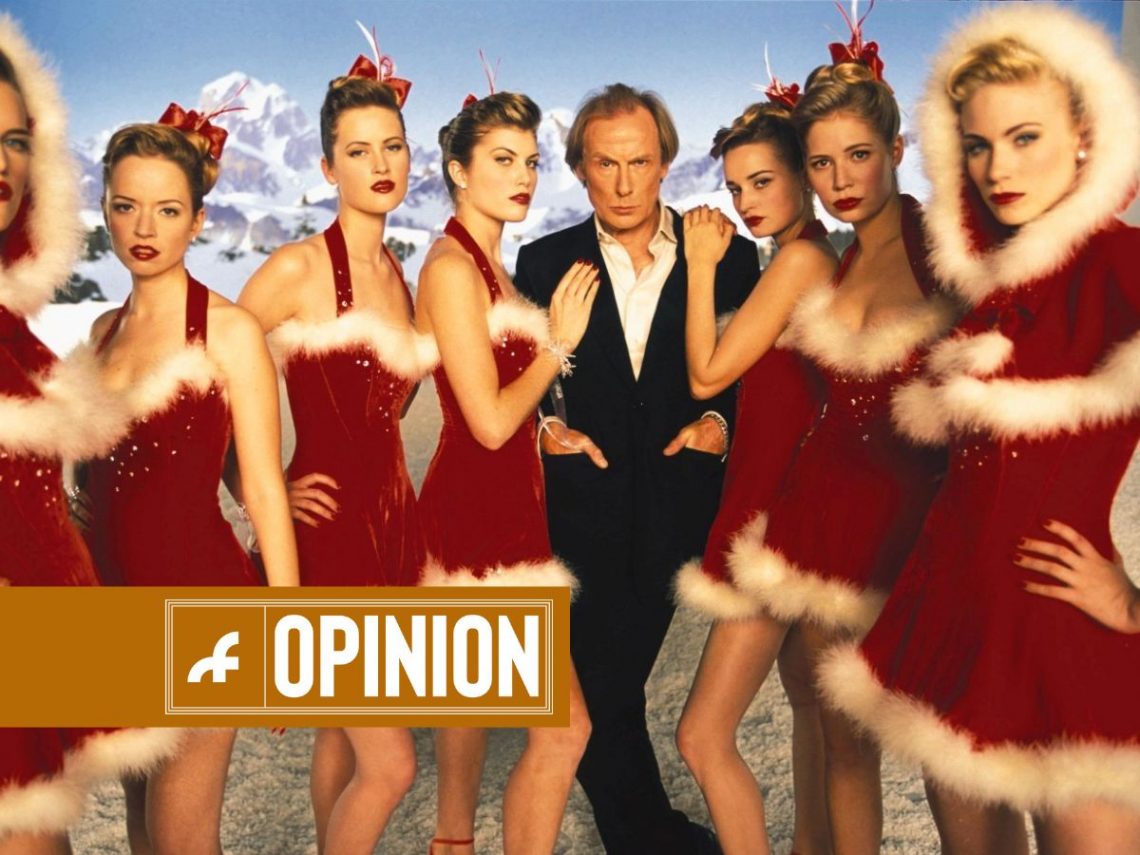
Hear Me Out: Richard Curtis’ ‘Love Actually’ is an escapist Christmas classic

British filmmaker and sovereign sentimentalist Richard Curtis made a name for himself as one of the most divisive figures of national cinema at the turn of the new millennium. The guilty pleasure of countless cinephiles, Curtis’ definitive hour came in 2003 with the release of his directorial debut Love Actually, a film of sickening sentimentality and sticky whimsical humour that might just make it the most accurate Christmas movie ever made.
Starring a ‘who’s who’ of British acting talent, including rom-com staples Hugh Grant and Colin Firth alongside other British icons Liam Neeson, Keira Knightley, Emma Thompson, Bill Nighy and the late Alan Rickman, Love Actually is a mosaic of short love stories that intermingle and intertwine like a smelly Christmas pile-on. Coming out at a far more innocent time, when the cynicism of the internet had not yet tarnished contemporary society, stepping into Richard Curtis’ world is like stepping into an alternative British reality.
This fantastical escapism is exactly why Love Actually remains such a generational favourite almost two decades later, serving as a portal into an unashamed time of whimsical fun and slushy family humour.
In a more socially conscious 2022, it’s difficult not to watch Curtis’ festive bonanza without noticing how hilariously detached his version of London is from the real thing. Whitewashing the inhabitants of the city, the director enlists the help of the most Anglo-Saxon cast possible and reduces Tony Blair’s Britain to the kind of picturesque landscape one might find illustrated on a dusty tea cosy in a charity shop.
Taking pole position in a film made up of several moving parts is Hugh Grant as an alternative version of the early-2000s prime minister, who bumbles through 10 Downing Street with all the conviction of a young boy in his dad’s work clothes. It’s certainly a sign of the times that the character can glide through the fantastical 2003 film, whilst, by comparison, a contemporary prime minister depiction wouldn’t breathe without insults, scandals and pleas to resign being launched in their direction.
Some of the other multiple storylines include Jamie (Firth), a heartbroken man who falls in love with a Portuguese housekeeper, Harry (Rickman), a managing director who regretfully engages in an affair and Sam (Thomas Brodie-Sangster), a young boy who falls in love with his American classmate. Each story wriggles and squirms with bumbling British humour and sickening joy, yet each is as uniformly saccharine as the last to the extent that it works as a festive whole.
If Christmas in the western world is a time for love, companionship and selflessness, well, then Love Actually does a pretty good job of reflecting this sentiment. The problem is that unless other genuine cinematic holiday favourites, like Frank Capra’s It’s a Wonderful Life or Satoshi Kon’s Tokyo Godfathers, which encapsulates similar ethereal feelings, Love Actually feels about as empty as Slade singing, “So here it is, Merry Christmas Everybody’s having fun”.
Existing in another world entirely, where pure happiness and blissful ignorance exist in a fictional utopian London, Richard Curtis provides a piece of escapism that is so far from the truth that it’s utterly baffling. Though, this is where the appeal lies. Love Actually is every Christmas song, advert, movie, short story and greetings card rolled into one beaming ball of gooey pudding. It’s the most inane piece of bewildering festive escapism there is; have a slice – you may as well.
