


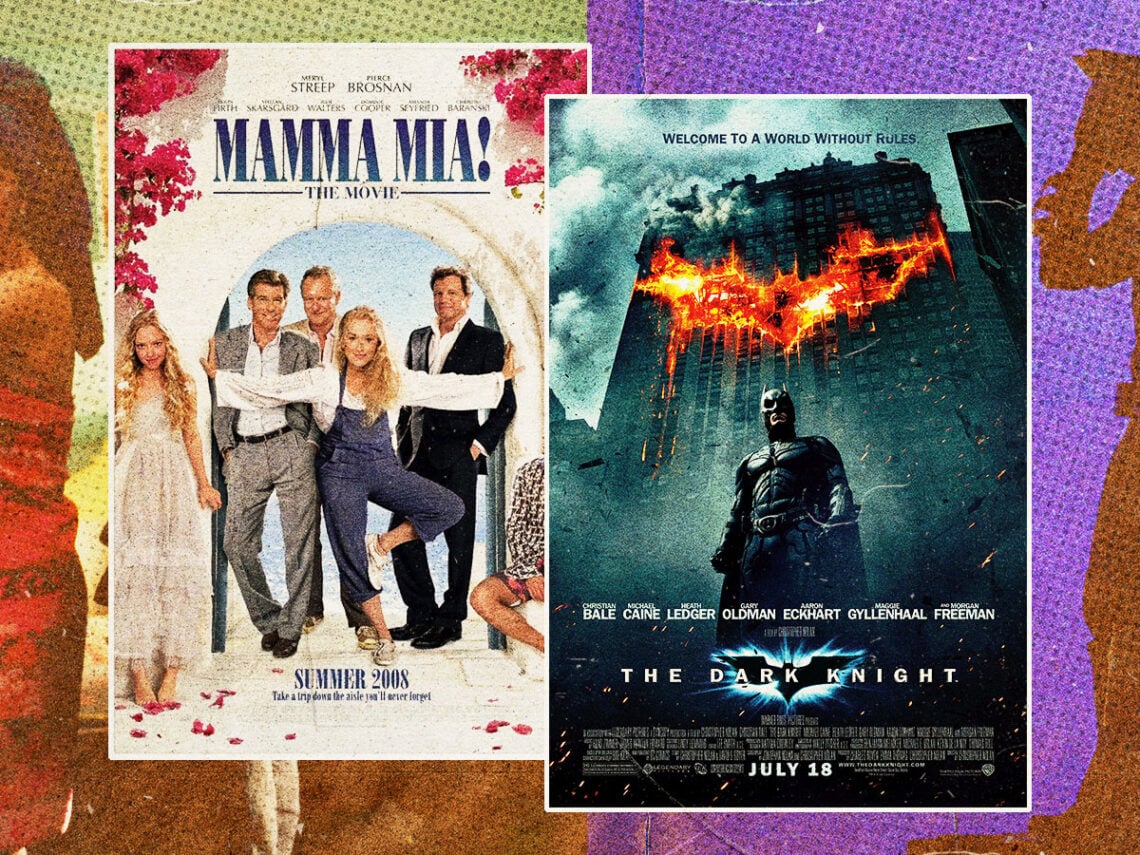
Revisiting ‘Mamma Mia!’ and ‘The Dark Knight’: The original ‘Barbenheimer’

With all the hype around ‘Barbenheimer’, you’d think that this was the first time in film history that two major movies were planned to be released on the same day. However, the convergence of Greta Gerwig’s Barbie and Christopher Nolan’s Oppenheimer is not the inaugural instance of such cross-programming.
Major studios have orchestrated simultaneous releases for decades, so why has it become such a big thing this time around? Before we go into that, let’s first go back some 15 years to when we had a similar situation with Mamma Mia! and Batman: The Dark Knight Rises.
On July 18th, 2008, Phyllida Lloyd’s ABBA-infused heart-warming musical Mamma Mia! was released. Amanda Seyfried, Colin Firth, Meryl Streep, Pierce Brosnan, and Julie Walters all star in an absolute sugar-fuelled dream of a film – it’s fun, and it’s corny, and that’s the whole point. On the same day, Christopher Nolan’s Batman: The Dark Knight entered theatres, earning an immediate reputation as one of the best contributions to the Batman franchise in history.
Usually, cross-programming is a conscious strategy that’s used when two inherently different films are showcased at the same time to avoid any detriment to box office profits. In the case of Mamma Mia! and The Dark Knight, the intention is clear: separate the Batman fans from the ABBA fans, and each film has a fair chance. Of course, this doesn’t necessarily account for zealous cinephiles who harboured an affinity for both.
Make no mistake, both films were huge blockbuster hits, but compiling them both into shared discourses wasn’t really…well, the thing. Nonetheless, if we’re to compare these two to the likes of the modern-day ‘Barbenheimer’ phenomenon, we’ll see some glaring similarities.
Take Barbie, for example; like Mamma Mia!, Barbie provides an obvious tongue-in-cheek take on an already familiar concept. Only, in Gerwig’s comedy, the story reframes ideologies behind the original Mattel doll and challenges everything it represents, including beauty ideals and the treatment of women in a patriarchal society. Like The Dark Knight, Oppenheimer is notably darker and more direct in its realism.
However, the truth is that Barbie and Oppenheimer present such stark differences that they’re really not that different at all. Despite their obvious dichotomies, they both deal with real-world struggles and existential paranoia. It’s the same with Mamma Mia! and The Dark Knight. There are multiple parallels at play, like the intricate struggles faced by their respective characters.
For example, consider Bruce Wayne’s enduring battle with his dual personas, a franchise-long exploration of his internal conflicts and moral dilemmas. When compared with Sophie’s journey in Mamma Mia!, we witness two characters perpetually navigating contrasting circumstances. Sophie, while seemingly confined to the idyllic Greek island, equally finds solace and purpose in its place.
Ultimately, whether or not the maturity of the internet is the sole reason behind ‘Barbenheimer’s emergence remains uncertain, but it undoubtedly played a big part. Social media, in particular, can’t resist the opportunity to take a funny idea and run with it. Back in 2008, we were still very much in the realm of understanding new forms of social media. We had yet to grace the surface of what it would become, and who knows, if Mamma Mia! and The Dark Knight had been released in today’s world, maybe we would currently be in the throws of a ‘Batmia’ phenomenon.
