


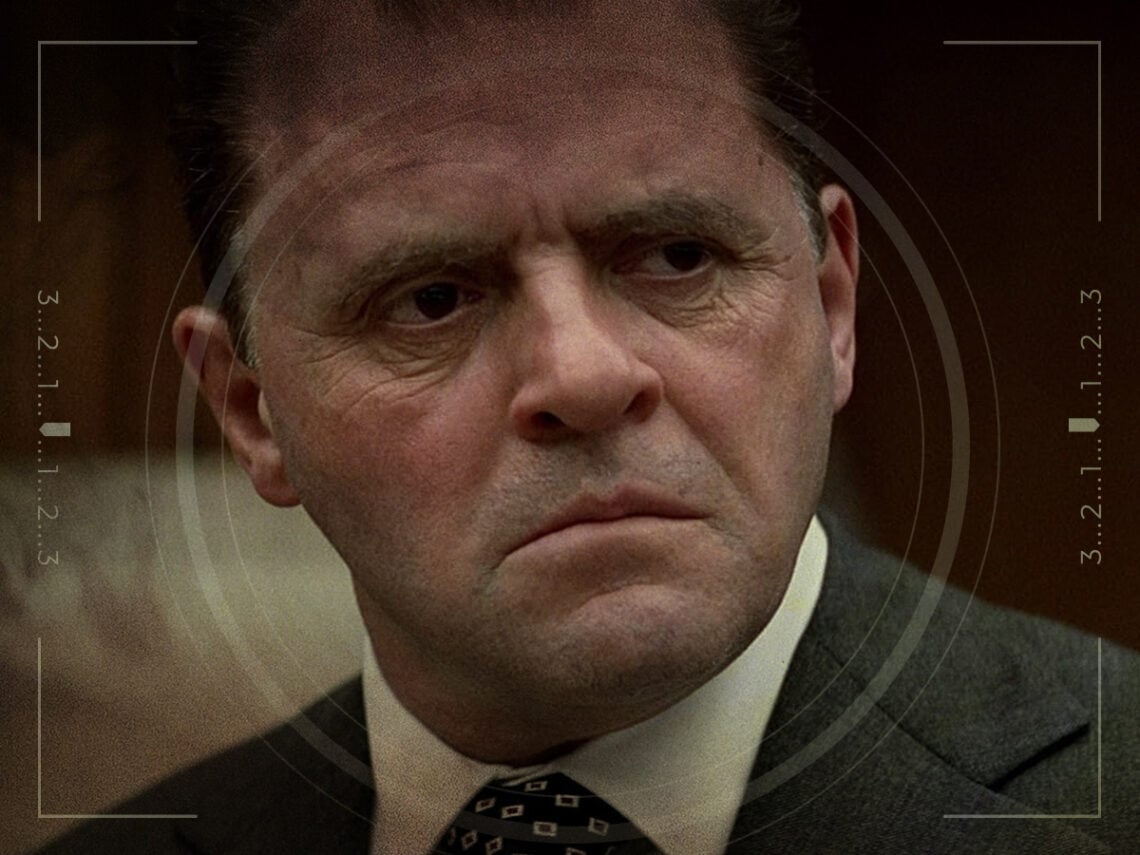
How reverse psychology earned Anthony Hopkins an Oscar nomination: “Chicken, huh?”

In his storied career, Anthony Hopkins has been nominated for six Academy Awards. He took home the ‘Best Actor’ trophy for his iconic performance as Hannibal Lecter in The Silence of the Lambs and his heartbreaking turn as a dementia-addled dad in The Father. Of his four nominations that didn’t turn into wins, though, Hopkins counts one of those performances as the hardest role he’s ever had. In fact, he turned it down before being baited with reverse psychology into signing on the dotted line by a director who wouldn’t take no for an answer.
In the years following his breakthrough win as Lecter, Hopkins was finally cemented as a Hollywood star. He’d been acting since the late 1960s and had flirted with superstardom in the ’80s thanks to movies like The Elephant Man and The Bounty. However, after he so memorably stole the show in Jonathan Demme’s seminal serial killer thriller, he was suddenly a known entity to audiences all over the globe. Between 1992 and 1995, he seized on this momentum by starring in Chaplin, The Remains of the Day, Shadowlands, and Legends of the Fall, the last of which was an enormous hit to the tune of $160million.
It was around this time, though, that Hopkins was made an offer that sounded preposterous to him. Oliver Stone, the firebrand provocateur behind Platoon, Wall Street, and JFK, approached Hopkins about playing disgraced US President Richard Nixon in a biopic, and Hopkins was stunned. “To play an American President, that’s a bit of a stretch of imagination,” he chuckled to CHUD.com in 2006.
However, Stone didn’t think it was a stretch at all. Having watched Hopkins in The Remains of the Day and Shadowlands, he became convinced the Welsh thespian had an isolated emotionality to his performances that perfectly suited the man most remembered for the Watergate scandal. “The isolation of Tony is what struck me,” he said. “The loneliness. I felt that was the quality that always marked Nixon.”
To Stone’s dismay, though, Hopkins initially rejected the offer to play Nixon. Naturally, though, someone like Stone wasn’t going to stand for that, so he decided to play some mental games with the reluctant star. “Oliver Stone is an amazing director, and he put the pressure on,” Hopkins chuckled. “I didn’t want to do it, and I remember he came to England to meet m,e and I’d already turned it down. He said, ‘Chicken, huh?'”
Hopkins had a vivid memory of hearing that taunting word escape from Stone’s lips at Hyde Park Hotel in London, and he had to confess it was effective. “I had a moment of clarity,” Hopkins revealed. “I can stay here in Britain and play nice, boring, safe parts in the BBC, or I can work with this crazy director in America and maybe fall on my backside or make a success of it. I just thought, well, I’ll just take the risk!”
Stone’s reverse psychology had worked a treat, and it would eventually lead to that Oscar nomination. However, Hopkins would admit that he didn’t exactly have a great time playing Nixon. It began when he read the script for the first time and realised just how much dialogue it entailed. He remembered thinking, “What have I done? I’ve taken on this nightmare,” and joked to the Toronto Star, “There were moments when I wanted to get out; when I wanted to just do a nice Knots Landing or something.”
Amazingly, Hopkins was also taken to task by his own castmates for failing to capture Nixon’s very particular accent. James Woods once revealed that Paul Sorvino supposedly told Hopkins he was “doing the whole thing wrong” and that he’d be happy to lend him some expert help.
Whatever the case, Hopkins ended up having no issue with Stone, who he realised was a great director as soon as they started rehearsals – although he was a harsh taskmaster. “He puts a lot of pressure on you, and you get to a point where you either crack or you get it,” Hopkins explained. “He was relentless until I got the feeling of the part, and I really liked Oliver.”
