


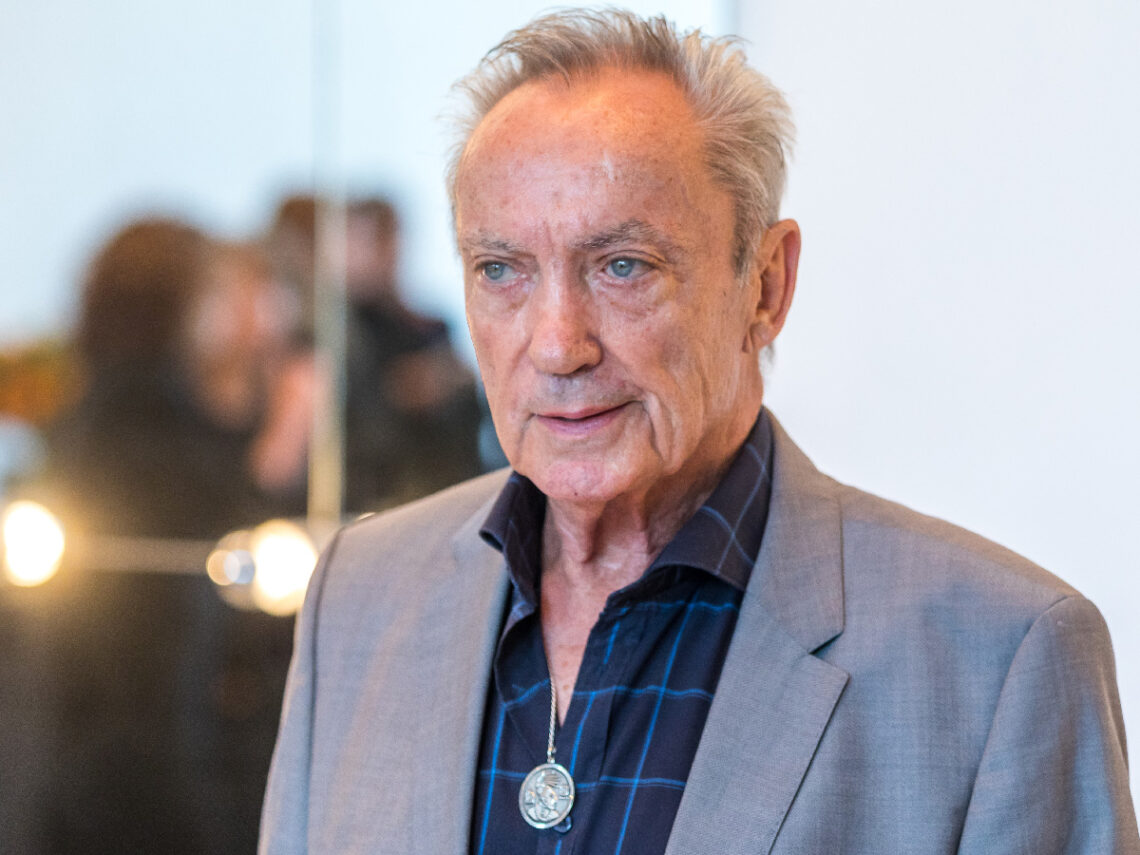
Remembering Udo Kier and his last great collaboration: “I was crying for the first time in 50 years”

“How many Udos are there? About 200?” – Kleber Mendonça Filho
If you don’t know Udo Kier by name, you would almost certainly know him by his steely green eyes, arched eyebrows, and cool, impassive expression that has defined many onscreen villains. Throughout his nearly six-decade career, the German-born actor played Hitler four times, as well as the Antichrist, Dracula, Frankenstein, and dozens of spine-chilling murderers, war criminals, and terrorists, but at heart, he considered himself an aesthete who fell into his profession by chance.
There is a case to be made that Kier has had the most varied career of any actor, ever, from being Lars von Trier’s muse and appearing in Ace Ventura: Pet Detective to starring in several of Madonna’s music videos, who else can say that they worked with some of the greatest directors of all time, including Rainer Werner Fassbinder, Dario Argento, and Wim Wenders, and some of the worst directors of all time, including Michael Bay and Uwe Boll?
Although his roles were almost always small, Kier was a formidable scene stealer who never displayed an ounce of theatricality, no matter how campy the dialogue, and of the nearly 300 credits to his name, Kleber Mendonça Filho and Juliano Dornelles’ 2019 feature Bacurau stands out the sharpest.
Set in a mysterious town in rural Northeastern Brazil that is beset by a group of foreign hunters, it follows Kier playing the leader of the hunters, a sadistic outsider intent on picking off the townspeople one by one. It wasn’t an unusual role for him, but it did give him more screen time than usual, and his character emerges as the most complex and tenacious villain of the group.
The film itself was a labour of love, as most films are, but Bacurau was a particularly ambitious undertaking, in that this Tarantino-esque western set in rural Brazil starred actors largely unknown to American and European audiences, featuring blood-soaked action, hints of magical realism, and comedy. It wowed critics when it premiered at the Cannes Film Festival, even though they struggled to describe exactly what made it so exhilarating to watch, as it revealed a world in which nothing is as it seems in strange, hypnotic, and constantly surprising ways.

For Kier, the premiere was an unusually emotional experience, regarding which he said, “When the lights came up, I was crying, for the first time in 50 years”, remembering that Filho was crying, too. “People love it,” he continued, “They explode with emotion and screaming”. The only thing he didn’t like about the experience was that he was being filmed as if he were giving a performance, explaining, “It was my moment. I didn’t do that for the audience”.
Filho cast Kier in the role as an homage to the actor’s own body of work. When the New York Film Festival ran a special series called Mapping Bacurau, the director picked the 1974 Italian film Blood for Dracula as one of the films, which starred Kier as a waifishly thin vampire scouring Italy for the blood of virgins; it is campy, erotic, comedic, and horrifying, as genre-defying as Bacurau and with just as much focus on the aesthetics of filmmaking. “How many Udos are out there? About 200?” Filho had asked in his notes on the film. With Bacurau, he gave audiences yet another.
Although Kier’s role in the 2019 film is less campy and experimental than his role in Blood for Dracula, he saw it as the beginning of a new chapter in his career, and noting that he had worked with von Trier for 35 years and had collaborations with Fassbinder and Gus Van Sant, he said, “My new director is Kleber. I will work with him again”.
In 2025, Filho’s latest film, The Secret Agent, won more awards than any other film at the Cannes Film Festival that year, and again, the director used Kier’s past to inform his casting, which saw him playing a German tailor covered in scars and with an uncertain past, leaving the audience guessing whether the actor is a Nazi or a Holocaust survivor.
Kier’s death at age 81 sadly puts an end to his collaboration with Filho. It’s not often that you can lament the lost future of an actor who appeared in well over 200 films, but, as Filho said, there were so many versions of Udo Kier that it’s hard not to mourn for the ones that never made it to the screen.
