


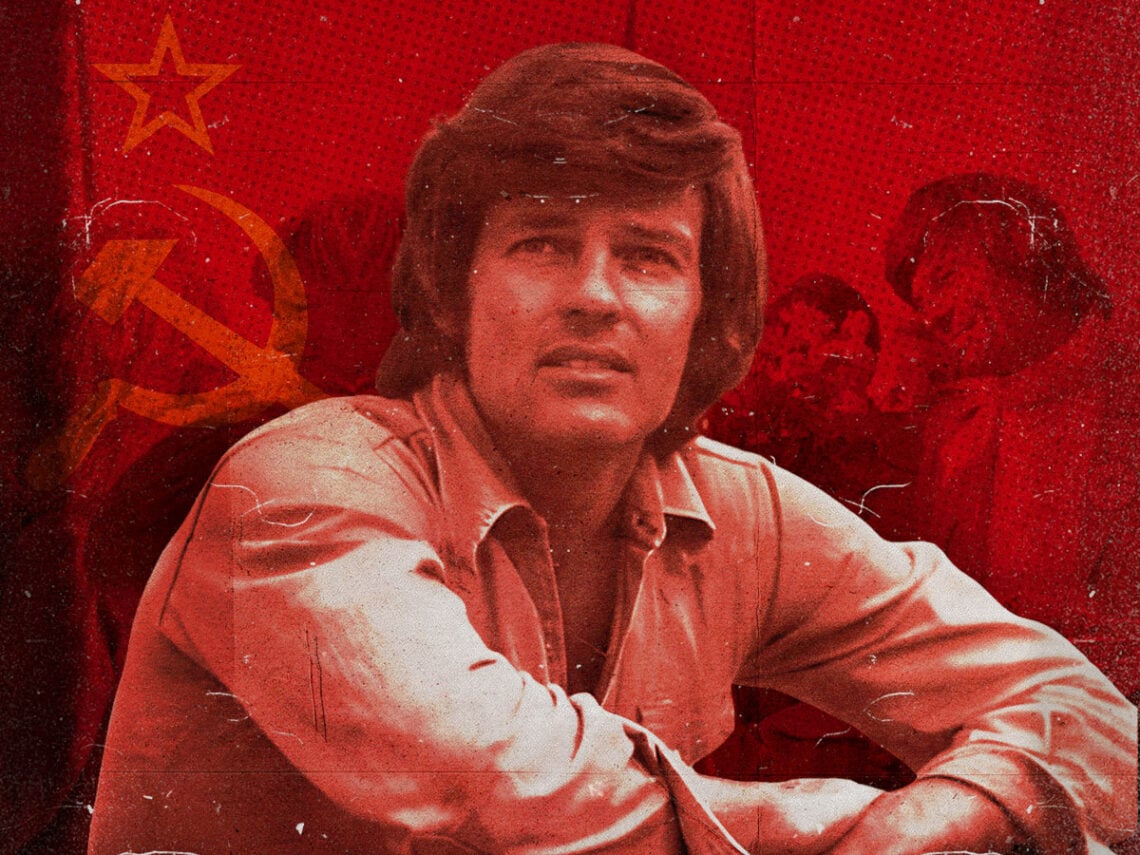
Red Elvis: the story of the first Soviet superstar

In the 1960s, it was the US rock musician’s job to upset the American government, and while many made a pretty penny appearing to do so, few were absolutely committed to the cause. Dean Reed, on the other hand, was only too keen to spurn his homeland. Known to the world as Red Elvis, or Red Sinatra, the American musician never made it in America but became a musical sensation in both Latin America and the Soviet Union, where he became the Eastern Bloc’s first bonafide superstar.
Reed’s long road to stardom began at the tail end of the 1950s. After dabbling in acting, he recorded a one-off single for Imperial Records. The label didn’t like the record and chose not to offer Reed a contract. Capitol, however, were more forthcoming and began to warp Reed into a clean-cut teen idol, his good looks already having won him a handful of TV roles.
Over the next few years, he released a string of singles, including ‘Pair of Scissors’, ‘Annabelle’, ‘The Search’, ‘No Wonder’, ‘I Kissed a Queen’, and ‘Our Summer Romance’. When not in the studio, he appeared in adverts and TV shows like Bachalor’s Father, by which time he was growing uneasy with life in the Hollywood machine. So, when ‘Our Summer Romance’ became a hit in South America, Reed took it as an opportunity. In the spring of 1962, he spent 40 days touring Brazil, Peru and Chile, where he adopted Marxism, started protesting against US foreign policy, and campaigning for nuclear disarmament.
After criticising America for the “deaths of 1,500 children not yet born,” he was approached by an ambassador from the American embassy and told to be more careful. “I only talked of saving lives and of peace,” he replied. [quotes via The Deen Reed Database]. I hope to God that that is not against the policy of the United States.”
“President Kennedy has explained that we must do this to keep Communism out,” the ambassador told him.”Do you want to live under Communism?” “No,” came Reed’s reply. “But before I kill myself and the rest of humanity, yes!”
Reed’s vocal support of Marxism won him the support of Chilean poet Pablo Neruda and politicians like Salvador Allende. His career blossomed as a result. At the same time, however, his rumoured “lack of basic niceties” and willingness to perform for wealthy Peruvian mining barons for vast sums made him the enemy of many on either side of the Captialist-Communist divide.
After a few years living in Rome in the 1960s, where he acted in TV commercials and spaghetti westerns, Reed started moving in the direction of the Iron Curtain. He performed in Helsinki, Finland, in 1965 for the World Peace Conference, where he delivered an unusually spirited performance for a crowd larger than any he’d experienced in the Americas. Observing the crowd’s enthusiastic reaction, Nikolai Pastoukhov, head of the Soviet Youth Organization, realised that Reed was precisely what he’d been looking for: an entertainer raised on Western influences which could cater to Soviet ideologies.
By the beginning of the 1970s, Reed had established himself as the USSR’s first and most successful rock ‘n’ roll star. Thanks to the support of the state, his concerts were regularly sold out, and tickets were selling for as much as 40 rubles ($48). While Americans living in Russia were bewildered by his popularity, the inhabitants of other Eastern Block countries were quick to celebrate Reed – both for his music and his attacks on American politics. In 1972, the Young Communist League of Czechoslovakia awarded him an honourary medal, and it wasn’t long before he was starring in East German films like The Good For Nothing, the popularity of which was so intense he was accosted by numerous women in the street, one of whom – it’s been claimed – attempted to rip his clothes off in a wild fit of erotic mania.
On marrying an East German interpreter, Reed settled in the German Democratic Republic, where he was given a lakeside residence by the government in return for performing pro-Marxist songs in schools, factories and worker’s clubs. In the 1980s, his popularity began to wane, and he started longing for his native Colorado, having failed to learn more than a smattering of German, Russian, Spanish or Italian. Isolated and disillusioned, he was struck with the terrible realisation that he’d never be able to forge a career back in America, where he was regarded as a traitor, a terrorist and a fraud, despite never having joined the Socialist Unity Party or renounced his US Citizenship.
Of course, he didn’t help himself by using his 1986 CBS 60 Minutes TV interview to compare Roland Raegan to Stalin, defend the Berlin Wall and celebrate Soviet intervention in Afghanistan. Six weeks after the broadcast, Reed’s body was found floating in Zeuthener Lake near his home. A suicide note was later found in the back of his car, though that has done nothing to dissuade the countless theories surrounding his sudden death.
