


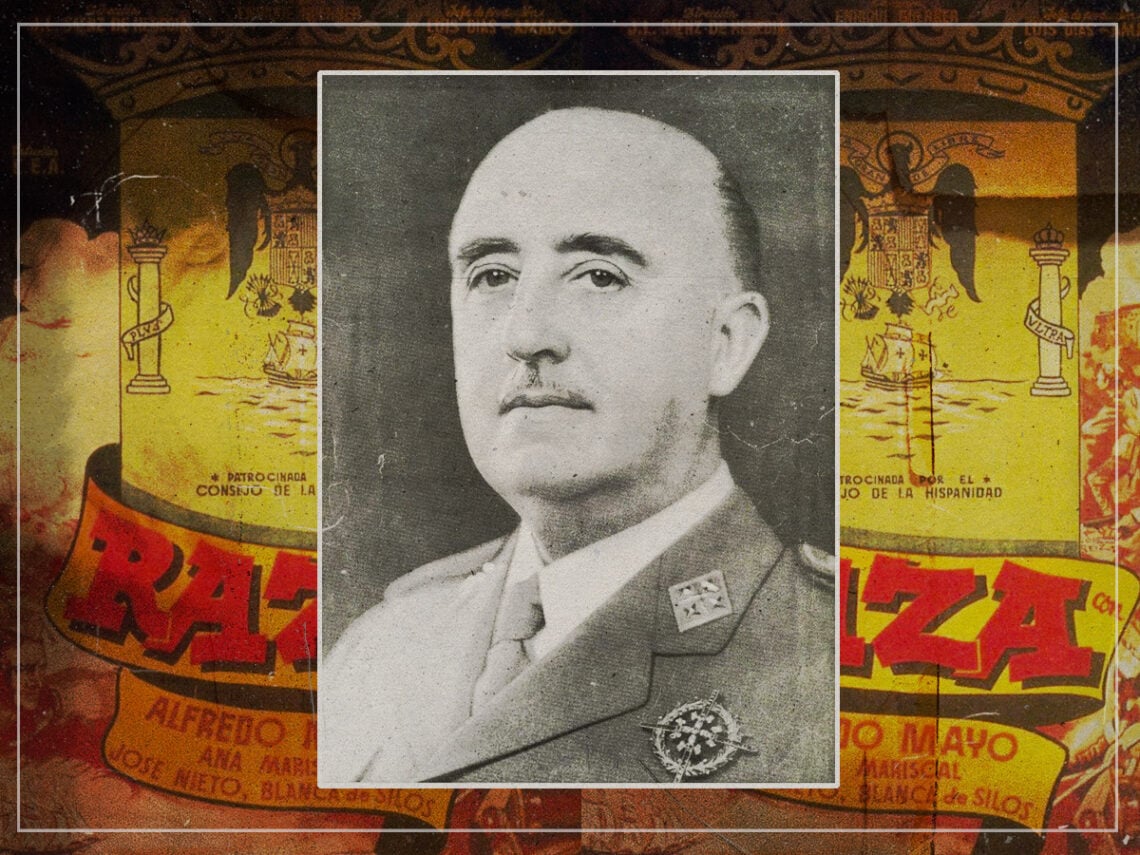
‘Raza’: the censored and destroyed Francisco Franco movie

Since the early years of the cinematic medium, many world leaders like Vladimir Lenin quickly realised its enormous potential as a propaganda tool. Ranging from the heinous productions of the Nazi regime to modern “documentaries” that attempt to poison public discourse, that function has never really been forgotten by the people in power. Francisco Franco, the brutal dictator of Spain who was responsible for unimaginable violence, was no exception.
Titled Raza (which translates to ‘Race’), the 1942 film was a product of the Franco regime and was meant to depict the ideals of his regime. Directed by José Luis Sáenz de Heredia, it painted an ideologically charged portrait of a family from the Spanish countryside as they navigated the historical notions of honour and nationalistic duty as well as the newly formed frameworks of modernity that were beginning to impact the public consciousness.
The screenplay was based on Franco’s eponymous novel, which he wrote under a pseudonym after becoming a director. In the text, the patriarch of the family is painted as a war hero who sacrifices his life for his country in Cuba. The character was Franco’s idealised version of a father figure whose own father abandoned his family after marrying someone else. The effects of Franco’s fractured relationship with him manifested in a lot of ways, but Raza is definitely a prime example.
Charting the meteoric rise of one of the sons who becomes an important military figure in the fascist ranks, Raza tries its best to weave the personal and the political into Franco’s highly doctored version of the Spanish Civil War. Using performative heroism to mask the atrocities and the violence that plagued the people of the country, the film mixes archival footage into its own visual narrative while trying to engineer a definitive public account of the horrifying historical event.
According to the director, Franco was initially very pleased with the final product: “We watched it together, Franco and I at the front, his wife and the others behind; out of the corner of my eye, under the light from the screen, I saw he was moved, and that his eyes were moist and attentive, which made me happy, because it meant it had gone well. And once it finished, he told me exactly that: very good, Saénz de Heredia — you have done it.”
After all, Raza wasn’t just a way to dominate the historical discussions, but it was also a project designed to change his own life story into a flawless archetypal heroic arc. Massively backed by the government and provided with ample resources, the production offered a glimpse at what statist cinematic spectacles looked like. However, it wasn’t long until Franco himself completely disowned his own creation.
Following World War II and the global dominance of the United States, Franco censored all anti-US references in his own propaganda film and changed the enemies into communists. Despite his best efforts to transform his mythology into an unimpeachable heroic one, Franco’s legacy within Spain has only grown more divisive over time.
Watch the film below.
