


Raving in Taiwan: Taipei’s abandoned temple parties

Since its advent, electronic music has gone hand in hand with rave culture, which has involved taking over abandoned spaces and turning them into places full of music, dancing and celebration.
Whether it’s hundreds congregating in open fields until the police come, or pulsating bass hitting your ears, as lights dart across an abandoned warehouse, the desire to hear sound systems play crosses all boundaries of race or gender. Some of our best memories have come as the sun was rising, and the fresh day perfectly complemented the sounds through the speakers.
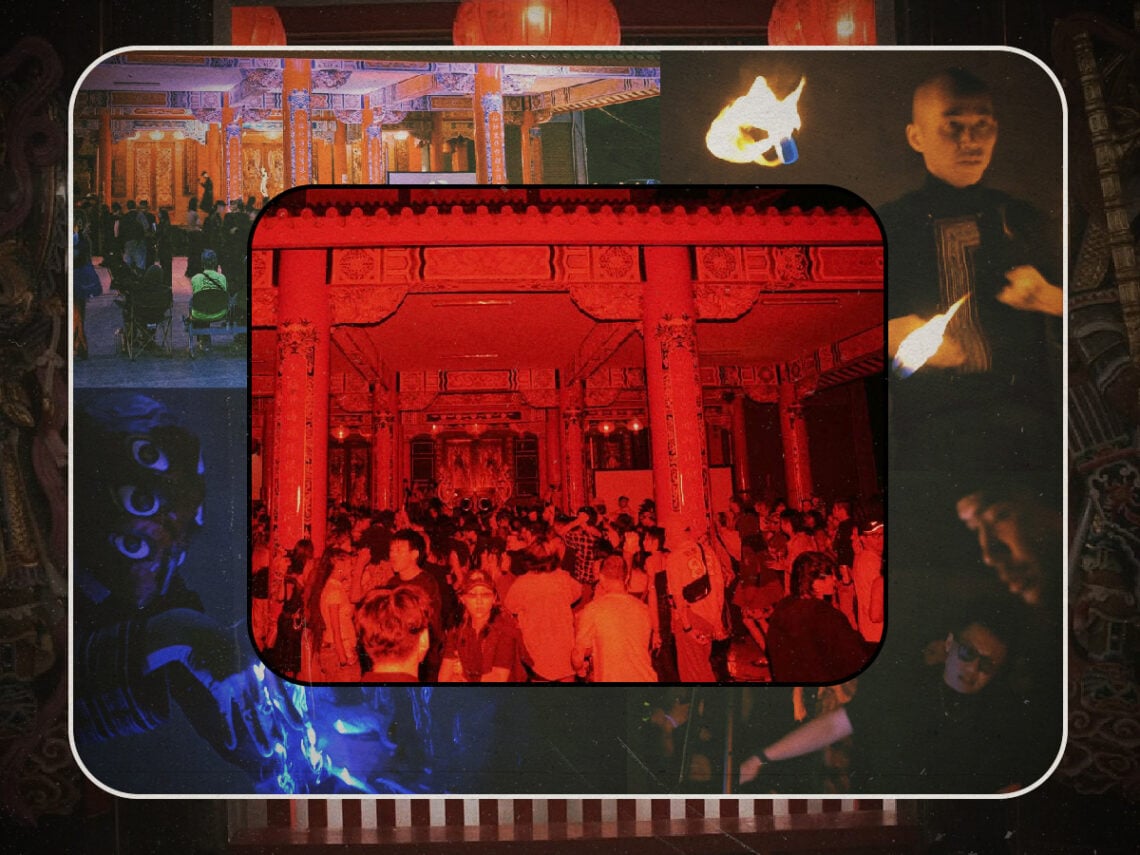
This is no different in Asia, and in Taiwan, especially, where people are making use of ancient, abandoned temples to host raves.
Dance music took hold in Taiwan in the mid-1990s with the first known rave taking place in Taipei’s Neihu district back in 1995. This growth was heavily influenced by British and European rave culture, and much like 1994’s Criminal Justice Bill back in the UK, it wasn’t long before the authorities looked to clamp down on this growing subculture.
Concerns about drug use saw a crackdown, and rave culture began to disappear from the spotlight. However, the past decade has seen a revival, with Taiwanese ravers taking things underground and organising guerrilla parties. With the cost of everything rising exponentially and a desire for something authentic and free from commercialisation, rave culture has undergone a resurgence worldwide, and Taiwan is no different.
The capital isn’t short of empty spaces, with thousands of air raid shelters across Taipei due to the threat of Chinese attack, an ever-present possibility in their lives. The relationship with mainland China is a complex one, but thanks to their independence, they have managed to avoid Mao Zedong’s Cultural Revolution, which was a decade-long movement to cement Mao’s legacy and standing, wherein the “four olds” were targeted, meaning old ideas, habits, customs and culture. That led to tens of thousands of historic temples being destroyed, with Beijing alone seeing 5,000 temples erased.
Temples abound in Taipei and its surroundings, and it’s these unused, beautiful spaces that are often repurposed as sites to party. Much like European rave culture, these are events that are organised in secret, with locations revealed at short notice. Instagram accounts such as temple_meltdown drop the coordinates of the event just hours before it starts, and much like their cross-continental cousins, they are also often shut down by local police forces.
There are some spaces that, like Tiger Mountain, a Dao temple in the Eastern limits of the city, have become a collective space; however, with a huge number of temples, these can be held anywhere, as well as in air raid shelters or underpasses across the city. As well as offering young people a cheaper alternative to clubbing, these raves also act as a celebration of Taiwanese culture. A space that is uniquely theirs, and one which can underline Taiwanese identity, as a time of increased tensions with their larger neighbour.
These are special places, and many ravers believe they can feel the spiritual energy within the walls of the ruins, even if the temples are long abandoned. With all the hallmarks of a race, the speakers, the drinks, the extra-curriculars, light shows, there are also performances that really underline local culture. No matter where you are in the world, it’s a rite of passage to melt off your face listening to music, but in Taiwan, they’re doing things differently, celebrating national identity and repurposing ancient religious spaces in the process.
