


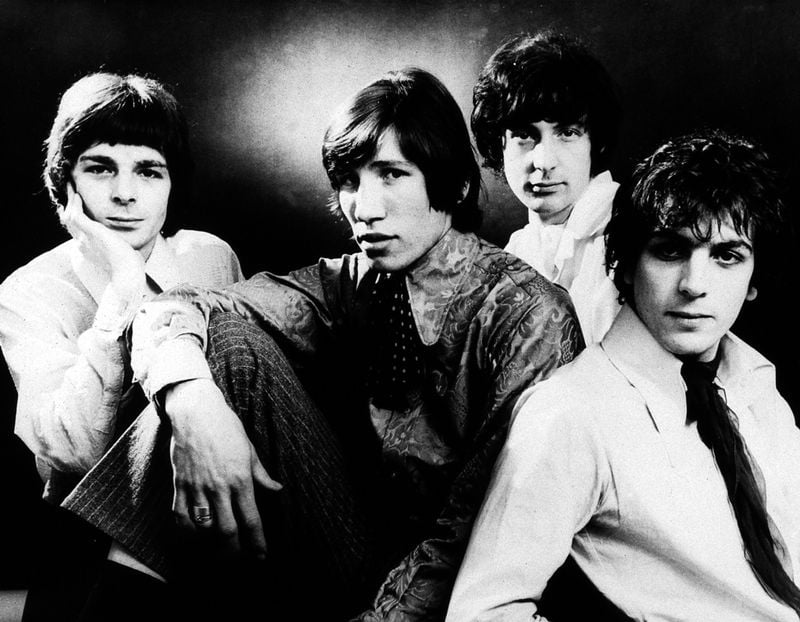
Watch rare footage of Pink Floyd performing in Amsterdam, 1972

Pink Floyd at their pomp was a sight to behold. Whilst the exact date of their best period is up for debate, with some maintaining it started in the latter stages of Syd Barrett’s tenure, whilst others claiming that it commenced with the release of 1970’s Atom Heart Mother, one thing is sure: by 1972, the Roger Waters-David Gilmour fronted band was gearing up to take over the world.
Pink Floyd’s story is a famous one. After original frontman and creative director, Syd Barrett, left the group in April 1968 due to his deteriorating mental health, the quartet regrouped with bassist Roger Waters and the recently recruited David Gilmour leading the charge.
The band enjoyed considerable success under Barrett’s leadership, with their debut album, 1967’s The Piper at the Gates of Dawn, celebrated as one of the highlights of the psychedelic rock genre. However, it was under the joint leadership of Waters and Gilmour that the group took proceedings to an entirely different level.
Whilst Waters assumed the roles of primary lyricist and thematic director after Barrett left, without his foil, David Gilmour, much of their post-Barrett brilliance wouldn’t have come to fruition. It wasn’t just these two, either. With the support of the other band members – keyboardist Rick Wright and drummer Nick Mason – the quartet refined their sound. As a unit, they created an expansive form of prog that was indebted to the heady sonic palettes of the counterculture whilst doing something entirely new.
The freak-out jams of their early years would still appear on occasion, albeit in a maturer form, particularly on tracks such as ‘Echoes’ and ‘Money’. Despite these brief bursts of nostalgia, the band had changed tact and were now creating music that contained greater lyrical and musical substance than what came before. For instance, the frivolous, Lewis Carrol-esque Englishness of Barrett’s premiership was nowhere to be seen. Instead, the band tackled themes such as mental health, ageing and politics.
In truth, all of Pink Floyd’s records are worth a listen, but after Atom Heart Mother, the shift in their sound is increasingly evident. Running alongside the group’s strides in the studio, they continued to evolve as a live act, with 1972’s Live at Pompeii perhaps the best reflection of their improvements. However, that performance in the shadow of Mount Vesuvius was just one of many great concerts the band delivered in 1972. With these shows, they anticipated their masterpiece, 1973’s The Dark Side of the Moon, which would crystallise their cultural standing and kick off their most acclaimed era.
One of the shows that heavily implied the impending greatness came in May 1972 in Amsterdam, The Netherlands, at the Rock Circus. For it, the band dazzled with a three-track performance of ‘Atom Heart Mother’, ‘Careful With That Axe, Eugene’ and ‘A Saucerful of Secrets’, with the set ranking among one of the tightest of this chapter of Floyd.
It was peak Pink Floyd, boasting a dynamic rhythm section, Richard Wright on heat, and David Gilmour supplying a range of flourishes on his Stratocaster. What makes it even more remarkable is that no one in the hypnotised audience could have foreseen the gravity of what the band were about to deliver. History was unfolding in front of them.
Watch the footage below.
