


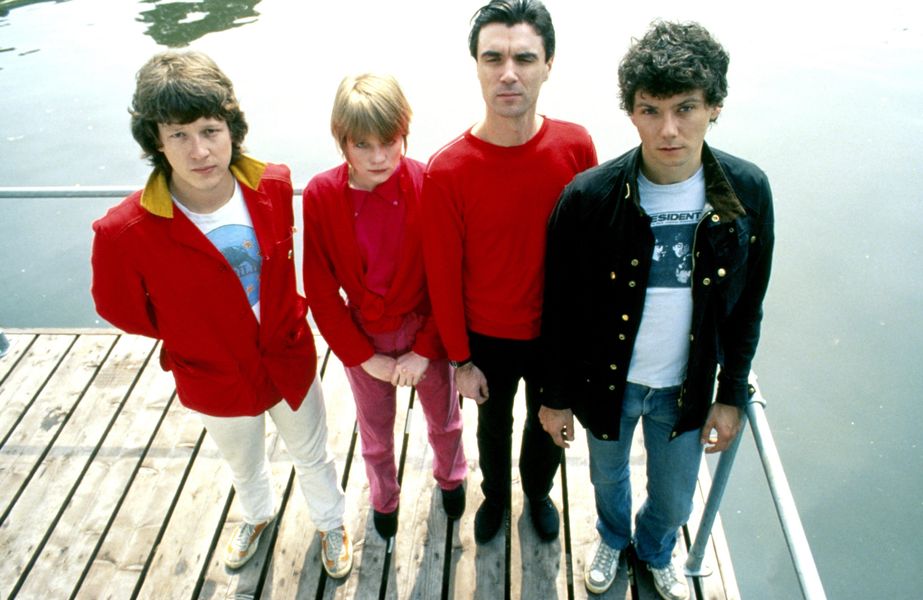
Ranking every song on ‘Talking Heads: 77’

When Talking Heads dropped their debut album Talking Heads: 77, it sounded completely unlike anything else in music at the time. There were some noticeable roots in punk, classic rock, and even krautrock, but the New York City quartet transformed these genres into something brand new. With angular guitars, frenetic rhythms, and frantic singing from David Byrne, Talking Heads were jumpy and excitable, yet somehow stiff and slightly awkward in a strange and tantalizing way.
That mostly came from Byrne, whose songwriting tended to focus on the banalities of everyday life. He would really double down on this focus on albums like Fear of Music, but Byrne’s preoccupation with books, streets, buildings, and emotions in a wonderfully blunt fashion was definitely unique in the punk scene that Talking Heads were wading around at the time. The other bands at CBGBs didn’t know what to make of this odd outfit and their gangly lead singer.
At this point, Talking Heads hadn’t adopted the rhythm-heavy dance approach that would go on to define their career in the 1980s. Jerry Harrison had only just joined the group, and bassist Tina Weymouth had only really been playing her instrument for about two years when the album was recorded. As a result, Talking Heads: 77 is raw and nervy in a way that no other Talking Heads album is. New sounds, and new funk-influenced musicians, would have to wait for later albums.
So, too, would the world music influence of Brian Eno. In the beginning, it was just Talking Heads trying to figure out their place in the music scene. Not even producer tony Bongiovi could get a hold of the band’s unique style (most of the album was allegedly recorded when Bongiovi wasn’t present). It was almost impossible for anyone outside their orbit to truly “get” what Talking Heads were about, but that uncertainty led to a sparse production style that complimented the band’s sound.
In all likelihood, Talking Heads: 77 would have just been another underground punk album had it not been a surprise hit single, ‘Psycho Killer’. Although it only scraped the bottom rungs of the Billboard Hot 100, Talking Heads were the first of the NYC punk bands to gain mainstream attention. They never really fit into that scene anyway, so their departure onto bigger and better things felt natural.
To celebrate the album’s anniversary, we’ve pitted each of the album’s 11 songs against each other. These are all the tracks from Talking Heads: 77 ranked in order of greatness.
Ranking all the songs on ‘Talking Heads: 77’
11. ‘Who Is It?’
A tightly compact less-than two-minute track, ‘Who Is It?’ is Talking Heads at their least essential. Sure, the track is a bit of goofy fun when taken on its merits, but the extremely minimalist arrangement and awkward fumbling around the theme of love don’t exactly fit in with the band’s style at the time.
Talking Heads: 77 has a surprising number of “love songs”, a topic that Byrne seemed highly uncomfortable with. He would largely swear them off starting with the group’s next album, More Songs About Buildings and Food, and ‘Who Is It?’ shows that it was probably the right decision.
10. ‘Happy Day’
One of the calmer and quieter songs on Talking Heads: 77, ‘Happy Day’ is a great example of Byrne’s strange mix of excitable quirkiness and restrained awkwardness. The high notes that Byrne sings in the chorus are underscored by a brief pause in the arrangement, showing off the rest of the band’s tight playing ability as a unit.
There’s simply not enough going on in ‘Happy Day’ for it to be any higher on this list. It’s a perfectly fine day, but it’s a little too saccharine and soppy. Byrne was far better when he was interrogating the world around him, not embracing it.
9. ‘First Week / Last Week… Carefree’
Most of the world music influences would have to wait until Talking Heads were a bit more comfortable with themselves. When they did appear, those influenced seemed a bit phoned in and imperfect on the band’s debut. The steel drum and güiro on ‘First Week / Last Week… Carefree’ feels strangely out of place on an otherwise stripped-back album.
The Caribbean style is only pushed into stranger territory when a saxophone comes tootling into the arrangement. Usually, strange is a good thing with Talking Heads, but it’s not as fun or interesting on ‘First Week / Last Week… Carefree’.
8. ‘Tentative Decision’
While David Byrne is largely credited with writing the band’s material, the rest of Talking Heads were equally important when it came to creating the group’s music. ‘Tentative Decision’ wouldn’t be as good as it is without Chris Frantz’s military drumming or Tina Weymouth’s slippery bass line, proving that Talking Heads were truly a collaborative band.
Byrne once again sounds like an alien who has never actually met human beings on ‘Tentative Decisions’. Why are all the boys and girls concerned with decisiveness? Why does Byrne care so much? It’s all part of the strange enigma that is David Byrne, and ‘Tentative Decisions’ is one of his first major interrogations of emotion and human interaction.
7. ‘No Compassion’
Byrne had quite a sinister edge to his writing when he wanted to show it off. “Other people’s problems, they overwhelm my mind” is probably the most stereotypical lyric that accurately describes Byrne’s approach to society, but the narrator of ‘No Compassion’ is much closer to the crazed central figure of ‘Psycho Killer’ than the jovial everyman of ‘Happy Day’.
After a minute-long march of an intro, ‘No Compassion’ suddenly lifts into a sprightly uptempo rock number. As Byrne slowly loses his mind over people pushing his compassion as far as it goes, Jerry Harrison gets to step up with some of his most inventive guitar playing on the entire album.
6. ‘The Book I Read’
It was almost comical how uninterested Byrne was in big topics. By keeping his focus on the small things, Byrne carved out a unique niche in music. There were no deeper meanings, hidden allusions, or even metaphors to be found: when Byrne says he’s “writing about the book I read / Have to sing about the book I read,” that’s exactly what’s going on and nothing more.
In that way, Talking Heads were weirdly cutting edge. After a decade of pomp and circumstance headlined by the fairytale escapades of Led Zeppelin and the fantastical sci-epics of progressive rock bands like Rush and Yes, Talking Heads brought rock and roll back to earth with a wonderfully wonky preoccupation with the mundane. ‘The Book I Read’ is probably the best example of this oddly fascinating minimalism.
5. ‘New Feeling’
Jerry Harrison was a necessary addition to Talking Heads. Although David Byrne was a perfectly serviceable guitar player, what the band really needed was a dual-threat guitarist and keyboardist who could keep up with their atypical arrangements and unique style. Harrison just happened to be the perfect man for the job.
What Harrison adds to the band is clear to hear on ‘New Feelings’, intertwining his high guitar stings with the scratchy rhythm playing of Byrne. As Talking Heads continued to evolve, Harrison’s focus shifted more towards keyboards, but ‘new Feeling’ is a wonderful showcase for Harrison’s guitar abilities.
4. ‘Don’t Worry About The Government’
It must have been incredibly strange to see any double bill featuring Talking Heads and anybody else playing CBGBs in 1977. While they complimented more angular acts like Television, there were times when the artsy and preppy band would be immediately followed by the more guttural street punk of the Ramones or the Dead Boys.
Certainly, none of those bands were worrying about the government, the clouds in the sky, the buildings around the city, or anything else that Byrne was preoccupied with at the time. Could you imagine Joey Ramone singing about pinecones? That’s part of what made Talking Heads so great, and ‘Don’t Worry About The Government’ was Talking Heads already fully formed.
3. ‘Pulled Up’
As Talking Heads: 77 comes barrelling into its final few songs, the album only seems to be heating up. In fact, the final two tracks are two of the best songs on the entire record. Just as you think they’re about to settle down, Talking Heads find brand new gear on the ecstatic album closer ‘Pulled Up’.
Featuring some of Byrne’s most enthusiastic singing on record, ‘Pulled Up’ is one of Talking Heads’ greatest hidden gems. Everybody is firing on all cylinders as the band round the corner with a frenetic album closer to Talking Heads: 77.
2. ‘Uh-Oh, Love Comes to Town’
For someone who largely disavowed romantic topics in his songs, David Byrne actually sang about love quite a bit on Talking Heads: 77. Granted, those songs were filtered through Byrne’s unique frame of reference, but the notion that Talking Heads were just singing about buildings and food wasn’t quite accurate.
‘Uh-Oh, Love Comes to Town’ kicks off Talking Heads: 77 with an infectiously jaunty groove. Everything singular about Talking Heads, from Byrne’s hyperactive style to Weymouth’s bouncy bass to Frantz’s precise drumming to Harrison’s mind-bending keyboards, is primed right from the band’s very first song on vinyl.
1. ‘Psycho Killer’
There’s no need to complicate the top spot on this list. For Talking Heads, there’s life before ‘Psycho Killer’ and life after ‘Psycho Killer’. Featuring an all-time great bass line from Tine Weymouth and one of the more harried vocal performances from David Byrne, ‘Psycho Killer’ is the first moment when Talking Heads truly became a great band.
As the band’s first hit and eventual signature song, ‘Psycho Killer’ runs the risk of potentially getting old on the 1,000th listen or so. Instead, there’s something new and fresh to find every time the song plays, whether it’s Harrison’s angular guitar work or Frantz’s driving rhythms. It’s the perfect synthesis of the entire band’s talents and one of the best Talking Heads songs ever.
