


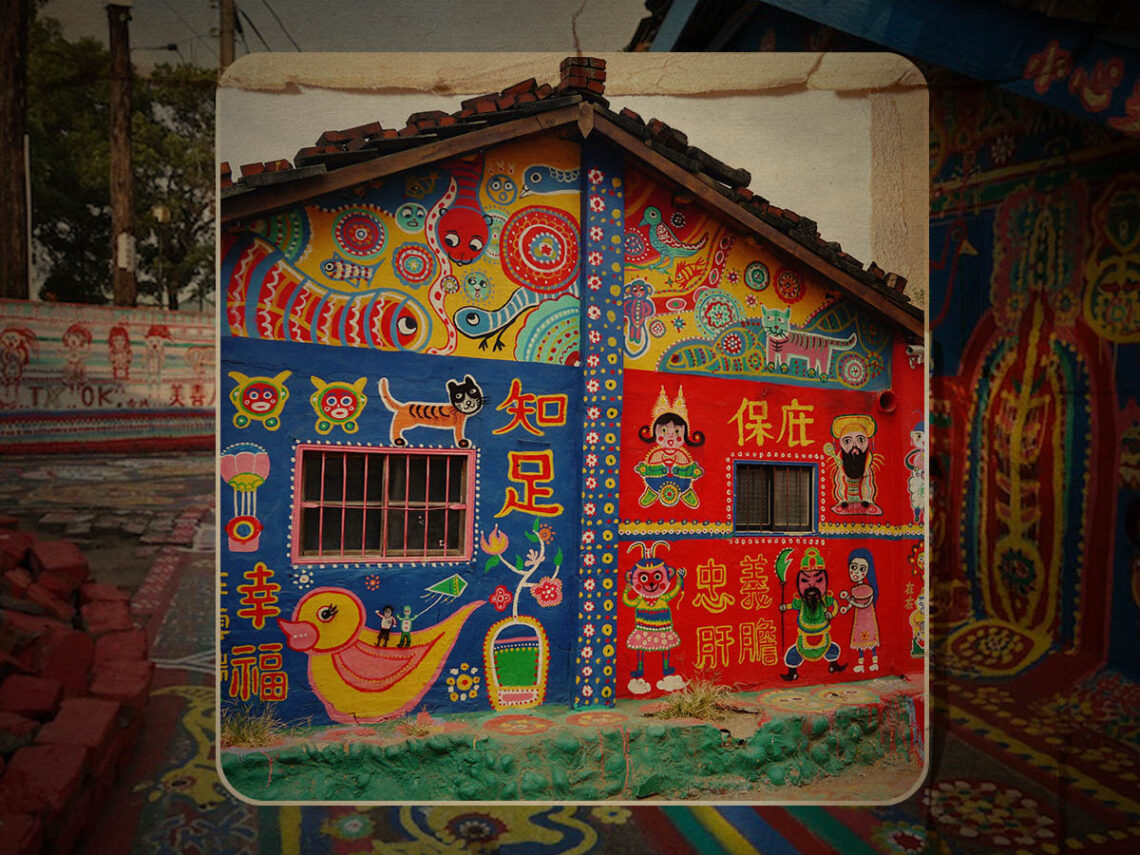
Rainbow Village, Taichung: The psychedelic town entirely painted by a former soldier

When you think of Taiwan, you think of great food, beautiful landscapes, democracy, and semiconductors, where street art doesn’t seem to feature in the equation, but at Rainbow Village, that’s exactly what you get, and it’s all from one man.
In the Nantun district of Taichung, there is a series of buildings that form part of what was once a military dependents’ village. In the aftermath of the Chinese Civil War, won by Mao Zedong’s Chinese Communist Party, the losing side of the KMT, led by Chiang Kai-shek, migrated to Taiwan, which saw 1.2 million people, comprising officials, soldiers and their families, flee to the island.
At the time, this was a tactical withdrawal, with an expectation that they’d be able to retake the mainland, but as time passed, that became impossible. This huge influx of people meant that the Republic of China (Taiwan) government had to build housing and do it fast, where speed and low costs were the priority, leading to many settlements built like military barracks popping up. These eventually became permanent neighbours, but at the turn of the millennium, with the former residents moving or passing away, and living conditions improving across the country, many of these settlements were demolished.
One such neighbourhood existed in Taichung, where at one point, the village boasted of over 1,000 homes, but as time passed, people moved away, and by the mid-2000s, the village had just 11 buildings. Unsurprisingly, it was set to be demolished, with all but one resident having moved out; however, Huang Yung-fu had different ideas.

Yung-fu was born on the mainland in Hainan, joining the military at 17 and picking up guns to fight first the Japanese, and then the communists, before his final fight against the local authorities, who wanted to demolish the settlement, for which he picked up paints and brushes and used his imagination.
One day, he decided to paint a bird on one of the walls inside his house, and he enjoyed it so much, revelling in the liberation that making the artwork offered, that, before you knew it, he’d taken his painting beyond his front door and into the community.
Spreading across the settlement, he simply couldn’t stop his artistry, and he adorned the walls with bright, colourful, psychedelic patterns and drawings of animals, celebrities and sportspeople. Some of his paintings told stories from his childhood, while others just celebrated people that he liked, and with that, every surface of the village was painted, from walls and doors to floors and windows, in vivid colours and cartoon imagery, subsuming the cold, militaristic architecture to turn it into something warm and inviting.
With its bright colours and graphic designs, it instantly attracted attention with visitors coming in from across the region, then the country, and then from across the planet, to see his paintings. It was likely more luck than judgment, but his project coincided with the arrival of selfie culture, the birth of Instagram and phones morphing into high-quality cameras, which led to greater visibility of the place and its artist. The increasing media attention and footfall led to the decision that the area should be preserved as an art site, and the colourful, happy art that Yung-fu spawned saw him christened with the name ‘Rainbow Grandpa’.
‘Rainbow Grandpa’ passed away in early 2004, not long after his 100th birthday, having lived a long, fulfilling life and leaving in his wake the vibrant legacy of the Rainbow Village, which reportedly attracts over a million tourists annually. It can’t be denied that his art not only saved the settlement but has inspired thousands of others with its recognisable style, as well as helped encourage the young country to preserve its history from being lost in the sands of time and rubble.
