


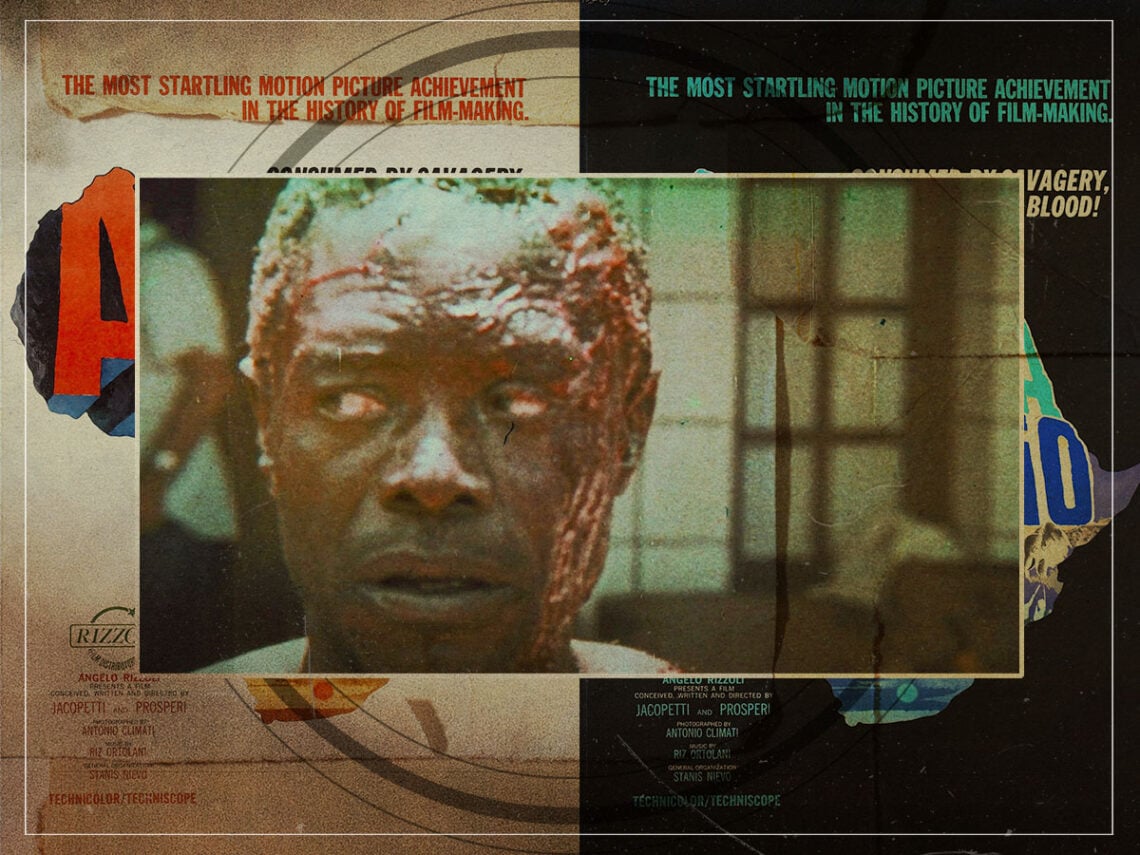
‘Africa Addio’: the racist shockumentary that was allegedly staged

Africa Addio was released in the mid-1960s and, at the time, was marketed as a documentary that followed the journey of directors Gualtiero Jacopetti and Franco E Prosperi through a tense, post-colonial Africa, highlighting the struggles and complex issues the continent faced at the time.
Thanks to its evidence of violence and social unrest, Africa Addio gained the moniker of a ‘shockumentary’. It has been criticised for exploiting the plights shown to engineer a sensationalised reaction rather than tell an authentic narrative. Since its release, claims of overtly racist undertones and questions about the film’s authenticity have enveloped Africa Addio and sparked debate around the ethics connected to documentary filmmaking.
A deeply problematic film, brimming with blatant racism and pro-colonial views, Jacopetti and Prosperi posit themselves as observers, capturing the truth of African life, but instead use the medium to reaffirm and reinforce racist stereotypes about the people they claim to be observing.
Transitioning quickly from scenes of beautiful wildlife to graphic sequences of footage that include executions and warfare at the hands of the post-colonisation population, combined with narration that showed contempt for said population, describing them as primitive and savage, incapable of the perceived ‘progress’ seen in Europe and the US.
The film perpetuates its Eurocentric perspective by implying Western civilisations to be superior over the chaos and violence they display as the example of Africa, a position that is not only misleading but dangerous, leading to further divisions and credence to the narrative of African inferiority that has plagued the academic and entertainment discourse for decades. The film played into long-standing tropes of a white saviour and a continent that needed the West in order to maintain order, erasing the history and contributions of the African continent.
Africa Addio’s controversy doesn’t end with its internal depictions of racist tropes, however. The lack of context for much of the violence and suffering shown in the documentary has gained the filmmakers accusations of staging or exaggerating the events to increase shock value for their narrative and to further drive a biased agenda via manipulation and exploitation.
Despite defending their approach, the directors’ choice not to accurately convey the context of the film’s content leaves the audience with a distorted view of the situations shown and an unclear understanding of whether what is on screen is authentic or simply added for narrative.
The ethics surrounding documentary filmmaking continue to be a subject of discussion, with Africa Addio often mentioned to demonstrate the importance of directors’ responsibility to convey the subject matter they’re covering accurately.
The ‘shockumentary’ became a common occurrence in the 1960s and ‘70s and is a genre characterised by sensationalism and graphic content over authenticity, prioritising shock value that often led to ethical and legal concerns over the content displayed, which often covered marginalised communities that, like with Africa Addio have left long-lasting implications for how these communities are viewed, and help perpetuate a cycle of stereotype and misunderstanding.
Africa Addio’s still stands as a testament to the perils of sensational filmmaking and helps reveal the dangers that can come with trusting sources that are unverifiable and seek to twist our perception of the world via access to places that we cannot, ourselves, often reach, focussing a lens not on the truth, but on a particular point of view.
The film’s legacy is a reminder to all documentarians that upholding the ethics of the genre, those of authenticity, dignity and accuracy, is more important than the pursuit of personal bias and narratives that can enforce prejudice and racism.
