


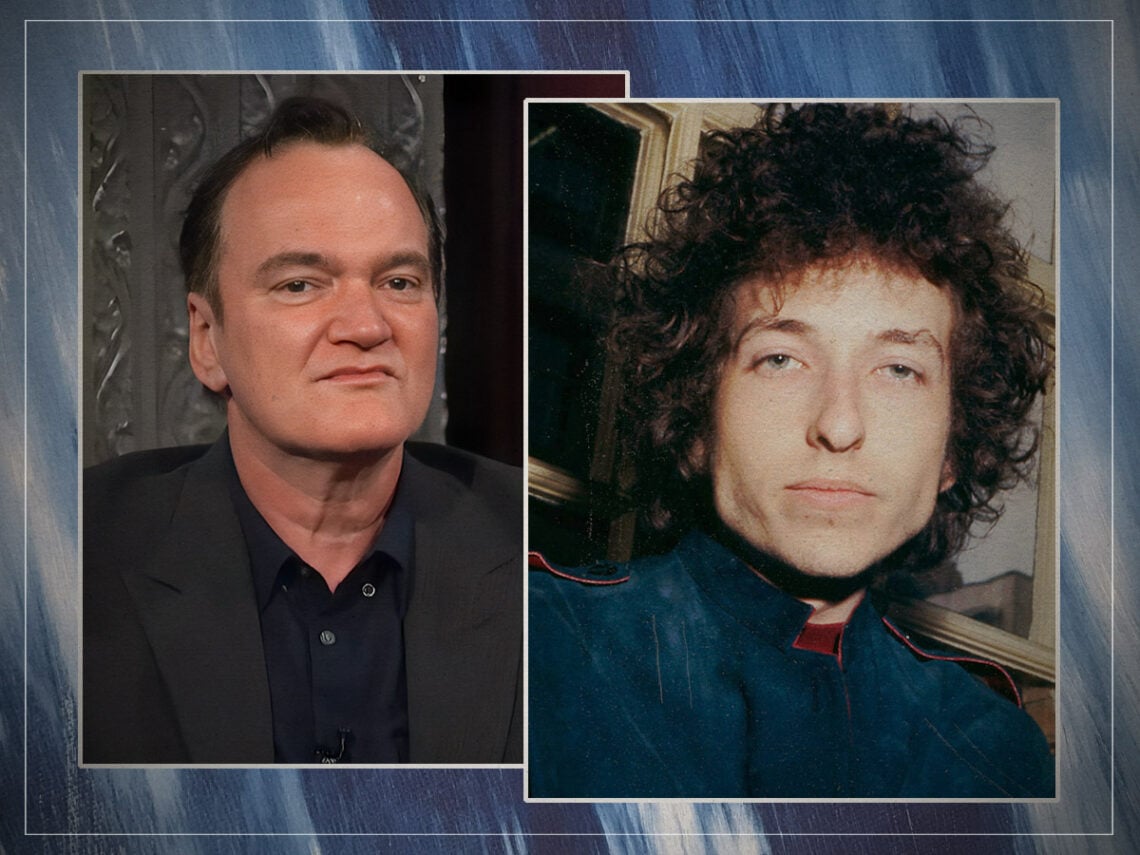
Why did Quentin Tarantino send his ‘Death Proof’ script to Bob Dylan?

Quentin Tarantino loves music. All of his films have been punctuated by the sweet tone of classic pop or the ragged edge of rock ‘n’ roll revelry. From Reservoir Dogs to Once Upon a Time in Hollywood, the director has arguably used music more effectively than any of his contemporaries, choosing songs that not only enhance the narrative but become intricately woven parts of it. The director has often shared his deep admiration for music, too.
“One of the things I do when I am starting a movie,” the acclaimed director once said when noting his process for creating some of pop culture’s most beloved films. “When I’m writing a movie or when I have an idea for a film is, I go through my record collection and just start playing songs, trying to find the personality of the movie, find the spirit of the movie. Then, ‘boom,’ eventually I’ll hit one, two or three songs, or one song in particular, ‘Oh, this will be a great opening credit song’,” Tarantino added, noting his affinity for hit tunes. But even we couldn’t imagine that the director would choose to get a green light of sorts from the pivotal figure of Bob Dylan.
Dylan isn’t just the freewheelin’ troubadour from the 1960s, with a career that has never truly dipped below the watermark, even across six decades. No, he’s also one of Tarantino’s favourite artists of all time. When speaking with Uncut about albums he holds close to his heart, the director noted Dylan’s iconic 1975 record Blood on the Tracks as the top LP from his list: “This is my favourite album ever,” he said. “I spent the end of my teenage years and my early twenties listening to old music–rockabilly music, stuff like that. Then I discovered folk music when I was 25, and that led me to Dylan”.
Tarantino added: “He totally blew me away with this. It’s like the great album from the second period, y’know? He did that first run of albums in the Sixties, then he started doing his less troublesome albums – and out of that comes Blood On The Tracks. It’s his masterpiece.”
The director also connects with Dylan on a professional level, using his career as a jumping-off point for dealing with his growing legacy. Asked by Vulture if he was nostalgic for the ’90s, Tarantino noted Dylan’s later resurgence as an inspiration for him to continue moving forward with his work: “I’m not, even though I think the ’90s were a really cool time,” he began. “It was definitely a cool time for me. But almost like how Bob Dylan had to survive the ’60s so he could be not just considered an artist of the ’60s, I had to survive the ’90s so that when VH1 does their I Love the ’90s thing, they wouldn’t mention me. I think the jury was out about that for a while. But if I am going to be nostalgic about the ’90s, it’s for the lack of everybody being connected to all this technology all the time”. But there was one moment when Tarantino reached out to share a little of his own work with Dylan.
Bob Dylan’s influence on Quentin Tarantino’s creative process
Death Proof isn’t necessarily a Tarantino classic, even if it does bear all the hallmarks of one. The film was released in 2007, by which time Tarantino’s iconography had already grown hugely. Sincerely regarded as one of the finest directors of modern cinema, films like Death Proof show the handwriting of the auteur more effectively than some of his more beloved pictures. But before the film was released, Tarantino reached out to his hero about the film, perhaps looking for a seal of approval.
“I just thought he’d get a kick out of the dialogue. I’ve always been a big fan of him, and I know him a little bit,” recalled Tarantino after sending the singer-songwriter the script. It seems that sending him the film’s skeleton was more about his own pride in what he had achieved rather than looking for any grandiose statement from the noted lyricist Dylan. “I just thought he would think the wordplay – the structure of the words in it and the different voices for the dialogue – I just thought he would appreciate it.” Given Dylan’s Nobel Prize award that would follow, it was a good idea to get his feelings on the script.
If you’re a staunch Bob Dylan fan, you’ll probably know how the rest of this story goes. Dylan never replied to the director, but we can’t even be sure he received the package. That’s because Tarantino, as the fanboy he was, never wanted to bother Dylan to find out, “It’s been so crazy ever since, I haven’t had a chance to give him a call.” While we would love to be a part of that call, the reality is that all we would hear would be Tarantino gushing about his undoubted musical hero.
Of course, maybe Dylan never replied because he didn’t have to. Tarantino’s body of work already stands as one long, mixtape-style love letter to his musical heroes. Whether it’s Chuck Berry soundtracking a twist contest in Pulp Fiction or The Delfonics echoing through Jackie Brown, his films pulse with the DNA of the records he grew up spinning. In that sense, sending the Death Proof script to Dylan wasn’t a pitch, more a quiet fan-to-idol gesture from a director who’s always known that great music doesn’t just underscore a scene, it can dictate.
And if Dylan did read it, maybe he smiled (or maybe smirked) and just kept on going. After all, these are two artists who don’t look back unless it’s part of the story. They’ve both made peace with the silence that follows a message sent into the void. For Tarantino, the thrill was in hitting “send”. For Dylan, maybe it was knowing someone out there still thinks he’s the guy worth writing to.

Never Miss A Take
The Far Out Quentin Tarantino Newsletter
All the latest Quentin Tarantino content from the independent voice of culture.
Straight to your inbox.