


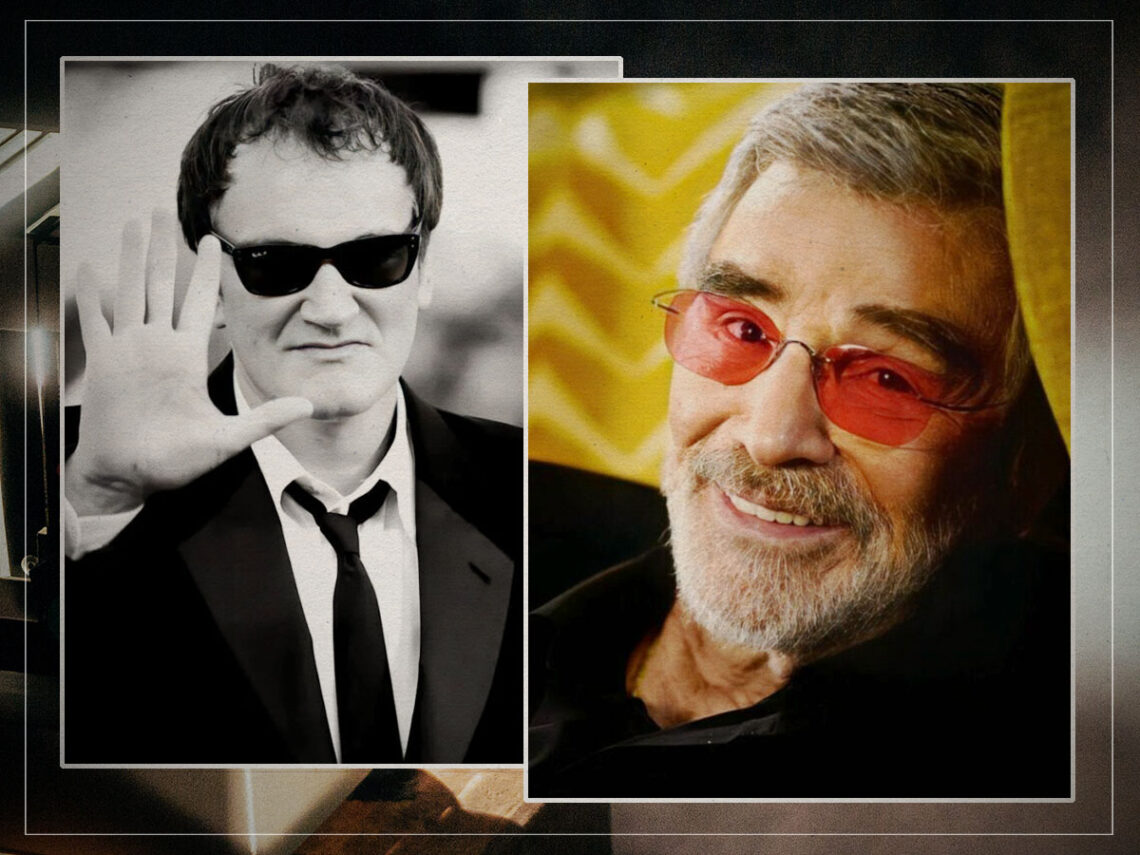
Quentin Tarantino’s least favourite Burt Reynolds movie: “A shamefully wasted opportunity”

One of the many benefits of being Quentin Tarantino is that the writer and director has the clout to cast whoever he wants in his movies, and he’s used that opportunity to draft in several stars he grew up idolising.
The two-time Academy Award winner literally built a shrine to John Travolta and showed it to him when he was courting the actor for Pulp Fiction, while his extensive knowledge of Bruce Dern, Robert Forster, Pam Grier, Harvey Keitel, and Kurt Russell’s careers lent an air of wish-fulfilment to their respective hirings.
Another one of Tarantino’s all-time Hollywood favourites is Burt Reynolds, who cast a huge shadow over Once Upon a Time in Hollywood in more ways than one. Not only did James Marsden play him in a deleted scene, but he was set to play George Spahn. The collaboration didn’t come to pass and Dern was brought in after Reynolds’ death and the last thing he did before his passing was run his lines for the film.
Tarantino’s encyclopaedic knowledge of even the most obscure film and television titles would always result in Reynolds ending up close to his heart, with the actor admitting he spent the first decade and a half of his filmography bouncing around between a string of terrible genre flicks and series before Deliverance finally set him on the path to stardom.
The Reservoir Dogs and Django Unchained maestro has made it clear that he’s capable of mounting a passionate defence of even the most dismal picture, but even the self-proclaimed Reynolds superfan couldn’t find it in him to try and sugarcoat the disappointment of a gun-toting 1969 western.
“100 Rifles‘ mediocre final product still seems like a shamefully wasted opportunity,” Tarantino wrote in a review for his New Beverly Cinema. “I mean, Jesus Christ, how do you fuck up a movie starring Jim Brown, Burt Reynolds and Raquel Welch?” As it turned out, the answer was ‘quite easily’.
It wasn’t a particularly easy shoot either, which may have contributed to the underwhelming end product. There was tension between Brown and Welch, and as someone who’d grown friendly with both of his fellow leads, Reynolds felt like he was placed in the middle of an unwinnable situation.
“After a while, they both displayed a little temperament,” he admitted. “But don’t forget, we were out in the middle of the bloody desert with the temperature at 110. Of course, I don’t think they’ll ever work together again. The critics have really been knocking those two, murdering them.”
Reynolds never had any issues in holding his hands up and copping to making a bad movie or ten, but as a B-tier western featuring three actors he had a soft spot for, it’s surprising that Tarantino wasn’t willing to give 100 Rifles even a little leeway. Then again, a terrible film is a terrible film, no matter how hard anyone tries to suggest otherwise, and the filmmaker had to stick his membership card to the Reynolds fan club in his pack pocket to give an honest assessment of a picture that was deservedly panned.

Never Miss A Take
The Far Out Quentin Tarantino Newsletter
All the latest Quentin Tarantino content from the independent voice of culture.
Straight to your inbox.