


Ranking Quentin Tarantino’s 10 greatest characters

Quentin Tarantino, unapologetic and unabashed, quirky and controversial, is not only one of the greatest directors in cinema history but also an auteur with unique and audacious directorial skills. Now a phenomenon, Tarantino’s oeuvre is a favourite subject among cinephiles; the quintessential elements that are distinguishable and ubiquitous in almost all his movies have led to the coinage of the term ‘Tarantinoesque’.
Tarantino’s films up the literary pedestal with ingenious ideas and nuanced storytelling, accentuated by soundtracks, violence and gore. In an interview, the director once revealed: “[My] head is a sponge. I listen to what everyone says, I watch little idiosyncratic behaviour, people tell me a joke and I remember it. People tell me an interesting story in their life and I remember it… when I go and write my new characters, my pen is like an antenna, it gets that information, and all of a sudden these characters come out more or less fully formed. I don’t write their dialogue, I get them talking to each other.”
Tarantino could be considered a revolutionary artist, a director who altered the cinema-scape of Hollywood with his 1994 film Pulp Fiction in which he transcends the conventional storytelling structure. He became a household name overnight and an inspiration to filmmakers worldwide. He continues to inspire generations today, and films inspired by Quentin Tarantino’s movies are now dubbed ‘Taraninoesque’.
Tarantino also loves subverting expectations; to date, this brilliant and eccentric auteur has only directed a select few feature films. Whether you believe that number to be nine or ten is up for debate, but what we do know is that we’ll likely only see one more effort, given his intentions to retire. According to Tarantino, he hopes to crystallise his cinematic legacy that will be the subject of debate forever. “I see myself writing film books and starting to write theatre, so I’ll still be creative. I just think I’ve given all I have to give to movies,” he once explained.
His most recent film, Once Upon A Time In Hollywood, would stand as a somewhat perfect ending to his outstanding career, an immaculate ode to the Hollywood he so loved and derived inspiration from. Fans are indeed waiting anxiously for his final film before the 59-year-old auteur retires; they certainly don’t want Tarantino’s on-screen magic to end, and neither do we. Tarantino’s verbose and unforgettable characters remain etched in the viewers’ minds. While fans brood over his decision to walk away, let us reminisce about the quirky auteur’s reckless and pastiche filmmaking art by looking at the ten most memorable Tarintinian characters.
Let’s get started.
Quentin Tarantino’s 10 greatest characters:
10. Rick Dalton (Once Upon A Time in Hollywood, 2019)
The sun has started to set on Rick Dalton’s career, which was once relevant and thriving. His crippling anxiety and existential displacement are heightened by the wistfulness of the ‘60s. His sudden realisation that he is washed and on the brink of his limelight being snatched away from him adds to the mellow mood. However, his new neighbours, Roman Polanski and Sharon Tate moving in next to him, and the latter inviting him over for drinks, is a cathartic shot in the arm for the flailing actor. The chaos that unfurls at home ends with Dalton relaxing on an inflatable bed in his pool. As one of the third Manson intruders is sent flying through his glass panel into the swimming pool, Dalton, unfazed, screams “what the fuck?” with excellent comedic timing.
Leonardo DiCaprio was tailormade for the role of Rick Dalton, an actor whose burgeoning career that began in classic Hollywood was reaching its eclipse. Dalton suffers from bipolar disorder, something that remains unmentioned in the film. Leo’s career is far from being washed out but his good looks are being clouded with age. The film is about Dalton’s epiphanic realisation that he is no longer the centre of attention as an actor of the yesteryear. Rick’s obscurity remains forgotten when Trudi compliments him, stating: “That was the best acting I’ve ever seen in my whole life”. The snippets of lifeline injected into the narrative are satisfying; DiCaprio who finally won an Oscar after eating a raw bison liver is “Rick-fuckin’-Dalton” indeed.
“It’s official, old buddy. I’m a has-been.”
9. Mr Blonde (Reservoir Dogs, 1992)
One of the most deranged and sadist psychopaths ever created by Tarantino, Mr Blonde – or Vic Vega – is the brother of Pulp Fiction’s Vincent Vega amid the universe that seemingly connects Tarantino’s movies. Played by Michael Madsen, Vic is a close friend of the Cabots and is assigned the diamond heist with five other men, using colour-coded pseudonyms. On being ambushed by the police, they shoot their way out. At the warehouse, the remaining gang tries to find out the mole in their group who leaked the information.
Mr Blonde gets off on shooting people and torturing cops. He is a psychotic and smooth-talking nihilist. He never unleashes his wrath, instead enjoys teasing his victims. When he is assigned the duty of guarding the L.A. police officer Marvin Nash, his contempt for police officers exceeds limits when the latter taunts him by saying Mr Blonde had a boss. While playing Stealer’s Wheel’s ‘Stuck in the Middle with You’ on the radio, Vic slashes off Nash’s right ear with a barber’s razor before dousing him in gasoline. As he removes Nash’s gag and derives pleasure from the latter’s painful screams, he is about to light him on fire when he is shot dead by Mr Orange. The effect of the song amidst the horrifying torture and “Mr Blonde maniacally dancing around”, adds an element of cruelty to the insane psychopath who has gone down in cinematic history as one of Tarantino’s greatest creations.
“Are you gonna bark all day little doggie or are you gonna bite?”
8. Calvin Candie (Django Unchained, 2012)
Rescued by a German travelling bounty hunter, Dr King Schultz, Black Salve and “the fastest gun in the south”, Django Freeman, sets out on a journey to free his wife, Broomhilda, from a despicable, narcissistic and malicious Mississippi plantation owner and brutal slave Mandigo fight enthusiast, Calvin Candie. Leonardo DiCaprio, as Candie, even ended up cutting his hand while the cameras were rolling, but that did not deter him from not going through with the scene. Despite his immense dedication, he did not get nominated by the Academy. However, needless to say, Calvin Candie, a relentless champion of racism, cruelty, and violence, is one of the finest performances of his career.
DiCaprio is downright vile and abominable as Candie. He found it exceedingly difficult to play the character that was so loathsome and evil. “For me,” he said, “The initial thing obviously was playing someone so disreputable and horrible whose ideas I obviously couldn’t connect with on any level.”
He went on: “I remember our first read-through, and some of my questions were about the amount of violence, the amount of racism, the explicit use of certain language… My initial response was, ‘Do we need to go this far?” Tarantino confirms by saying: “He’s the first villain I’ve ever written that I didn’t like. I hated Candie, and I normally like my villains no matter how bad they are.”
“Broomhilda is my property. And I can choose to do with my property, whatever I so desire.”
7. Hans Landa (Inglourious Basterds, 2009)
Good old Tarantino boasts of a stellar ensemble in this “masterpiece”, where Lt. Aldo Raine heads a commando unit named ‘Basterds’ where he expects each of his men to bring 100 Nazi scalps. Having massacred Nazis for years now, in France, Raine plans to bring the Nazi government once and for all and end the war. With that, he enlists the help of Shoshanna a young woman who wants to avenge the murder of her family, witnessed by her, at the hands of a German officer. “A Tarantino film resists categorisation”. Bloody and bold, bizarre and belligerent, the war film lacks a war which is balanced by immense menace and cruelty.
In his gruesome and grotesque depiction of the terror and brutality unleashed by the Nazis which led to the eventual fall of Hitler, Tarantino adds intriguing dialogues and wonderful cinematography which keeps the audience glued to their seats. This film is a testament to Tarantino’s insatiable thirst for violence, notoriety and captivating, non-linear narratives. Christoph Waltz stands out in his role of a narcissistic and callous Jew-hunting German general, Hans Landa, which well-deservedly, helps him win the Academy Award for Best Supporting Actor. He switches between German and English dialogues effortlessly, and his cruelty is enshrouded by unfeigned friendliness and politeness. Landa is a master manipulator and as smooth and well-versed in acting as the actor playing him.
“If one were to determine what attributes the Jews share with a Beast, it would be that of a rat.”
6. Mr Pink (Reservoir Dogs, 1992)
Originally scripted to have been played by Tarantino himself, Mr Pink was played by the talented Steve Buscemi who left Tarantino spellbound with the audition. Of course, not much is known about Mr Pink. He is mysterious and a cynic. Known for his famous opinionated monologue about tipping, Mr Pink vehemently objects to the colour assigned to him as he wants something “less weak”, as it makes him sound like “Mr Pussy”. Having known Joe Cabot since his early days, Mr Pink believes that Joe had given them away during the heist.
Mr Pink is a no-nonsense person who cannot stand people’s emotions clouding their judgement. He is smart and wily enough to understand they are being set up. “Somebody’s shoving a red hot poker up our asses and I wanna find out whose name is on the handle,” he said. He is also the only known Dogs survivor. With an innate survival instinct and sharp cunning, Mr Pink avoids possible confrontation and hides under a ramp at their hideout when he realises that Mr Blonde has been shot by Mr Orange. As he scrupulously protects his background information, it rouses curiosity and intrigue in the minds of the viewers who just cannot seem to get enough of this unabashedly selfish, tight-lipped character.
“You’re acting like a first-year thief. I’m acting like a professional! If they get him, they can get you. They get you, they get closer to me, and that can’t happen!”
5. Vincent Vega (Pulp Fiction, 1994)
John Travolta, who had become a lost Hollywood star at the time of casting, had his career resuscitated by Tarantino when the latter roped him in to play the role of Vincent Vega. Tarantino’s brutal and complicated crime and drug-fuelled odyssey through L.A.’s underworld witnesses Vincent and his partner, Jules Winnfield, to recover the stolen briefcase containing valuable possessions from the gang and return it to Marsellus Wallace, while constantly evading the seductive advances of his boss’s wife, Mia Wallace. A classic Tarantino movie abounds in violence, humour, wit, wordy dialogues, profanities, plots that transcend the linearity of time, and endless pop culture references. Pulp Fiction is a product of Tarantino’s quirky brilliance.
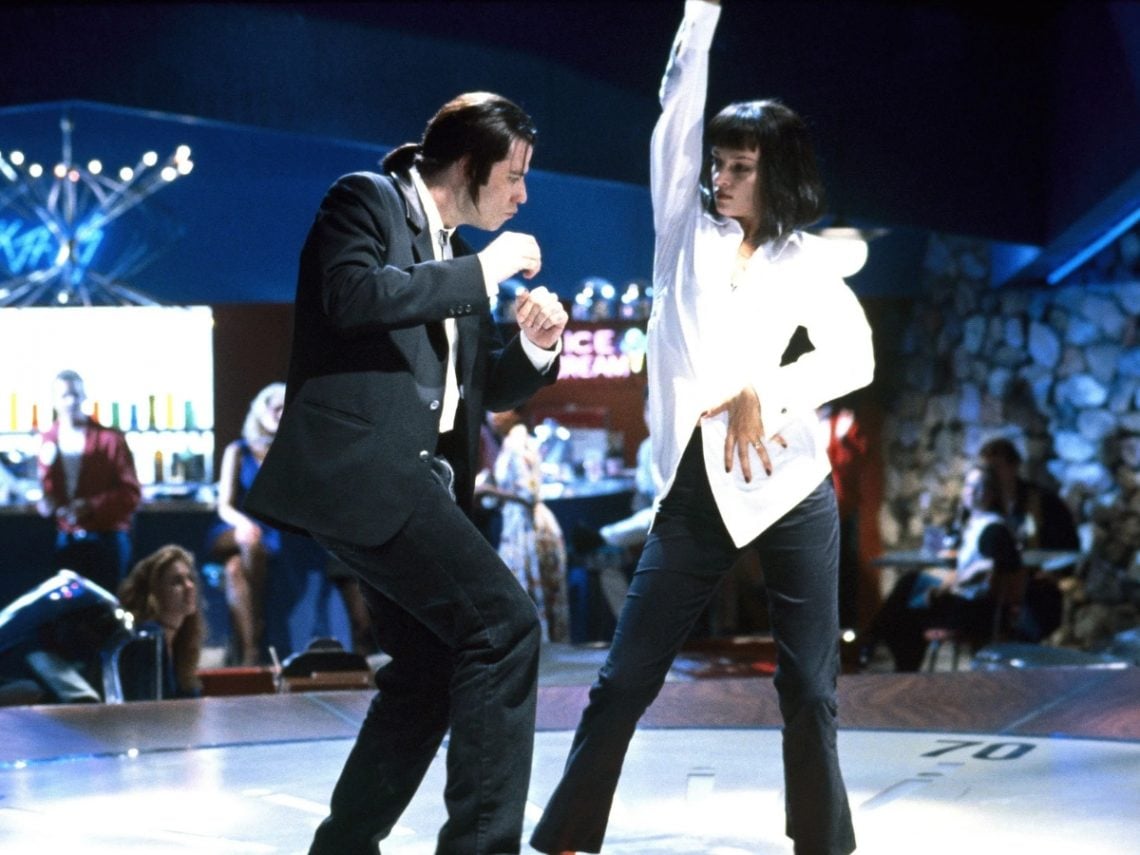
Level-headed and rational under the effect of heroin, Vega saves Mia from a heroin overdose by plunging adrenaline into her chest. He is not afraid of having a good time and likes to have things under his control. According to Joseph Natoli, Vega is a post-modern man with an air of cool indifference as “it doesn’t matter one way or another to Vincent.” Unfortunately for him, whenever he goes to the bathroom, mishaps occur. Mia’s overdose, the coffee shop robbery, as well as his murder at the hands of Butch, occurs right after he visits the toilet. Much like the iconic dance scene, which was supposed to be ‘The Twist’ but was mainly improvised on the spot, Travolta danced his way back into mainstream Hollywood with the character of Vincent Vega.
“Now, if you’ll excuse me, I’m going to go home and have a heart attack.”
4. Jackie Brown (Jackie Brown, 1997)
Quentin Tarantino has a knack for reviving the careers of lost and forgotten Holywood stars. Although Elmore Leonard’s book Rum Punch had a white protagonist, Tarantino, in an attempt to be able to work with his favourite 1970s blaxploitation actress Pam Grier, changed the race of the character. Pam plays the eponymous character who is a flight attendant for Cabo Air. She is caught between the cops and a gun runner as she helps smuggle drugs and money for Ordell Robbie, outmanoeuvring everybody with the help of a bail bondsman played by Robert Forster, whose career had been revived by Tarantino as well.
Pam’s character is a classic example of a woman reclaiming her space among a pack of women who have tried pushing her down or “taking her out”. Much like Grier’s own journey in Hollywood, Jackie is not taken as a plausible victor due to her history and social and economic status. Jackie is intelligent and agile; aware of the duplicitous odds she has to face on her quest. Her iconic dialogue “shut your raggedy-ass up, and sit the fuck down” is reflective of the strength and moral conviction that resides within her. Via Jackie, Pam Grier herself embarks on this journey to find her true worth and pave the path towards freedom, taking down all the obstacles on her way. She is motivated by her pursuit of independence from the conventions that she has been aligned with. She is desperate for survival, and it is a perfect blend of a triumphant protagonist, slick trickster and beautiful lover.
“If I lose my job I gotta start all over again, but I got nothing to start over with. I’ll be stuck with whatever I can get. And that shit is scarier than Ordell.”
3. Mia Wallace (Pulp Fiction, 1994)
Modelled after Anna Karina in Bande à part, Uma Thurman’s Mia Wallace, with her blunt black bob and classic combo of a white button-down shirt and black cigarette pants, is the definition of intriguing. The wife of Marsellus Wallace, Mia is a rather peculiar character. Not much is revealed about her except her love for expensive clothing, rare burgers and flavoured $5 shakes, affinity to ‘Red Apple’ cigarettes and addiction to cocaine. She attempts to seduce Vincent, with whom she shares her experience of being a failure as an actress, and later they partake in a twist contest where they groove to Chuck Berry’s ‘You Never Can Tell’. Thurman is said to have based the iconic dance scene on the character of Dutchess in the 1970 Disney film, The Aristocats. Mia was also the promotional featurette for the film.
Mia overdoses on heroin while Vincent is in the washroom and is nearly dead until a fearful Vincent plunges adrenaline into her chest. She is foxy and troublesome yet the most interesting character. The audience does not just love Mia, they want to be like her despite her irresponsible decision to be an articulate drug addict. Although Thurman initially turned down the role, Tarantino pushed and pleaded before she finally agreed to it. Mia’s verbose dialogue seemed tailor-made for Thurman’s facile delivery style that brought out the coolness on screen. Thurman’s portrayal of the enigmatic and corny Mia Wallace catapulted her into the world of Hollywood A-listers and Mia is considered to be one of the most iconic females in films of all time, for it subverted the typical role of a mob wife wherein it breathed freshness of perspective into a predefined role.
“That’s when you know you’ve found somebody really special: you can just shut the fuck up for a minute and comfortably share silence.”
2. The Bride (Kill Bill: Volume 1, 2003)
Borrowing elements across all movie genres, Tarantino creates a well-crafted and intriguing masterpiece with the story of a femme fatale, The Bride, who is aided by her indomitable spirit and unwavering determination, embarks on a quest for revenge. Having been in a coma for four years after her jealous ex tried to take her life, the Bride is motivated by an insatiable thirst to avenge her unborn child, her wedding party, and the four precious years of her life. With a planned hit list and lust for vengeance, the Bride completes her quest till she reaches the titular Bill.
The Bride was a collaborative creation between Uma Thurman and Quentin Tarantino. Clad in a yellow jumpsuit, Uma Thurman as Beatrix Kiddo The Bride goes down as one of the deadliest females in the history of films. Tarantino loved the Bride and commented that: “As far as the first half is concerned, I didn’t want to make her sympathetic. I wanted to make her scary.”
Thurman’s ferocity in the graphic and bloody film coupled with her desire to avenge her perpetrators is an example of a blood-thirsty mother out to avenge her child and lost innocence. Her endurance while being tortured at the hands of unscrupulous enemies is commendable, her empathy is not to be mistaken for weakness. Her emotions are the driving force behind this odyssey and Thurman as the Bride delivers a phenomenal and unforgettable performance as the ‘deadliest woman in the world’.
“Those of you lucky enough to still have their lives, take them with you! However, leave the limbs you’ve lost.”
1. Jules Winnfield (Pulp Fiction, 1994)
Pulp fiction is a product of Tarantino’s eccentric mastery and made him a household name. The screenplay boasts layered characters, most of which are too memorable not to be listed here. The deuteragonist Jules Winnfield is most likely the director’s most memorable and well-crafted characters. The narrative transcends chronology to mirror the anthological structure of Tarantino’s favourite pulp magazines and allow Jules to experience an emotional epiphany during the climactic scene. In one of the scenes, Jules and his partner, Vincent Vega, pull off a hit on a group of slackers, when he delivers a famous monologue that goes down in cinematic history as one of the most iconic Tarantinian monologues.
Uncompromising and brash, Jules is extremely quick-witted and self-aware. He is a ruthless killer who shoots men unrelentingly before standing over their bodies, pulling out fictional biblical verses. Eloquent and smart, Jules questions the ways of the world unlike the morally ambiguous Vincent and is prone to change. Only an actor as great and versatile as Samuel L. Jackson could balance the wonderful contradiction of being both an intense motormouth reeking of violence as well as the shepherd, protecting the weak from the tyranny of evil. Jackson’s epic and badass portrayal along with the perfect delivery of magnificent monologues makes Jules Winnfield the most famous and memorable Tarintinian character.
“If my answers frighten you, then you should stop asking scary questions.”

Never Miss A Take
The Far Out Quentin Tarantino Newsletter
All the latest Quentin Tarantino content from the independent voice of culture.
Straight to your inbox.