


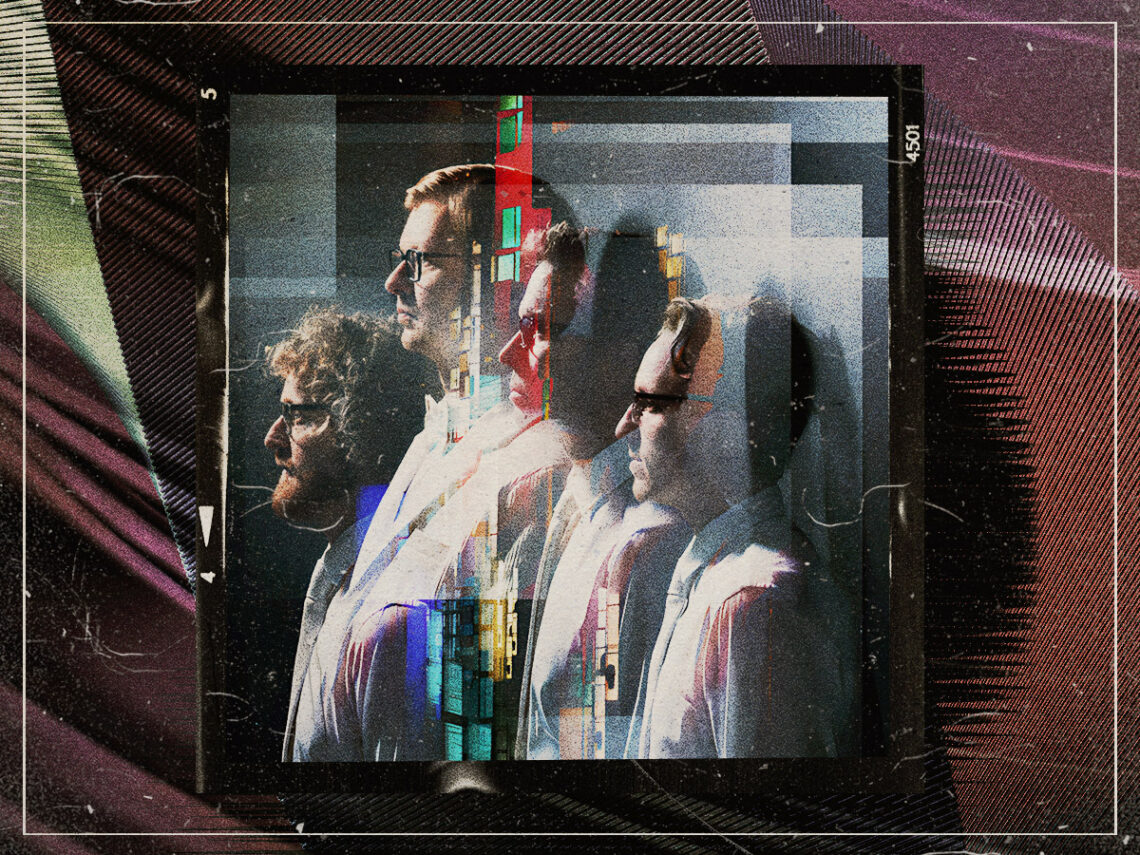
Public Service Broadcasting pick their five favourite concept albums

Plenty of romantic fools with guitars have written about the stars and moon, valleys low and mountains high, but not many musicians have paired their songs with these poetic notions with the veracity of Public Service Broadcasting. Their mantra is to teach “the lessons of the past through the music of the future” by marrying sonic exploration with some of the most fascinating audio documents in history.
With The Race for Space, they blasted everyone to the moon utilising a soundscape so adrenalised it qualifies as aural rocket fuel in conjunction with actual NASA tapes from the moon landing’s control room and beyond. They’ve similarly summited Everest, got industrial with Blixa Bargeld, and travelled to the valleys to chart the rise and fall of coal mining.
Their latest effort, This New Noise, sees them team up with the BBC Symphony Orchestra and Jules Buckley to create a score that fills you with a bounding energy only usually afforded to you when strolling out of the cinema after a masterpiece whereby you briefly acquire the swagger and importance of the leading actor. Because beyond the novel intelligence of the band, the tenet that sets their work soaring is its ability to impact you emotionally.
This combination of education and thunderous inspiration has not only made them a force to behold but a bearer of true originality in your record collection. This is the beauty of a concept album: three-minute pop songs are preordained to platitudes. In fact, it is positively impossible to avoid them, but when an idea is fully realised over a chronicled journey, it becomes a unique, stand-alone work. Given that Public Service Broadcasting are masters of the craft, we asked the band’s J. Willgoose, Esq. to tell us his favourites in the field.
Public Service Broadcasting’s favourite concept albums:
PJ Harvey – Let England Shake
PJ Harvey’s 2011 album saw him take her singular sound towards a more expansive scope. It began with an exploration of the humble autoharp and then ended in a masterpiece, two and half years’ worth of solid work later. After retreating to the rural confines of Bridport, Harvey felt a new lease of creativity and Let England Shake is the roaring result.
As Willgoose explains: “This record, focused on WWII, actually came out while I was working on The War Room EP, and I felt it rather stole my thunder (and then some!) – it’s such a moving, powerful and also unusual album and quite deservedly ran away with the Mercury Prize.”
Primal Scream – Vanishing Point
“I remember this coming out in the mid-late ’90s and having a huge impact on me; it probably sounds obvious now to anyone who knows our output and goes back to listen to this album. It’s loosely based around the film of the same name, and the use of samples in tracks like Kowalski was clearly a huge inspiration to me,” Willgoose explains.
To give you a flavour of the record, the 1971 film, directed by Richard C. Sarafian, on which it is based comes with the following synopsis: “During the 1970s, car delivery driver Kowalski delivers hot rods in record time but always runs into trouble.” It’s a high-speed thrill ride with a self-awareness that always saves the throttle from ever choking, and the album is much the same.
DJ Shadow – Endtroducing
“Possibly not a concept album for some,” Willgoose says, “But I’d argue it very much is – the concept being, what would happen if you distilled the listening habits and expertise of a lifelong music-lover, via sampling into an album-length meditation on music itself? The result is the sound of a life in music, a life of loving music and being fastidious and diligent in picking out the bits and pieces of what he loved (and so skilfully rearranging them) that it seems to me to be both highly conceptual and highly successful as a record.”
Released in 1996, Endtroducing was a labour of love that took DJ Shadow two years to fully assemble using an Akai MPC sampler. His layering style tessellated his influences into a jigsaw that completely transforms the original tracks. Presciently, this pioneering approach is almost akin to how some people see AI working in music moving forward.
Bon Iver – For Emma, Forever Ago
For his debut album as Bon Iver, For Emma, Forever Ago, Justin Vernon absconded to a hut in the forest to forget his break-up, the split of his band, and the waining of his creative flame. He knuckled down in this snowy cabin, and in July 2007, he self-released a masterpiece that inspired the nu-folk movement.
“Again, not one most people might say would be a concept album, but I think most of us at the time heard the story – man has heartbroken, retreats to a cabin in the woods and makes a record all about it, in isolation – before we heard the music. The story (and the concept) shaped the record and primed us for it. It’s an incredible and incredibly good sounding despite its apparent origins, album,” Willgoose opines.
David Bowie – Low
“David went to Berlin with Iggy for isolation,“ his guitarist Carlos Alomar states. “It was to humanise his condition, to say, ‘I’d like to forget my world, go to a café, have a coffee and read the newspaper.’ They couldn’t do that in America. Sometimes, you just need to be by yourself with your problems. Sometimes you just wanna shut up.” This drift into a crumbling city helped him to settle down and produce a masterpiece.
As Willgoose explains: “You could argue that every Bowie record was a concept record of some sort, some more successful than others, but Low remains the pinnacle for me; it’s the sound of a man rediscovering himself artistically and personally, pushing his music to the very edge of what could have been classified as contemporary mainstream and permanently shifting the goalposts for everyone along the way. It’s the sound of a city, shaped into a compelling, daring record through a uniquely talented storyteller and musician.”
