



‘Project Hail Mary’ vs ‘The Manosphere’: two very different visions of modern masculinity

Somewhere in space, two guys are working through the challenges of living in close proximity.
“You can’t just show up in a space ball unannounced and move into someone else’s spaceship,” one of them says. “There has to be boundaries.” He is dressed in an astronaut’s outfit. The other is a pile of rocks. They are quite literally from different planets, but both of them are trying to prevent the extinction of their species by figuring out why the sun is slowly dying.
The human, Ryland Grace (Ryan Gosling), is a science teacher who is the sole survivor of his team. The alien, Rocky, is a mechanic and also the sole survivor from his team. Light years from their respective homes and with multiple planets depending on them for survival, they team up to save everything they love, and in the process, develop an unshakable friendship for the ages.
Released in mid-March, Phil Lord and Christopher Miller’s Project Hail Mary quickly became a box office hit. It beat industry predictions by pulling in over $80million in its opening weekend and has gone on to secure a remarkable $301m as of this writing. Even more impressive is its staying power. While most movies see a substantial drop in ticket sales after their first week in cinemas, Hail Mary has had almost unprecedented stamina, dropping by only 32%. Compare this to 2023’s Oppenheimer, which pulled in a similar amount in its opening weekend but dropped by 43% in its second week. It also went on to gross close to a billion at the box office and won the Oscar for ‘Best Picture’.
Project Hail Mary has plenty of the hallmarks of other box office toppers from recent years. It’s an adventure set in space with lots of special effects, action, and quippy humour. Lord and Miller are no strangers to lighthearted, action-packed fare, having topped charts with The Lego Movie and Spider-Man: Into the Spiderverse. But there are several things that set Hail Mary apart from the most recent box office juggernauts like F1, Jurassic World: Rebirth, and all those video game adaptations. It’s an original story, based on Andy Weir’s 2021 novel, and its overriding theme is the power of male friendship.

The fact that the release of Hail Mary came barely a week after Louis Theroux’s divisive documentary Inside the Manosphere hit Netflix underscores just how mercifully out of sync the movie is with contemporary conversations about men. The manosphere refers to that online cesspit of websites, forums, social media platforms, and blogs that champion misogyny and patriarchy in the name of so-called “men’s rights”. Its icons include sex trafficker Andrew Tate, aesthetic influencer Clavicular (both of whom have been arrested at some point for physical violence against women), and Canadian psychologist Jordan Peterson.
These communities feed off of the very real epidemic of loneliness and status anxiety that currently plagues Gen Z and millennial men, and it’s a constant subject of debate among the sane and non-evil members of society. Another wing of this conversation is the first-person experiences of women. There are countless anecdotes and think pieces from straight women who are fed up with dating because the options are so dismal. All of this might lead a person to conclude that the majority of men under the age of 40 are, at worst, violent incels or, at best, quietly ticking time bombs of resentment who struggle to meaningfully connect with people of any gender.
The success of Project Hail Mary is a refreshing counterpoint, thanks to its fixation on the friendship between Grace and Rocky. Seriously, it’s hard not to feel a bit short-changed by the complete lack of science in the film.
Any time Grace and Rocky aren’t having a goofy inter-species misunderstanding or soulful heart-to-heart, the script seems to cut corners at breakneck speed to get back there. Forget about all the astrophage stuff. Don’t get caught up in questions about how the software was able to translate Rocky’s language so quickly or what exactly he was fishing for on that flaming green planet thing, just get us back to a heavy-handed needle drop and jokes about fist bumping.
It’s rare to see so much time devoted to masculine friendship in a major movie, or any size movie. 2025’s indie cringe-comedy Friendship, for example, was all about how an awkward male friendship can go spectacularly wrong, while movies like The Hangover highlight the kind of bro-y, sexist antics that would qualify as male bonding to the manosphere. In the realm of huge-budgeted action fantasy movies, 2024’s Deadpool & Wolverine features an enemies-to-reluctant friends story arc but still reeks of ‘no-homo’ vibes.
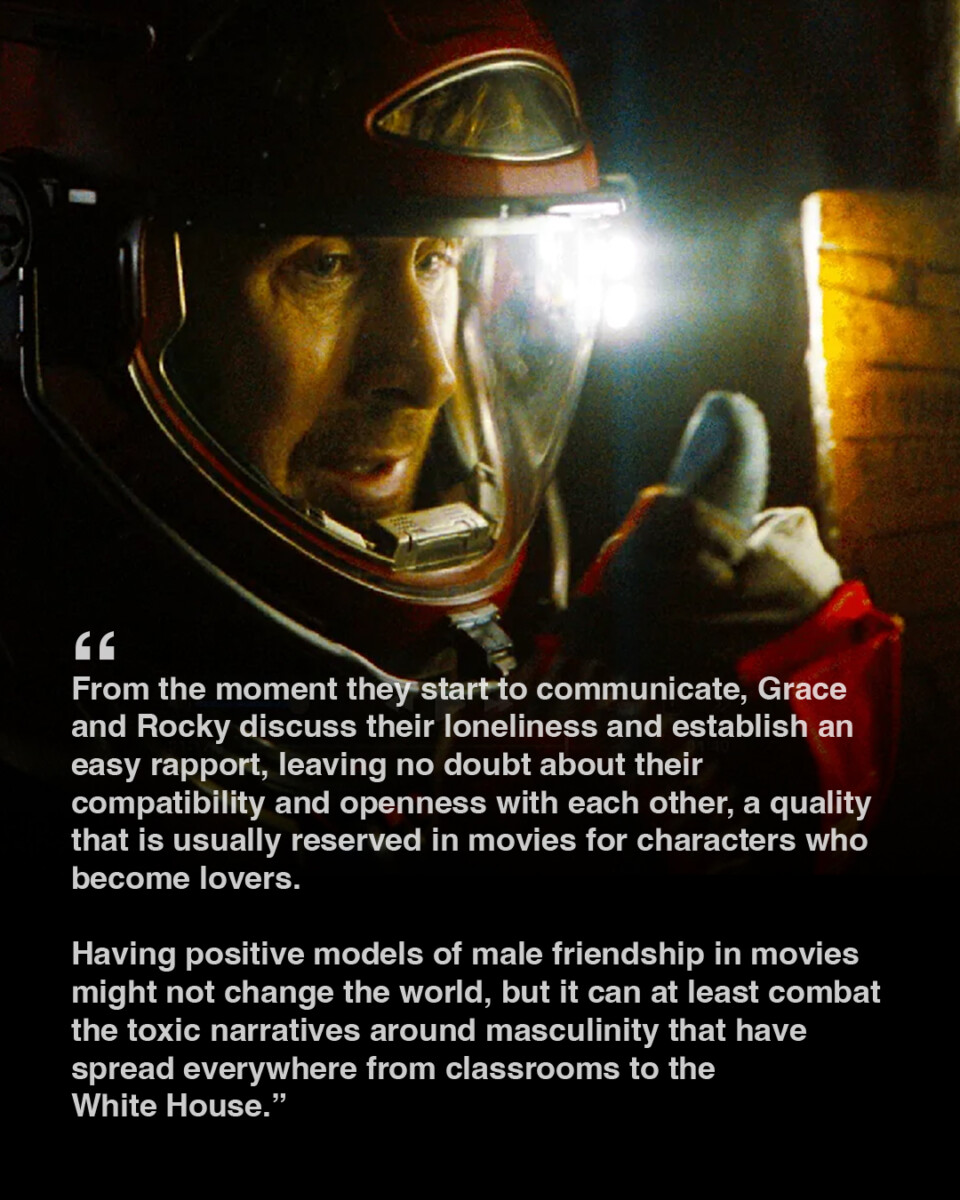
In contrast, the lighthearted tongue-in-cheek humour of Project Hail Mary is downright earnest. If Grace and Rocky had confessed their undying platonic love and devotion to each other, it would not have come as a surprise. Lord and Miller have said on multiple occasions that the crux of the story is whether adult men can make friends if the universe depends on it, and while that makes for a funny soundbite, it doesn’t seem accurate.
From the moment they start to communicate, Grace and Rocky discuss their loneliness and establish an easy rapport. There is never any doubt about their compatibility and openness with each other, a quality that is usually reserved in movies for characters who become lovers.
It’s not just the overall box office numbers that tell us that this type of earnest, emotionally secure friendship is resonating with viewers. When you break down the demographics, things look even rosier. Deadline reported that the audience was 57% male and 55% under the age of 35. That’s not unusual for the genre, but its continued popularity suggests that it’s hitting home with the exact demographic range that seems most drawn to the manosphere, not despite its central theme, but because of it.
Having positive models of male friendship in movies might not change the world, but it can at least combat the toxic narratives around masculinity that have spread everywhere from classrooms to the White House.
