


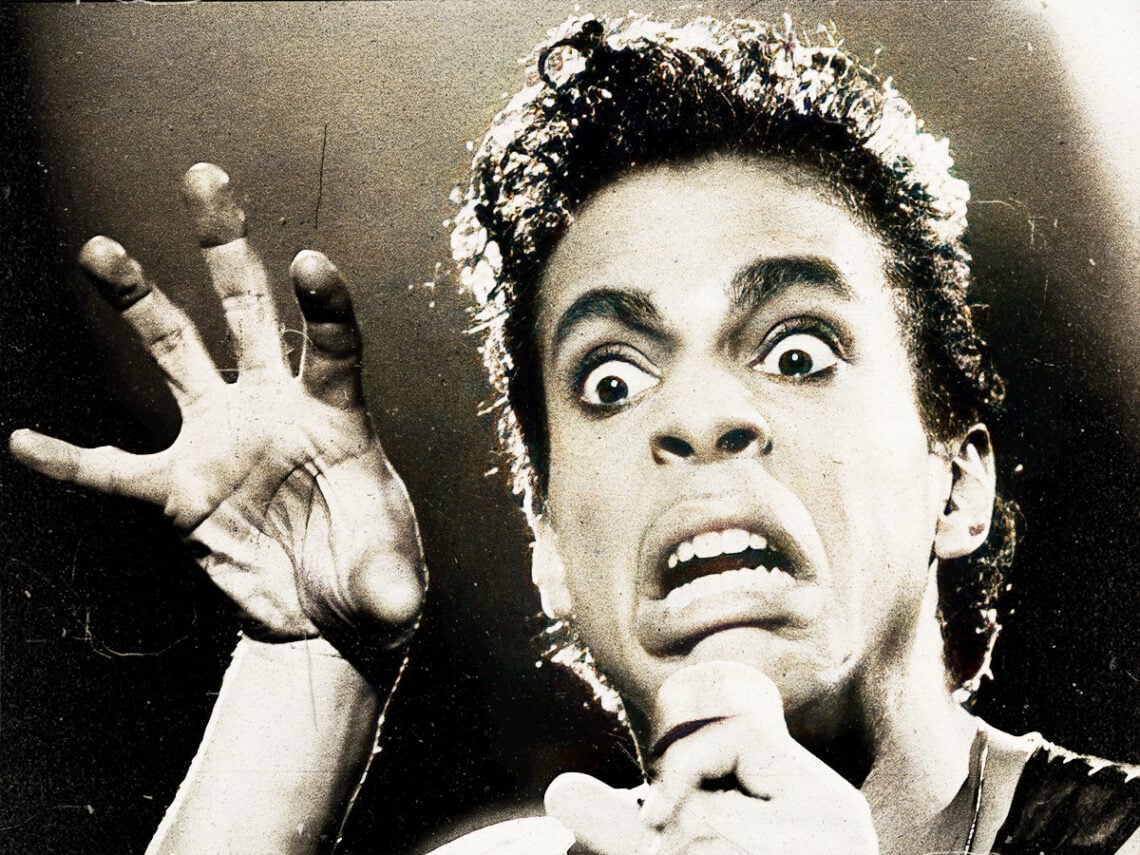
The ecstasy epiphany that prompted Prince to pull ‘The Black Album’

“Technology is cool,” Prince once said, “But you’ve got to use it as opposed to letting it use you.” In 1986, that mantra was muddied. Pop was becoming oversaturated with synths and sheen. It was a period when popular music found itself in a state of flux and even the late, great Purple One became unsure if his latest effort, The Black Album, was suitable to sever the shackles of the current landscape.
This epiphany came to Prince after he had taken ecstasy, the drug making him confront whether the music he had created was up to the standards he had set himself. The deeply religious musician found an epiphanous truth in his narcotic reverie, further proof that in every single thing he did, he did so in the name of art.
The singer had just released his seminal LP Sign O’ The Times and The Black Album, which was set to be released as a reaction to that record more than anything else. This album was Prince’s way of returning to his all-out funk roots and away from the fusion of pop-orientated sounds he lusciously displayed on its predecessor. Sign O’ The Times is possibly the most adored record that Prince ever produced, and his initial response to the success of the masterpiece was to take a left turn rather than go down the same route again.
Sign O’ The Times was received with almost universal admiration, drawing praise from old-school figures like Jimmy Page and even Randy Newman, not to mention the contemporaries that quickly looked to copy him if they could. However, Prince was criticised by others for selling out in a bid for mainstream pop success and turning his back on his black roots. “That was his way of answering those people who said, ‘You ain’t funky no more,’” Prince’s former tour manager and Paisley Park Records president Alan Leeds told Rolling Stone in 2016 about the fabled The Black Album.
Adding: “It’s like, ‘Motherfuckers, I can do this in my sleep!’ And then he had the so-called epiphany and thought better of it. And his explanation was simply, ‘It’s an angry album. I made it for the wrong reasons.’”

Before Prince had second thoughts about the record, his label had already sent out a promo-only release that didn’t contain any titles, production credits, or photography. The record was simply a black sleeve accompanied by a disc. The only bits of printing anywhere on the album were the tracklisting and catalogue number (25677)—which were both published on the CD.
The original commercial version was only to have the catalogue number in pink on the spine of the record. However, at the last minute and after the label had already printed countless copies of the album, Prince had a change of heart about the album while high on pills and demanded the album not be sold. During the clarity of mind that Prince had during the trip, he became convinced that the album was an “evil” entity and demanded that the cursed record was not to be released. This decree arrived just a week before it was due to hit the shelves.
In 1988, it was replaced by Lovesexy, which was a brighter, more illuminating pop-heavy record and only included the track ‘When 2 R in Love’, which featured on The Black Album. Prince’s decision to halt the official release of the record was an example of the type of maverick character he was. The singer was not only a perfectionist but a creator who acted on instinct. When that instinct turned on him, he decided to make the bold call.
Withdrawing the record would end up being a slightly futile act and too little too late. The process was simply too far down the line to stop the album from ever reaching the public, and the LP would later become the most bootlegged album of all time. The record would eventually be shared in 1994 after Prince found himself in a legal battle with his label, which forced his hand into giving it an official release. However, the terms of the release meant that this was on a strictly limited edition basis, and it was only available for two months, thus quelling the true impact of the supposed curse that Prince had foreseen.
The Black Album isn’t a record to be ashamed of, and for many artists, it would be their magnum opus. With a fresh fierceness, it delves into the depths of funk and sings of revolutions. However, Prince realised that he had made this record to prove a point to other people rather than making it for himself — something that had been an intrinsic part of Prince’s process thus far. By withdrawing the album because he didn’t believe in it, despite knowing it would have been a commercial success, Prince proved that, above all else, he was an artist and not a trained musician for the public’s entertainment.
Like his hero, Joni Mitchell, he kept things true to his sentiment. As for the horrors he feared this record would unleash, we’re still none the wiser; perhaps that was just part of his ruse to ensure his discography was exactly how he’d like it, not the product of his label’s demands.
