


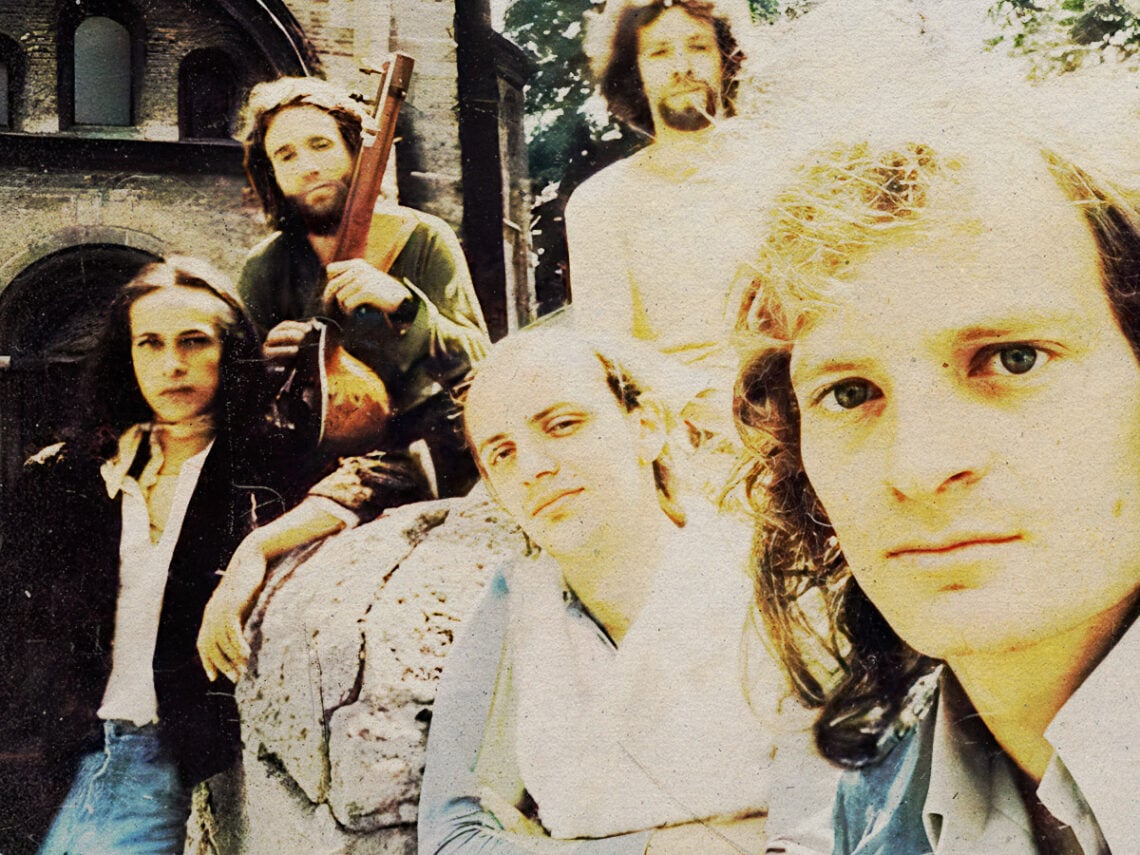
Popol Vuh: the krautrock band Werner Herzog said created “something we have never seen or heard” before

Any band named after the sacred mythological text of a far-flung tribe from Guatemala is one that is likely to be fairly singular. Thus, it is no surprise that the krautrock legends Popol Vuh approached their craft with an eye firmly fixed on the adjective: revolutionary. Their unique aim was to pair the awe and virtues of religiosity with the expanding global influences of musical development in the cosmopolitan age.
This standpoint was solidified with their 1972 album Hosianna Mantra; the album truly seemed to hark back through the mists of time despite its decidedly forward-thinking musicology. Speaking about this record, their then-frontman, Conny Viet, remarked: “I refrain from the classification ‘church music’, although I think it is entirely possible and appropriate that Hosianna Mantra be used as music for church. I realised this record was actually about something else for me.”
Continuing: “With the means at my disposal I wanted to grasp the original Christian being and feeling in order to convey the correctness of elementary truths in the Christian word. Not as a preacher, but as someone for whom archaic ways of life seem more valuable and right than our own contemporary culture.” This was an odd juxtaposition with what had come before from the band, as they focused firmly on the future.
It was this peculiar dichotomy that attracted Hollywood’s strangest chicken-hating director, Werner Herzog, to the band and their enigmatic leader, Florian Fricke. Herzog had always been drawn towards music with a progressive bent. He had been sheltered from it as a boy, and then a Promethean moment changed his worldview. “I only ‘got’ the message when the first Elvis movie came to Munich, and I was there at the opening night,” he once recalled. “Twenty minutes into the film, the young kids, mostly young men, stood up from their seats, and quietly and methodically demolished the theatre. And I thought, ‘This is big!'”
Thus, when it came to his soundtracks, he wanted the visceral edge of music moving forward to feature. He had previously hired Fricke to play a pianist in one of his movies, but when he discovered that the young German prodigy was one of the first people to ever own a Moog synthesiser, he decided to try him out on soundtrack duties.
So, he asked him to score his 1972 movie Aguirre, the Wrath of God. His request could hardly have been more fitting for what Fricke was trying to achieve with Popol Vuh: Aguirre, the Wrath of God is a historical drama, but Herzog didn’t want the score to dwell in the past, but rather the create a sense of timelessness, he wanted it to be potently original. As a keen purvey of pop culture’s new technological edge, Fricke figured there would be no better way to do this than to use something that had never been used before.
He rigged his Moog to a tape relay keyboard and created a sort of proto-Mellotron / and a primitive version of the layering Robby Wedel achieved with Donna Summer’s ‘I Feel Love’. “Literally you have to imagine a machine that runs parallel sound tapes,” Herzog said in awe. “Each tape is a different pitch of tone, and you can access it and play it [like] a choir organ. [Fricke] said, ‘I would like to do something with a choir organ,’ and I said, ‘Yes. […] Create the space, create the mystery, create something we have never seen or heard.'” He believed they succeeded.
It seemed like a match fated from the start. Ethereal tones whisked off to exotic landscapes, and all gathered around the core tenet of primordial human virtues. Fricke and Popol Vuh truly were the Herzog’s of music. But like Herzog and his early adherence to celluloid, Popol Vuh’s use of technology was mere an experiment, and eventually they returned to acoustic methods, resplendent with the lessons learnt from synths and the expanded scopes on offer.
They released records from 1970 up until their final studio album in 1999. During this time they would welcome a world of sound, from the Amdo stylings of Tibet to Bachata rhythms of Guatemala, into the welter of their krautrock sound. This made them a pivotal marker in the expansive sound of the era, turning Germany into a hotbed of avant-garde creativity that drew the likes of David Bowie and Nick Cave to its lair.
As the liner notes for the reissue of Hosianna Mantra read: “Florian was and remains an important forerunner of contemporary ethnic and religious music. He chose electronic music and his big Moog to free himself from the restraints of traditional music, but soon discovered that he didn’t get a lot out of it and opted for the acoustic path instead. Here, he went on to create a new world, which Werner Herzog loves so much, transforming the thought patterns of electronic music into the language of acoustic ethno music.”
