


What is “pop music” and why is it not the same nowadays?

‘Popular’ is a word we use to describe what’s in vogue, trending or fashionable. Like language, fashions change. The flashing trainers that were once granted rule of the playground would no doubt face a shower of abuse in the adult office environment. The fashion of today is the folly of tomorrow. Similarly to fashion, the music we consider popular has evolved over the years, but, confusing things further, the meaning of the term has drifted askew.
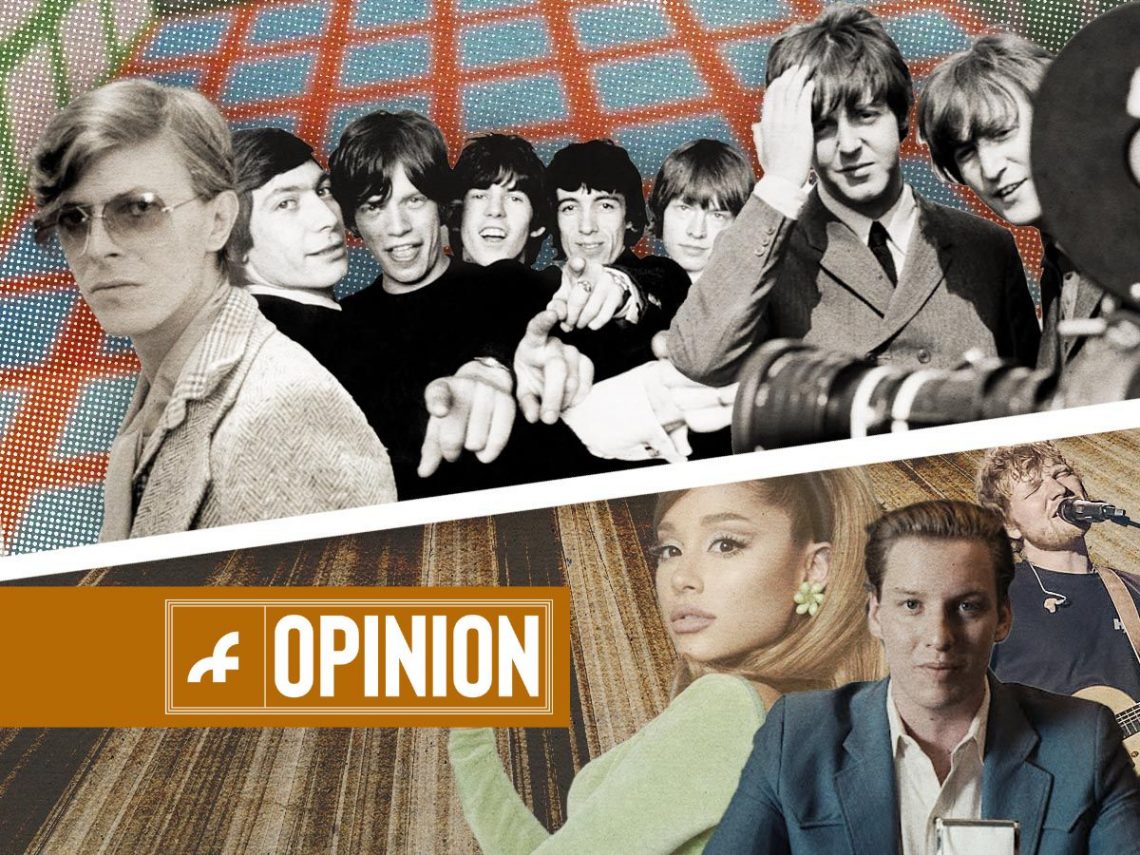
In my ramblings, I like to use The Beatles as an omnipresent cultural touchstone. The obvious reason for this is that they were popular and still are more than five decades after their dissolution. In the 1960s, the rhythm and blues music championed and enhanced by The Beatles and their contemporaries was undeniably “pop music”. This British Invasion took the reins after Elvis Presley’s rock ‘n’ roll shouldered Frank Sinatra’s jazz-inspired “pop music” of the 1940s and ‘50s.
The latter decades of the 20th century saw rock music propagate into a plethora of unruly offspring. The 1970s offered prog, punk, funk and glam, which hit the fan at the turn of the 1980s as heavy synths were dragged unrelentingly into the fold. By the 1990s, we were in an admin manager’s worst nightmare, with thousands of subgenres and no obvious pigeonholes to neatly file them away in.
As the musicologists of today tiptoe the swamped plains of the musical landscape, scratching their heads with a stress-gnawed pencil tip, a question begs: what, in this cluttered scrapyard, is pop music? In the 1980s, it was synth-pop, and in the 1990s, a return to the guitar offered Britpop as the salient candidate; thankfully, the clue was in the names.
What is pop music?
Since the turn of the century, or perhaps a little before, “pop music”, alongside “indie”, has become a genre in itself. Was this a deft move from the head-scratching musicologists? With most artists genre-bending and genre-blending, the charts were rammed with hip-hop, contemporary R&B, pop-punk and electric dance music, among others. A glossy mix of any of these could now be glibly labelled “pop music”.
Nowadays, artists like Ariana Grande, Beyoncé, Ed Sheeran, Rihanna and George Ezra are all described as pop musicians. They dominate the charts and have marginally different yet overlapping musical styles, but if and when groups like Arctic Monkeys or The 1975 surface to the top ten with their new releases, are they “pop music”? No, they are “indie”, which is shorthand for “rock that circumvents the abrasive alienation of heavy metal or hardcore punk but carries too much artistic and emotional depth to fall under the ‘pop’ banner.”
So, now we know what pop is and that its meaning has become increasingly arbitrary over the years, but this doesn’t wholly suffice as an answer to the second part of my question: why is it not the same nowadays?
Despite the words of adolescent bullies, being different is “popular”. Cutting against the grain and laying tracks toward the unknown is admirable and worthy of the highest praise. The Beatles are remembered so fondly today because of their innovative ideas and perpetual influence. “Pop music” in the 20th century had a habit of jumping on the zeitgeist of a generation and forcing them unwittingly into the future.
Would Citizen Kane have been so revered if Orson Welles had followed the trampled path of convention? Of course not; people want something that challenges their preconceptions. Most people, and all critics, like to experience new possibilities, it’s hardwired deep within our insatiable consumerist psyches. Even the Britpop era, for all its faults and gobby hooligans, had its nuances. For music to carry a generation, it has to brandish novelty.
The music that plagues BBC Radio 1 today might suffice to keep the head of a vacant cabbie bopping through tedious dance beats and formulaic auto-tuned lyrics, but very few will remember these artists as a cultural landmark in a year, let alone five decades. Popular music of old always seemed to surf on the crest of the creative wave, with avant-garde explorers tangled in the mangroves way out in front. Today, the fodder dominating the upper reaches of the charts seems to have missed the wave entirely, instead finding itself stranded somewhere far offshore.
I don’t claim that punk, for instance, was ever considered “pop music”, but it was indeed popular. What the “pop music” of today lacks is a driving countercultural accompaniment. The hippies countered “pop music” in the 1960s but counterintuitively fuelled its ongoing development. A decade later, the punks spearheaded the anti-establishment youth culture of the 1970s and laid the groundwork for the ‘80s.
As Brian Eno pointed out in his recent ‘Space Music’ talk at the Barbican, music has historically united us in times of sociopolitical unrest. With the climate crisis and political instability of today, why doesn’t music offer the cultural fibre and cohesion it once did?
Is a lack of countercultural unity banishing music to a dwindling state of irrelevance, hence allowing a stagnant pool of “pop music” to fester?

Never Miss A Beat
The Far Out Beatles Newsletter
All the latest stories about The Beatles from the independent voice of culture.
Straight to your inbox.