


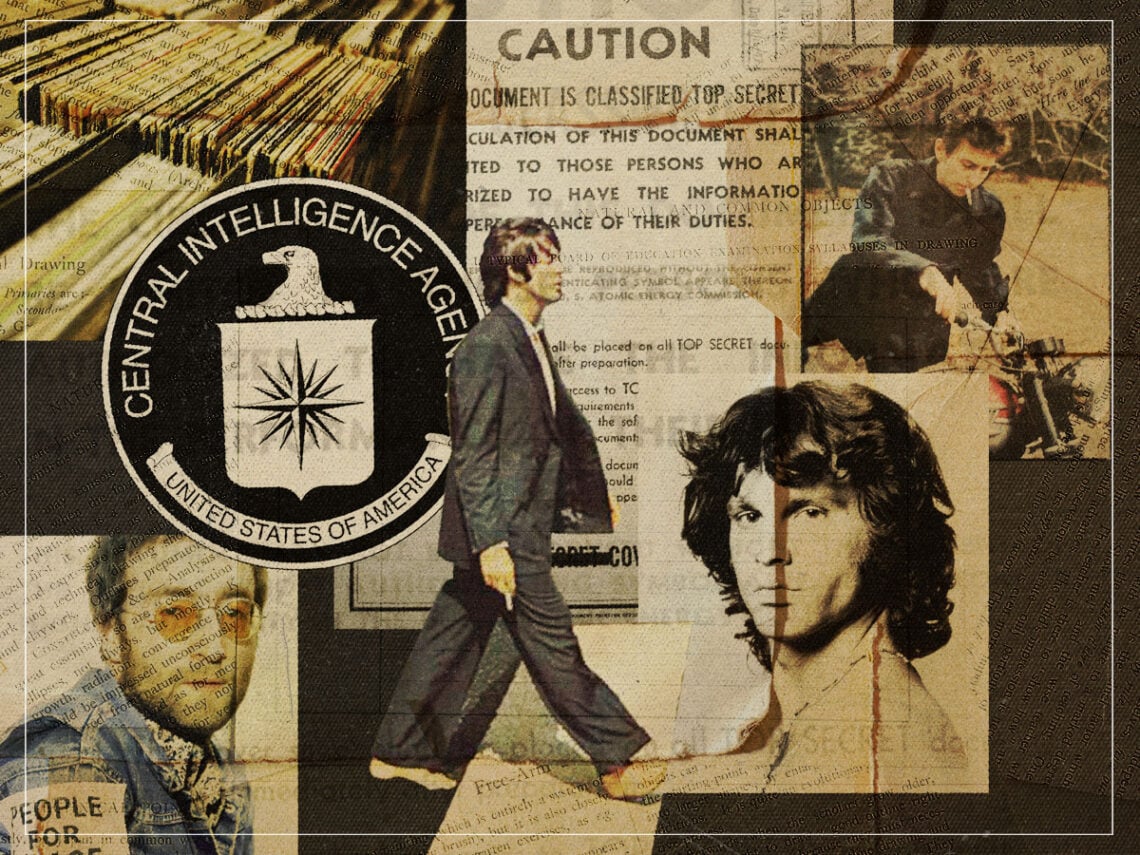
From ‘Paul is Dead’ to ‘Bob’s Mystic Motorbike’: Why were there so many pop culture conspiracy theories in the counterculture age?

These days, one of the many terrors the technologically advanced future holds is the rising threat of so-called Deep Fakes. Already, with rudimentary inputs into a basic, open-platform app, you can generate pictures of John Lennon playing football with Paris Hilton, or you can mock up a vaguely realistic video of King Charles’ Christmas speech being a vulgar anecdote involving candy bars. However, the counterculture age had its own ‘fake’ paranoia, too.
The infamous ‘Paul is Dead’ fiasco ran rampant, purporting that Paul McCartney had met with an untimely end in a car crash in 1966 and was replaced by a lookalike called Billy Shears. Around the same time, Bob Dylan went missing from public life after skidding off his motorbike, and his rehabilitation was anonymous enough for rumours that he had actually died to surface. Thereafter, Jim Morrison’s death was instantly shrouded in the same sense of mystery as the most outspoken stars of the age were either deemed too deadly to live or too immortal to die in an unfurling paradox of confused conspiracy.
While they are largely ludicrous in their own right, a curious trend emerges when they are stacked against each other. Why did so many ‘deathly’ conspiracy theories emerge surrounding the pop stars of the age? Well, as it turns out, the pop culture climate of the times meant it was only natural for the feverish fans to get fruity with their theories—they had just reason to be concerned.
For the first time in history, musicians were political radicals with enough of an amplified platform not to be shunned by the establishment. Certainly, the likes of Woody Guthrie and Billie Holiday, who came before the 1960s crop, might have been trailblazers, but they weren’t caught up in quite the same commercialised mainstream fervour as counterculture stars to be considered major threats to the established order.
And the established order really did see them as threats. Bob Dylan, Paul McCartney and Jim Morrison were all figures firmly on the left of the era’s politics. Their outspoken words were at odds with old-school American ideals, best surmised by Dylan’s verse:
“Come, mothers and fathers
Throughout the land
And don’t criticize
What you can’t understand
Your sons and your daughters
Are beyond your command
Your old road is rapidly agin’
Please get out of the new one
If you can’t lend your hand
For the times they are a-changin’“

Some mothers and fathers couldn’t bite their tongue, they had too much to gain from the old road, and too much to lose if it took a turn. One of those fathers was J Edgar Hoover. The late former FBI head positively hated the ‘left’ and vowed to quash the counterculture movement. He wasn’t alone. When Ronald Reagan rose to power, he famously made a proclamation as good as a declaration of war against the left, stating: “If it takes a bloodbath, let’s get it over with”.
While a few of the pop culture conspiracy theories about rock stars dying and being replaced might have arisen before Reagan’s startling, ugly claim, it was a product of the same wary climate. Reagan was himself an actor, acutely aware of the power of culture in America. Suddenly, you had musicians being heard by millions saying, “And I hope that you die”, and the biggest band in history, artists who had amassed an engaged audience the likes of which the world had never seen, were saying that the original vagabond singing such lines was their “hero”.
Meanwhile, the government were trying to quash communism by relying on the same kids who were snapping up these records, shipping off to fight in a war their heroes were telling them not to believe in. All the while, the FBI and CIA were operating in a shroud of secrecy without any legislative need for transparency. So, it was only natural for the public to fear for the heroes singing for their safety.
Of course, the tenuous Paul is Dead and Bob Dylan’s motorbike stories that followed might have been daft, feverish offshoots of this that could be laughed off as campus capers – and they barely even seem to have any political bent, to begin with – it is also easy to see how they became the accepted reportable from a culture of justly conspiratorial college kids beginning to question the covert powers of the powers that be and how they could be yielded against the young kids with guitars vying against them.
In fact, these theories might now be laughed off as ludicrous curios from a funny old era, but the same type of thinking led young radicals to launch an espionage operation of their own as they broke into an FBI field office in Media, Pennsylvania and uncovered several suitcases worth of evidence that the FBI and CIA had launched joint, illegal domestic spying operations to “discredit” and “neutralise” the left and its various movements.
They had whole dossiers on John Lennon, actively angling to have him deported. Phil Ochs was also surveilled so intensely by the FBI that his paranoia drove him to suicide ten years after he famously declared, “I’m a folk singer for the FBI” in 1966. These figures were stirring up “campus malcontents”, and as Reagan would eventually say, even if it took bloodshed, they would have to be stopped. The “four dead in Ohio” incident that soon followed these remarks, whereby the National Guard shot and killed four unarmed, peaceful student protestors, proved the stark realities of this point.
However, not all the realities were quite so brutally apparent. The Black Panthers had nearly as many informants in their ranks as they did members, Jerry Garcia often discussed how he could spot countless feds floating around in their circle from a mile off, and many more incidents provided cause to believe that underhand covert measures were being deployed in bids to destabilise the culture of the left, and now there are documents to prove it.
So, in short, the daft and frivolous theories reported in the music mags at the time were tall tales fit for a time when the truth was even taller. McCartney certainly didn’t die, Dylan’s motorbike mishap provided him with a convenient excuse to finally get some rest, and the mysteries surrounding Morrison’s end are unlikely to be answered by any official document, but these interesting little tattle tales were pretty much designed to be laughed off, to discredit the daftness of the sort of questioning thinking that led to the discovery of “dangerous, degrading and blatantly unconstitutional” spying programme that boldly infiltrated the counterculture scene.
Today, the stupidity of conspiracy theories is at an all-time high, and the truth is in short supply, so be careful when choosing the ones you subscribe to.

Never Miss A Tale
The Far Out Bob Dylan Newsletter
All the latest stories about Bob Dylan from the independent voice of culture.
Straight to your inbox.