


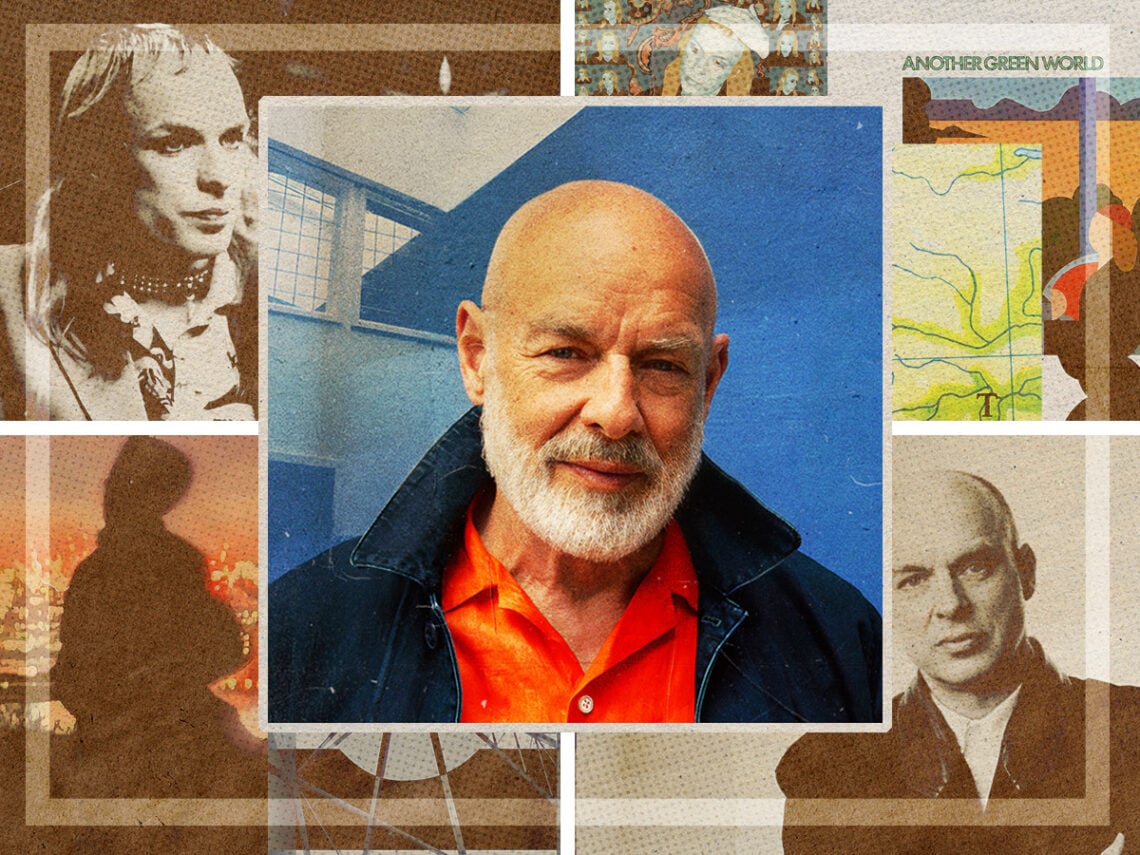
Playlist: The 50 best songs produced by Brian Eno

Suffolk’s greatest export, Brian Eno, has enjoyed a career that has seen him succeed on both sides of the studio mixing desk. After starting his musical career in 1971 with art rock heroes Roxy Music, Eno left the band two years later, following tensions with the frontman, Bryan Ferry. Striking it out on his own, he would become one of the most respected names in music and one that every musician admires.
After he departed Roxy Music, Eno started to realise his true creative self. In 1974, his first solo album, Here Come the Warm Jets arrived. Whilst that record bore similar stylistic hallmarks to his former group, it was the beginning of the rest of his career. From the mid-70s onwards, the clean break from the past was made, and he became deeply ensconced in the world of minimalism. 1975’s Discreet Music and 1978’s Ambient 1: Music for Airports remain standouts of the era, with the latter a defining moment in the history of the genre that would become known as ambient. Encapsulating Eno’s cerebral essence, it has long been deemed his quintessential work.
Alongside his solo efforts, Eno forged a penchant for collaboration during the 1970s, helping to elevate the work of some of the era’s most prominent names. These included adding his style to the art-pop refinement of David Bowie’s 1977 effort Low and converging with the eminent American composer Harold Budd to create one of the most hypnotic albums ever in 1978’s The Pavillion of Dreams. The likes of Robert Fripp and John Cale also welcomed him into the studio to add his distinctive magic.
One of his most essential chapters came in producing a trio of albums for Talking Heads, 1978’s More Songs About Buildings and Food, 1979’s Fear of Music, and 1980’s Remain in Light. The Englishman is credited with fostering the David Byrne-led group’s blend of art school attitude with the dynamic, West African rhythmic complexities that would see them confirmed as one of the most consequential acts of the era. Also, during this period, he helmed Ultravox’s 1977 debut album Ultravox! and Devo’s first chapter the following year, Q: Are We Not Men? A: We Are Devo. He also worked on 1978’s influential no wave compilation, No New York.
Following the 1970s, Eno would continuously develop as a producer. In 1984, he produced Toto’s soundtrack for David Lynch’s adaptation of Dune. Later that year, he facilitated U2’s segue from post-punk icons to a global juggernaut with The Unforgettable Fire, which remains their most artistic effort. He then confirmed that Bono and the rest of the band were here to stay when he helmed their fifth album, one of the world’s greatest best-sellers, The Joshua Tree, in 1987.
Not to be pigeonholed as a studio whizz, since then, Eno has worked with U2 on subsequent records and produced studio efforts by Coldplay, David Bowie, Grace Jones, Jean-Michel Jarre and more. He’s also helped a host of others bring their work to life in a non-production sense, such as providing synths and textures for shoegaze pioneers Slowdive on their heady 1992 masterpiece, Souvlaki.
Blending a broad musical taste with a deep grasp of the studio as an instrument, Brian Eno has long been one of the ultimate figures in popular music. It’s a credit to his efforts that the landscape would be much different without them. To mark that impact, we have looked at his studio work and compiled the 50 best tracks that he has produced below (with a caveat that no album can feature twice in the list). And what’s more, we’ve wrapped them all up in a playlist at the foot of the piece.
The 50 best songs produced by Brian Eno:
- ‘With Or Without You’ – U2
- ‘Beautiful Day’ – U2
- ‘Deep Blue Day’ – Brian Eno
- ‘The Big Ship’ – Brian Eno
- ‘1/1’ – Brian Eno
- ‘First Light’ – Brian Eno and Harold Budd
- ‘Sparrowfall (1)’ – Brian Eno
- ‘America Is Waiting’ – Brian Eno and David Byrne
- ‘The Lost Day’ – Brian Eno
- ‘I’ll Come Running (To Tie Your Shoe)’ – Brian Eno
- ‘By This River’ – Brian Eno
- ‘Emerald and Stone’ – Brian Eno, Jon Hopkins, Leo Abrahams’
- ‘Lay My Love’ – Brian Eno and John Cale
- ‘In Our Sleep’ – Laurie Anderson
- ‘Discreet Music’ – Brian Eno
- ‘Prophecy Theme’ – Brian Eno, Daniel Lanaois and TOTO
- ‘Mr Trembo’ – Damon Albarn
- ‘One Fine Day’ – David Byrne
- ‘I Zimbra’ – Talking Heads
- ‘Wind on Wind’ – Robert Fripp and Brian Eno
- ‘Delta Rain Dream’ – Jon Hassell and Brian Eno
- ‘This Is’ – Grace Jones
- ‘Aliens’ – Coldplay
- ‘Laid’ – James
- ‘The Big Country’ – Talking Heads
- ‘Strangers When We Meet’ – David Bowie
- ‘The Dance No. 3’ – Laraaji and Brian Eno
- ‘Juno’ – Harold Budd
- ‘Uncontrollable Urge’ – DEVO
- ‘Once in a Lifetime’ – Talking Heads
- ‘Saturday Night In The City Of The Dead’ – Ultravox
- ‘Viva La Vida’ – Coldplay
- ‘One’ – U2
- ‘Solitude’ – Geoffrey Oryema
- ‘Sail Across the Water’ – Jane Siberry
- ‘Emma’s Song’ – Sinéad O’Connor
- ‘I’m Hardly Me’ – Brian Eno
- ‘Dead Finks Don’t Talk’ – Brian Eno
- ‘Return’ – Brian Eno and Karl Hyde
- ‘LUX 1’ – Brian Eno
- ‘Always Returning (II)’ – Brian Eno
- ‘The sound of someone you love who’s going away and it doesn’t matter’ – Penguin Cafe Orchestra
- ‘The Heavenly Music Corporation I’ – Robert Fripp and Brian Eno
- ‘Reflection’ – Brian Eno
- ‘Heaps Of Sheeps’ – Robert Wyatt
- ‘Welcome’ – Harmonia
- ‘Stay (Faraway, So Close!)’ – U2
- ‘Pride (In The Name Of Love)’ – U2
- ‘Getting Away With It (All Messed Up)’ – James
- ‘Sometimes’ – James
