


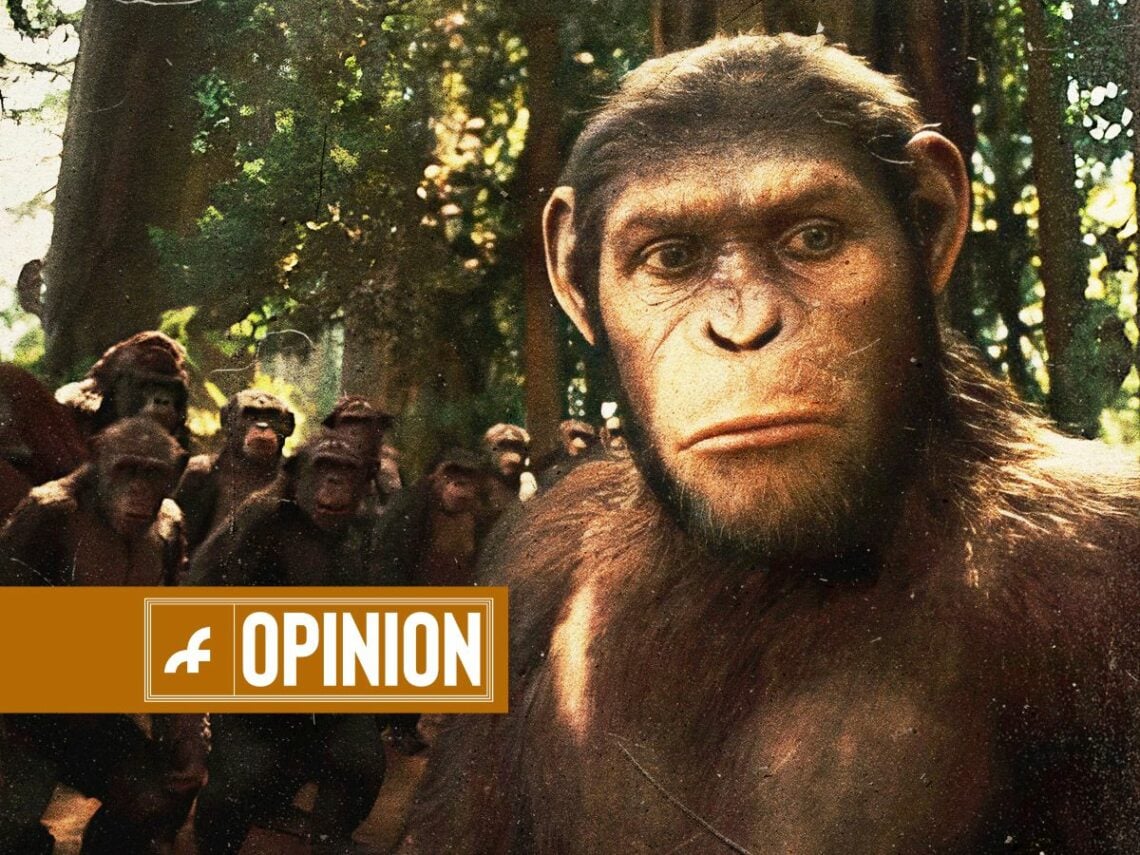
Hear Me Out: the ‘Planet of the Apes’ trilogy was 2010’s ‘Lord of the Rings’

As the world of cinema seemingly continues its downward trajectory, shedding artistic merit, purpose and integrity like some obscene and creatively devoid python, things that seemed pretty good at the time take on an added level of reverence and merit. Suddenly, movies from ten years ago seem like the crème de la crème of blockbuster cinema in comparison to the slush pile we have to sit through these days. For instance, consider the Planet of the Apes franchise.
From the outset of Rise of the Planet of the Apes in 2011, it was clear that director Rupert Wyatt was handling the franchise with an added sense of dignity and gravitas that it hadn’t seen before. Ignoring Tom Felton’s laughably weak portrayal as an antagonising zookeeper, the core characters of James Franco’s Will Rodman and the hyper-intelligent chimp, Caesar, were genuinely compelling.
The film took its time, had a great sense of pacing, balanced humour and action well, and, most importantly, it committed to being the first of a series. There was no abrupt cliffhanger, no attempt to shoehorn in teasers or easter eggs alluding to future instalments. It was simply the first picture in the broader canvas yet to be told.
Two things could happen after its success, earning over $400million worldwide at the box office. Firstly, in classic studio fashion, producers could have descended on the IP like sharks in a feeding frenzy, not bothering to dissect and analyse why it did so well, instead focusing on making another product and earning more money.
The other option? To build upon the foundations of a moderately good film, to take what was ostensibly a special-effects heavy blockbuster and guide it into a higher, deeper and more artistic place. If only it had the right person to do so.
How Matt Reeves elevated the Apes trilogy
Cue Matt Reeves, a director renowned for his ability to balance commercial appeal with artistic flair, demonstrated in 2008 by his inarguably excellent work on Cloverfield, and his thoughtful and respectful remake of the Swedish vampire film, Let Me In. With his appointment, the franchise saw an immediate uptick in quality, and it was clear to everyone that Dawn of the Planet of the Apes took everything great about Rise and made it ten times better.
He continued the core story introduced in the first one while bringing in new elements, characters and themes that imbued with a particularly artistic sense of purpose; here was a 20th Century Fox blockbuster, with guns, explosions and apes galore, and still the filmmakers had something to say about humanity. With Reeves at the wheel, the Apes films weren’t just monkeying around.
Three years after Dawn, Reeves was brought in again to finish the trilogy, and with a co-writing credit to boot, it was clear just how invested the filmmaker was in the series. War for the Planet of the Apes upped the ante even more than anyone thought possible, bringing an epic and widescreen conclusion to the saga with equal parts loud and quiet.
Reeves gave us the spectacle of gun-toting apes riding horses but then balanced it out with haunting hallucinations that plagued Caesar. Now, six years later, having seen the calibre of high-budget films that have continued to sully our screens, it’s apparent that the Apes trilogy was rather remarkable. In fact – it may be the 2010s version of The Lord of the Rings.
Why the Apes trilogy was last decade’s The Lord of the Rings
The similarities between Peter Jackson and Reeves are striking. Both directors were given the reins to massive franchises, both were trusted with enormous budgets, and both created cinematic chronicles that were clearly moulded by a distinct directorial vision. And yet, such artistic freedom in an age dominated by commercial appeal and mindless crowd-pleasing is not just uncommon; it’s almost unheard of. Now, the Apes films just simply aren’t as good as Jackson’s adaptation of Tolkien’s fantasy behemoth, but in retrospect, they represent last decade’s multi-movie, director-led cinema event.
Particularly in the context of today’s big-budget films, the Apes trilogy stands out like a gem amidst dirty, moss-covered stones. The MCU has its brief moments of charm, like with James Gunn’s Guardians of the Galaxy trilogy, but those films nevertheless had to bend over backwards to make sure they didn’t disrupt whatever bloated and uninspired 20-movie plotline that the nerds at Marvel had cooked up. On the other hand, the Apes trilogy managed to marry high-octane action, eye-watering big budgets, state-of-the-art CGI and soulful storytelling, all thanks to Reeves.
If the Lord of the Rings came to life because studios didn’t know any better, the Apes trilogy was born despite their reservations about taking such a big risk once again. In the annals of spectacle cinema, those two trilogies shine bright as franchises that were entrusted to genuine artists who loved, cared and nourished the brands bestowed upon them. Perhaps, with the success of Denis Villeneuve’s Dune adaptation, we’ll see that again this decade.
