


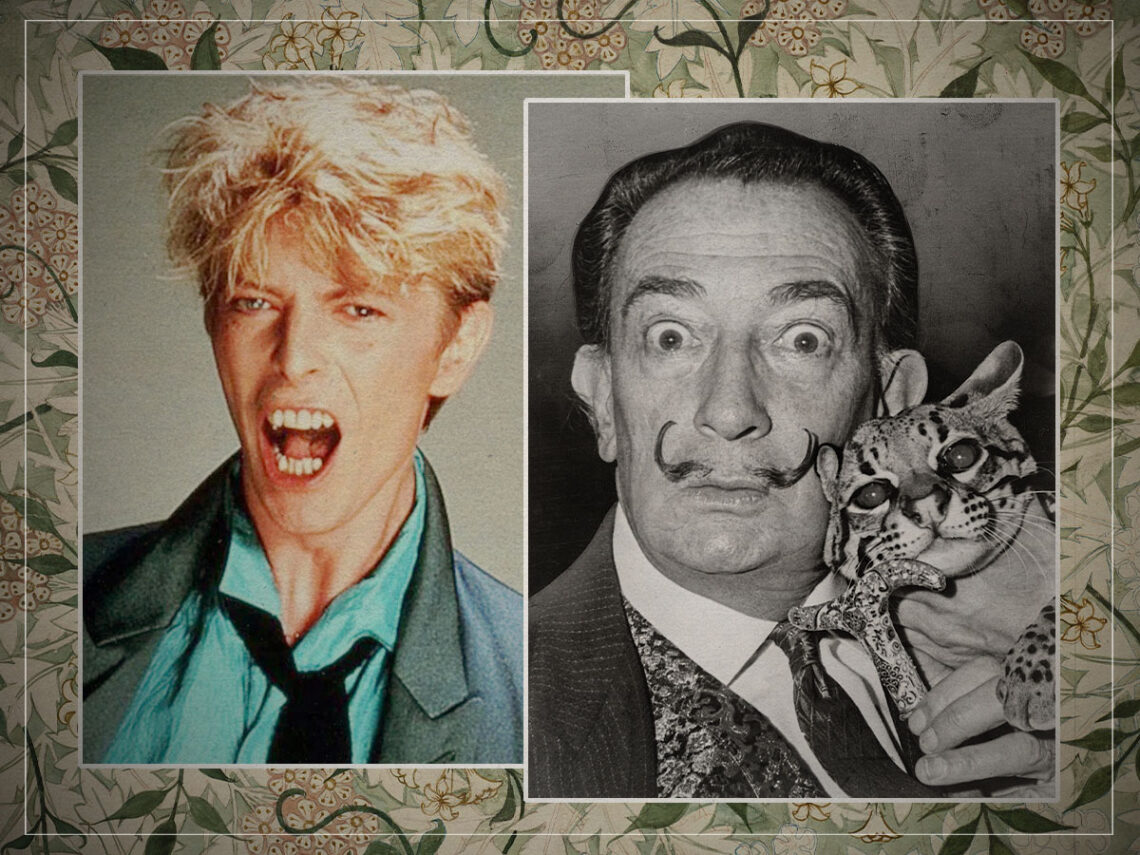
“Plagiarism”: The philosophy David Bowie ripped off from Salvador Dalí

Though David Bowie was undeniably a singular artist, cutting a path many have since followed, he wasn’t inspirationless. There were several musicians who influenced his sound, characters that inspired his looks, but when it came to his philosophy, he turned to one of the greats.
People love to describe Bowie as an alien who appeared from nowhere. That’s the thing; he was seen as the man who fell to earth, as if the artist was this completely isolated phenomenon, too otherworldly to be tethered to anything here.
While that’s a nice story and a powerful reputation, it was not quite truthful. Bowie was a Brixton boy. If it hadn’t been for the inspiration he was surrounded by or spent his youth discovering, the world likely would never have known his name. He never would have become David Bowie. He’d simply be David Jones, and maybe he’d have been a waiter or an office worker like his parents.
But luckily, that didn’t happen. Luckily, his brother introduced him to jazz, and his father kept bringing home 45s to play in the house, introducing him to the sounds of Little Richard and Elvis. Luckily, he was surrounded by people contemplating things like Buddhism, beat poetry, the occult, and more. He might have gone on to mix all these influences into something uniquely his, but the world is incredibly lucky that at the start, Bowie was inspired by so much and connected to so many interesting things and people.
All of that led him to what came to be his philosophy, as it steered him to Salvador Dalí, the iconic surrealist. I barely even need much more for it to be clear how much Dalí inspired Bowie. The two seemed to operate on the same plane, as even something like Bowie’s ‘Ashes to Ashes’ video somewhat looks like a woozy, colourful Dalí piece.
It was less about the artist’s style and more about his mindset, or the way Dalí’s open-to-interpretation surrealism forced Bowie to contemplate how different people engage with different things. Inspiration isn’t as simple as merely being shown something, as each person reads, hears, or sees an artwork differently. “Dalí is a prime mover. He would paint something, and the way it would be received by the majority would be totally different from the way he put it out,” Bowie once said on that point.
It’s an idea could lead back to that singularity mindset, claiming that if each person sees something different, each person is alone in their influences even if they’d all seen the same things. But Dalí’s influence said otherwise.
“There’s another thing that Dalí once said: ‘anything which does not follow tradition is plagiarism’, which I understand inasmuch as one should follow tradition, and then digress from it when one has made a thorough study of it,” Bowie said, laying out the philosophy he’d taken from him.
Really, he’d taken it from Dalí, who took it from Eugenio d’Ors, a Spanish philosopher and critic. But the point still remains. While the idea that tradition is the only pure form feels complex, there’s also truth to it, and truth to Bowie’s idea that to bend the rules, you must first understand the foundation. He definitely did that when considering his youthful influences and the way he built from there, shown perfectly in his covers of classic songs or other artists, taking their foundation, honouring the tradition and then making it his own—both plagiarising and not at all.
So, in that way, no great artist ever could be an island. No one could or ever should be truly singular, as the greats remind us that everything comes back to the earliest pioneers, and you can only become one yourself if you understand them first.
