


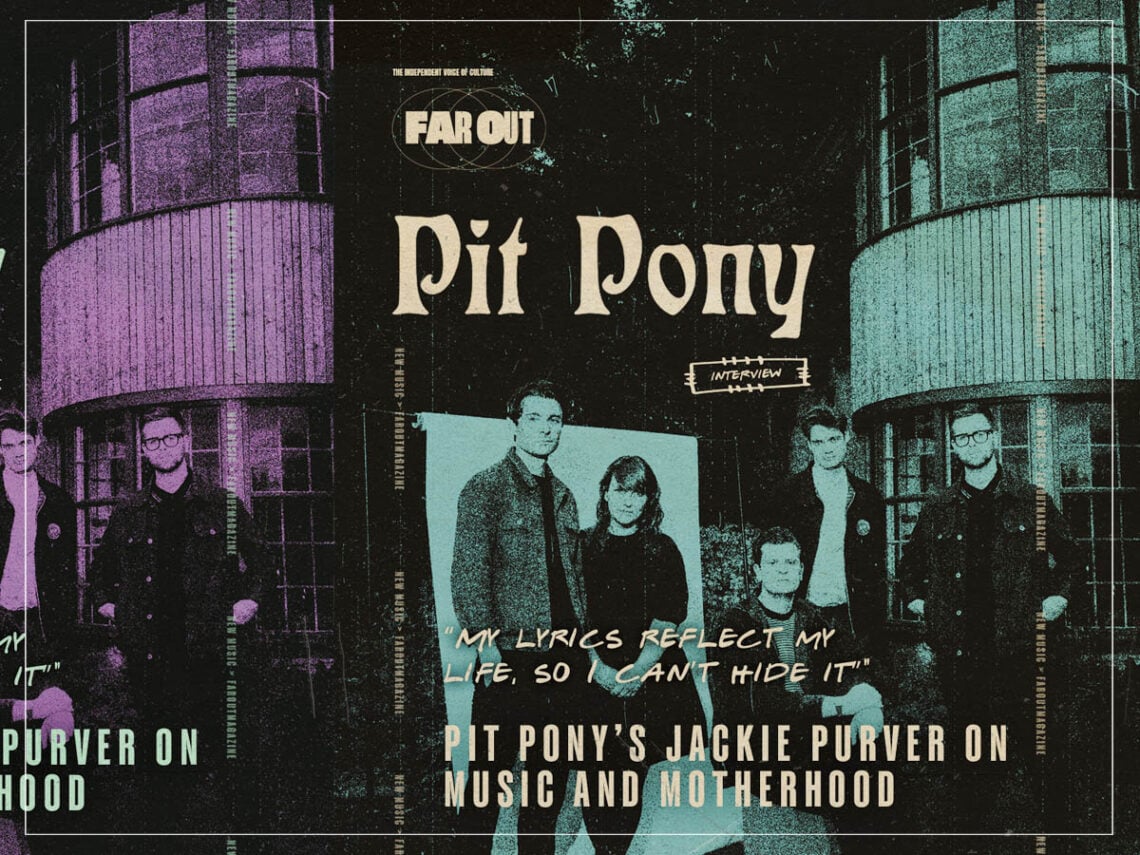
“My lyrics reflect my life, so I can’t hide it”: Pit Pony’s Jackie Purver on music and motherhood

“It’s funny ‘cos we recorded it in April 2023, so it feels quite like we’ve been playing some of the songs for a while,” Pit Pony lead singer Jackie Purver talks about the band’s upcoming album, Dead Stars, which is set for release on February 7th. “It’s also quite nice because I suppose you listen to it so much when you’re doing it, you kind of lose sight of whether you like it or not. Now, listening back to it, someone will put in the band chat, ‘I’ve just listened back to the first track, and it’s really good.’”
It’s always interesting, as a music lover rather than a music maker, to hear the length of time that often disperses between recording and releasing a record, especially given how much the shape of things can change in that time. It might be hard to connect with a song about a break-up when you’ve been given a year to get over them and realised it was never that serious; the theme of tracks could contort and change, and fundamentally, musicians might look at an album much differently compared to when it was initially written.
This isn’t the case for a lot of Purver’s songs, though, given she wrote them about her daughter. In this sense, the means of the song change, as while they remain expressions of emotion, they also act as snapshots, memories that she can look back on during a time that parents often admit passes too fast.
“She’s five; she was seven months when the pandemic hit, so she was maybe one, one and a half when we did the first album,” she said. “So, it kind of influenced that, but you’re always working retrospectively, so we did the album at the start of last year, and then we wrote it the year before that, which was like 22/23, so you’re always kind of working backwards. She was much smaller when we wrote the songs. She’s five now, so she’s in school.”
As a parent, writing about your child only makes sense. Music is an outlet for emotion and experience, and what experience is more emotional than becoming a mother? These songs act like a tangible representation of a very precious moment, but they also highlight a fundamental flaw presented by the music industry, which is that it’s not a market built for parenthood. This is initially represented in the fact that despite it being so common, it’s not something musicians are given a platform to talk about.

“I just think it’s something that I don’t think women talk about a lot in music. I think you hit a certain age, and it’s kind of like, ‘Get on with it, don’t mention it’; you just have to be a good frontwoman, but men are in the same position,” Purver elaborated. “My husband, Garth, is in the band as well, and nobody will ask him any questions about our little girl. I’ll be at a gig, and people will be like, ‘Oh, who’s got the kid tonight?’ and I’m thinking, ‘Well, you haven’t asked him; he’s the other parent, but you’re just asking me.’”
She continued: “It’s just kind of that ‘Alright for a mum’ thing. People say, ‘Oh, she’s alright for a mum’, that kind of thought process where you just put women with children, and you don’t put men with them, and that’s why I feel like I just wanted to talk about it because we’re writing about our life experiences, my lyrics reflect my life, so I can’t hide it, it’s just my normal every day.”
Purver certainly has a point, as while there are songs about motherhood, they don’t equate to the amount of musicians who are mothers. Lyricists who discuss the subject have songs hailed as unwavering testimonies of love and bravery, whereas songs about parenthood from parents should come as naturally as chord progressions do guitarists and beats do drummers.
“I suppose there is an element of it where it’s someone’s interpretation of a song. On the first album, the album is called World To Me, and the song ‘World To Me’ is about having a baby,” she said. “Lots of people just assume that it’s a love song about a couple’s relationship, so maybe there are a lot of songs out there where we don’t know people have actually written them for their children, maybe we just don’t realise, but we don’t talk about it so we’re not gunna realise.”
She continued, “I remember before we went on tour after we’d done the first album, I was googling ‘Female musicians on tour’, like, how do you do this? There was an article by Emmy The Great, and she’d written about how she’d taken her six-month-old baby on tour. I was like, ‘Oh great, so it can be done’, and then I went to an event in Newcastle and spoke to Hazel from Lanterns On The Lake, and she had a baby sort of a similar age to mine. Just as I’d built it up, I thought, ‘Well, there are a lot of people who are in the same position.’ It’s not necessarily that they don’t wanna talk about it; they’re just not asked about it in the media. You’re asked about it personally all the time, but not on a platform.”
Bands already face huge logistical issues when trying to arrange a tour; however, these problems are heightened when a child is involved. The music industry is not built for children, and it introduces a problematic ultimatum for artists who want to become parents, which seems unfair.
“I suppose one of the things that ties into the wide conversation is about people earning money,” said Purver. “I know Kate Nash has done something about going on OnlyFans to earn money to actually go on tour. I know other musicians have spoken about that before, so, If you have to put in place childcare on top of that, you couldn’t take a child on tour or afford to drive to shows and come back […] You have to do it all in one tour, you couldn’t really factor childcare into that because of the cost of it.”

She continued, “If you’re a smaller artist trying to build things up, you’re playing gigs where there’s a green room that three bands are sharing; it’s not an environment for a child.”
The harsh reality is that the music industry’s attitude towards parents stems from deeper-rooted inaccessibility aimed towards women. The whole field has often been described as a boys’ club, and while that’s steadily being phased out, the ripple effect caused by such a big sinking stone still makes waves that modern female artists are drowned out by.
“I’m in a band with four men, and we always try and present as a full band; it’s not me and a backing band, yet that assumption is made all the time,” she said. “The vocals get turned up really loud, and I have to say ‘Can you put it lower in the mix?’ It’s always just seen as a woman in a band. She has to be this, like, ethereal frontwoman, and it’s all about how people perceive her […] You’ve got to be a goddess and not a real person, and I think that just plays into it.”
Anytime we miss out on new music, it’s a tragedy, and there will be a great amount of music we have missed out on because of how hard it is for people to raise children and still work as artists. Purver knows this first hand, as the moment Pit Pony’s debut album started to gain traction, plans had to be cancelled.
“I remember, we had a song called ‘Osaka’, and Mary Anne Hobbs played it on six music, and then everything sort of blew up,” she added. “Like, loads of people were interested in it, but I was pregnant at the time. We were releasing music and getting ready to do an album and stuff, and then I was like, ‘Yeah, so, actually, I can’t do any of that now because I have to go and have a baby’.”
Continuing, “Talking about things that people don’t talk about, when we made that album, the last album, we were in the studio for two weeks, and I missed the second half because I had a miscarriage. The band were so good, they were so lovely, but I was just like, ‘Okay, I can’t do any more vocals now; I’ll have to come back in and do them later’. It was like something they had obviously not personally experienced, but it was just another part of life for me. It’s just, ‘Oh well, that’s something that women have to go through’, […] Now, when I go back and listen to some of the songs, I’m like, ‘Ohh, I didn’t know they’d done that’.”
Steps must be taken so that musicians no longer have to choose between parenthood and artistry. The industry’s attitude towards motherhood has directly resulted from its attitude towards women. As we strive for a more inclusive scene which is representative of all those listening, we fail to acknowledge the common issues, both logistically and financially, that come with being a mother, which is a natural part of a lot of people’s lives and shouldn’t impede the creative process. More support should be in place to create a better balance for artists who are parents, as Purver can attest.
“I do think women are treated differently to men. I’ve turned up to gigs, and basically, someone will assume I’m the girlfriend of someone in the band, and I’ll be like, ‘No, I’m in the band’. It’s these weird assumptions,” she concluded. “You can be treated a lot differently, which is sad. But the more we talk about and the more women who are in music, who play live music and go to studios, the more we’ll learn.”
