


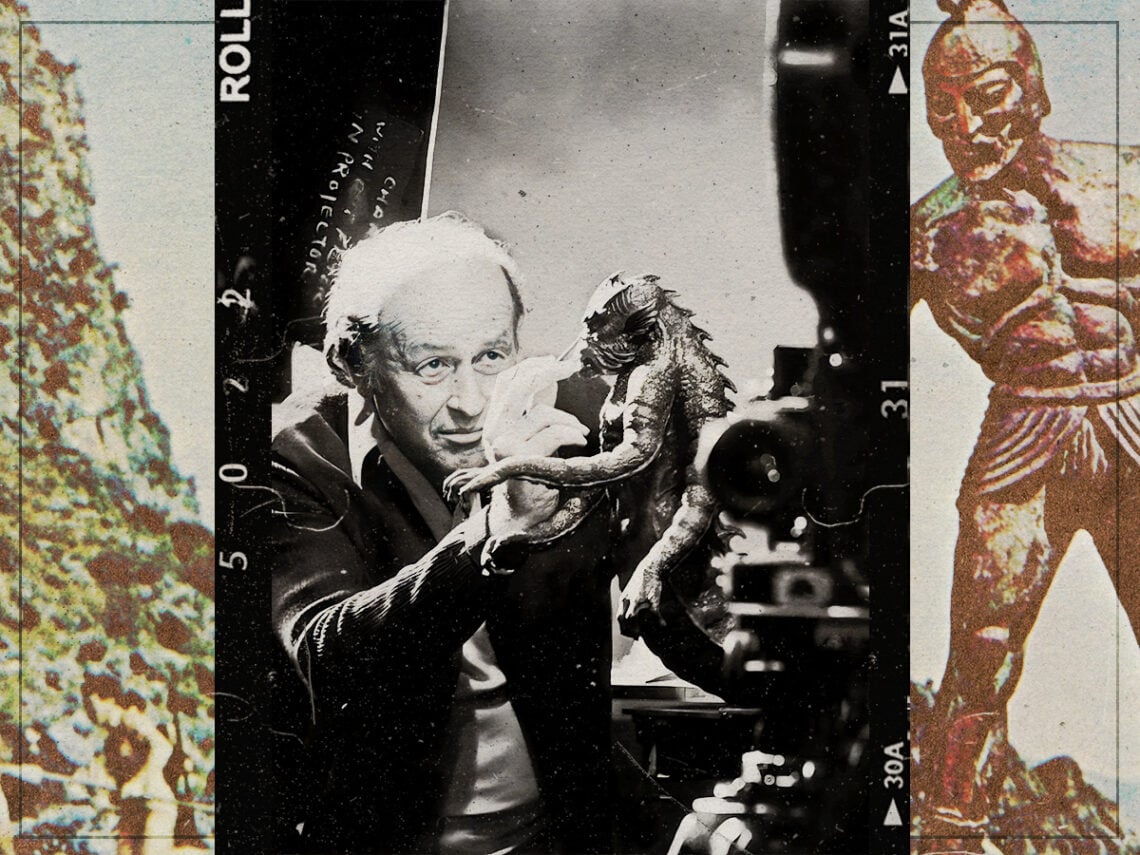
The pioneering efforts of animator Ray Harryhausen

These days, visual effects are mainly created through computer-generated animation, with some of the highest-grossing movies of recent years boasting impressive graphics. From Avatar to Avengers: Endgame, it’s hard to catch a blockbuster hit that doesn’t utilise some form of visual effects.
Yet, before CGI and digitally created graphics, filmmakers needed to get more creative. Many films used stop-motion animation, manipulating handmade models to look like they were autonomous beings. Stop-motion is still used today, as demonstrated by movies like Wes Anderson’s Fantastic Mr. Fox and Isle of Dogs. However, the development of animation is largely due to the pioneering efforts of Ray Harryhausen, who remains one of the most prolific stop-motion animators and special effects masters in the history of cinema.
His contributions to filmmaking have significantly influenced the course of modern animation and visual effects, although his importance is often overlooked. Without Harryhausen, it is hard to imagine what modern cinema would look like, especially the action and adventure movies that rely on otherworldly creatures and characters.
Harryhausen first expressed an interest in animation when he was a teenager after watching 1933’s King Kong. The stop-motion effects were created by Willis O’Brien, who Harryhausen soon got into contact with to ask for advice. Luckily, O’Brien was kind enough to mentor the budding animator, and Harryhausen cracked down with learning the intricacies of model-making, photography, anatomy and filmmaking.
In his memoir, Harryhausen recalled: “So at the impressionable age of 13. I set off with my mother and aunt to see a movie about a gorilla. When I look back, I find it all rather difficult to believe that in one afternoon, a film about a giant gorilla had the influence to alter the direction of my entire life.”
Soon, he went to university to further study the arts and built up a small portfolio. Subsequently, Harryhausen landed his first job as an animator on Puppetoons, a series of short animated films created by George Pal. In 1947, he assisted O’Brien with the animation of Mighty Joe Young. Harryhausen was given the chance to complete much of the animation himself after O’Brien was tasked with fixing many technical issues, proving the young animator to be incredibly skilled. The film now remains one of the most impressive examples of stop-motion in cinema history, and much of this is down to the hard work and dedication of Harryhausen.
Within a few years, Harryhausen was given significant control over his projects, and although he was rarely credited with being a director or writer, the animator contributed heavily to all production aspects of much of his work. One of his first significant projects was The Beast From 20,000 Fathoms, which was based on his friend Ray Bradbury’s short story, The Foghorn. Released in 1953, direction was carried out by Eugène Lourié. Yet, the movie is most memorable for Harryhausen’s contributions – it was his first project to use his Dynamation technique.
Dynamation significantly helped to transform stop-motion, helping to solve many problems, such as combining animation with live action. Harryhausen fixed this issue by splitting the scene into two parts – the background and the foreground, making it appear as though the model creatures existed within the same universe as the real actors. This was revolutionary, aiding the possibilities for stop-motion animation to appear more realistically integrated into the filmic world.
Harryhausen continued to create mesmerising effects through the following decades, working on notable productions such as The 7th Voyage of Sinbad, Jason and the Argonauts, First Men in the Moon, The Golden Voyage of Sinbad, and Clash of the Titans. Throughout his career, he often worked with the help of his parents, who would aid him in fashioning costumes and models as he got to work in his garage.
Jason and the Argonauts remains one of the most spellbinding examples of Harryhausen’s work. In his memoir, he explained the gruelling process that went into bringing the film to life. “It was painful to the extreme. Hours and hours of the same movements can wear a man down,” he said. “But it was worth it. It is there on film for all to see, and no matter what technology is invented, it can never be reproduced. In stop-motion, the whole scene has a supernatural quality that could only be achieved by dimensional animation.”
To celebrate his achievements, Harryhausen has been awarded an honourary Oscar, Bafta, and ‘Lifetime Achievement Award’ from the Visual Effects Society, as well as earning his own star on the Hollywood Walk of Fame. With that, he has greatly impacted filmmakers such as Tim Burton, George Lucas and Steven Spielberg, and his influence lives on through modern cinematic animation, which would truly be nothing without him.
