


A scientific study of how Pink Floyd song ‘The Great Gig in the Sky’ affects brain waves

Have you ever caught a train to London to listen to just one song? Until very recently, nor had I. I’m hoping you’ll spare me the straitjacket, however, as this was a rather special song listened to under extraordinary circumstances. The song in question is the 1973 Pink Floyd classic, ‘The Great Gig in the Sky’, and the venue was the Dolby Screening Room, Soho.
In October, Pollen Audio Group conducted their Brainstorms Project at Dolby’s London headquarters. A group of lucky individuals, myself included, had their brain activity recorded while listening to the atmospheric track from 1973’s The Dark Side of the Moon. As a keen admirer of the band, album and song in particular, the trip from Brighton seemed a small price to pay to be involved in such an experiment.
After arriving at the Dolby building in Soho, I was ushered downstairs to the labs and into a small soundproofed studio. Here, I met Erica Warp, a genial neuroscientist who talked me through the process while fitting a rubber cap of electrodes as close to my cranium as my mop of hair would allow.
Before we could commence with the song, I was asked to fill out a form which quizzed me on my familiarity with the song, musical aptitude and current mental state. With prior visions of Malcolm McDowell’s headgear and eye forceps in A Clockwork Orange, my overriding emotion was one of relief.
Looking slightly daft with a small fortune perched on my head, my office chair was swivelled to face a projector screen and an armoury of speakers. Although the main speakers were situated in front of me, smaller units were positioned on the walls and ceiling beside, above and behind me to enable the full three-dimensional illusion of Dolby Atmos technology.
Finally, I was told to sit as still as possible and to click a button in front of me at any point throughout the song if and when I felt a “chill event”. Rather jarring, discordant piano tones bookended the Pink Floyd masterpiece to jolt my synapses into a frenzy of peaks and troughs. This allowed the neuroscientists to synchronise my electroencephalography (EEG) output with the song.
As expected, the song was clearer and more powerful than I had previously experienced. Subtleties lost to background noise and dust in the grooves of my original vinyl copy now presented themselves in their full, unadulterated glory. I wasn’t entirely sure what would constitute a “chill event” for me, but reticently, I was never compelled to click the button.
As the closing tones rang out in my skull to lay some final, jagged lines on the EEG, I asked Erica why they chose ‘The Great Gig in the Sky’ for the study. As I suspected, the song was selected due to its breadth of intensity and emotional qualities. Furthermore, the instrumental track is the brainchild of late Pink Floyd keyboardist Richard Wright, whose estate helped fund the project.
After leaving the small studio, I was taken to a board room where I met Richard Warp, the CTO and Creative Director at Pollen Audio Group, and Gala Wright, the Creative Director at Richard Wright Music. Here, we discussed the project’s aims and potential applications.
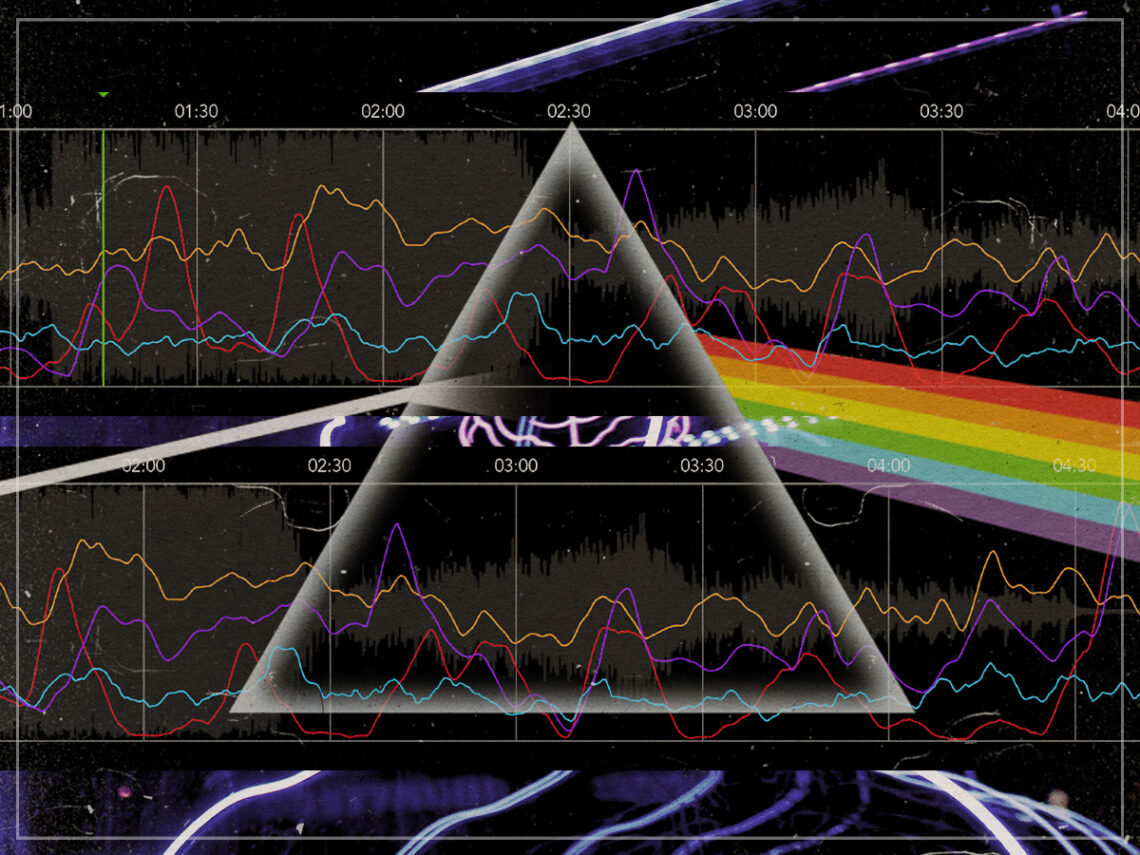
While the Brainstorm Project had no principal hypothesis, they aimed to capture the subtle dynamics of neural activity from approximately 100 participants, compiling results to discern any noteworthy correlations. The EEG readings, as seen below, reflect the participants’ excitement, interest, relaxation and stress.
Alpha waves, associated with relaxation, are among the study’s most important variables. Neuroscientists hope that, with a greater understanding of how music affects these waves, audiotherapy applications can be enhanced.
Results from the Brainstorms Project have also been used to create “artistic and intuitive visual representations of how the brain responds when experiencing music in Dolby Atmos.” In the board room, Richard Warp showed me an example of one of these visual representations wherein clouds cloak a night’s sky to a lesser or greater degree, with lightning flashes and darkness reflecting emotional stimulation.
Richard explained that such representations are more tangible for laypeople and could be used in the future for real-time personalised visuals on streaming platforms. Ostensibly, headphones of the future could be fitted with non-intrusive electrodes for a more personalised audiovisual experience.
Below, you can see a full breakdown of my personal results from the Brainstorms Project. The video presents my results in the form of a stormy sky, as presented to me in the Dolby board room. Intriguingly, my stress and excitement levels tapered off at the beginning of the song before returning acutely at the end.

