


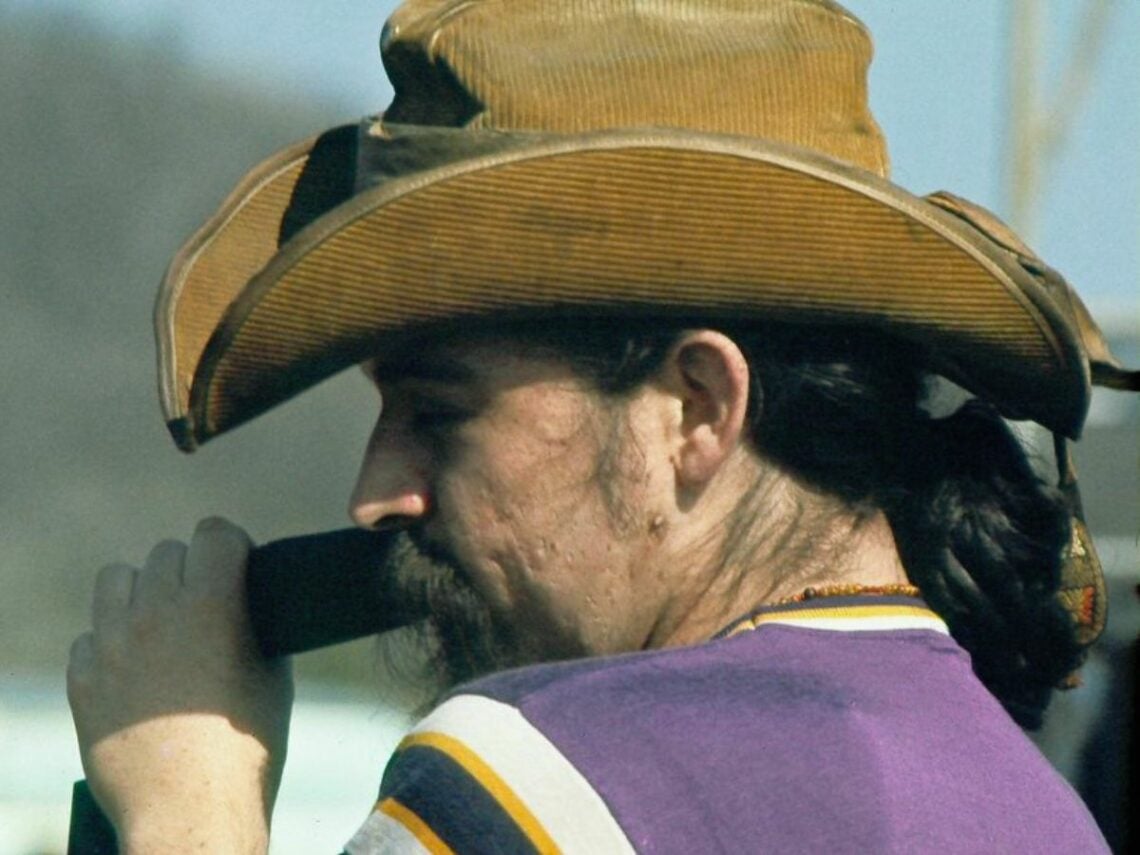
‘Pigpen’: The Grateful Dead solo album that never was

By 1972, three members of the Grateful Dead had released solo albums. Jerry Garcia was the first, putting out his debut Garcia in 1971. The following year, Bob Weir and Mickey Hart would each release their own solo albums, Ace and Rolling Thunder, respectively. But there was likely supposed to be a fourth studio album: one from keyboardist and vocalist Ron ‘Pigpen’ McKernan.
Pigpen was one of the founding members of the band, performing with Garcia and Weir in Mother McCree’s Uptown Jug Champions and inspiring the change from acoustic jug band music to electric rock and roll. Pigpen was a bluesman at heart, pushing the Dead to play classics from Slim Harpo and Jimmy Reed in their earliest days. Pigpen himself would often take the lead, singing and blowing on his harmonica.
As psychedelia began to take off in San Francisco, Pigpen was initially ready for the change. Although he never liked LSD, Pigpen switched his focus to keyboards and provided the band with a heady lead instrument that bumped up against Garcia and Phil Lesh. Pigpen still got his blues numbers, and the Dead began to make their name as San Francisco’s wildest rock group.
It didn’t take long for Pigpen to begin slipping away. As the band’s direction turned more experimental, Pig’s blues songs no longer had their place. Although he stepped up as the lead singer for songs like ‘Alligator’ and ‘Caution (Do Not Step On Tracks)’, Pigpen was lagging behind in terms of musical evolution. His dependence on alcohol over hallucinogenics separated him from his bandmates, and along with Weir, Pigpen was even fired for a brief period in 1968.
By the time the Dead reached 1970, they had burned out on psychedelic experimentation. Looking to return to their roots, the group wrote and composed acoustic material that eventually morphed into the albums Workingman’s Dead and American Beauty. Pigpen fit well in this setting, singing Robert Hunter’s ‘Easy Wind’ on Workingman’s and his only solo songwriting credit, ‘Operator’, on American Beauty.
1972 represented both the biggest peak and lowest valley of Pigpen’s life. Health problems began to wreak havoc on his ability to perform, but as the Dead were planning to embark on their 1972 European tour, Pigpen was determined to go. That was probably because he had a large collection of new songs that were ready for the stage.
Across 1969 and 1971, Pigpen had made very brief stabs at recording his own material. Although it doesn’t seem likely that there was any intention for a solo album during that time, the possibility seemed more real as his bandmates made plans for their own LPs in 1972. During the Europe 72 tour, Pigpen could be seen with a notebook at the side of his organ, likely filled with in-progress songs and lyrical fragments that were meant to be fleshed out.
It has never been officially confirmed, but it seems likely that had Pigpen stayed healthy, there would have been a real possibility that he would have recorded his own studio album. He certainly had enough material to make it happen, and chances are good that his bandmates would have encouraged him to do so. So what would this hypothetical solo album have looked like?
Most of the clues come from his final contributions to the Europe 72 tour. Throughout that tour, Pigpen would often trade off songs with Garcia and Weir during the first set, contributing equally as a third lead singer. As always, his songs were mostly covers, but there were a few original songs that had popped up in Pig’s repertoire during his final years.
At every single concert on the Europe 72 tour, the Dead played a new Pigpen song, ‘Mr. Charlie’. Co-written with in-house band lyricist Robert Hunter, the track was a jumpy blues rock number that let Pig embody the same old-timey spirit that he portrayed in his blues tracks. ‘Mr. Charlie’ eventually became Pigpen’s sole contribution to the final Europe 72 album, but it almost certainly would have appeared on a solo album as well.
Throughout the late 1960s and early 1970s, Pigpen began reviving some of his earliest blues covers. The Dead briefly played acoustic sets in 1970 and revisiting their folk roots got Pigpen back into some of his old standbys. Made famous by Junior Wells, ‘Next Time You See Me’ was first played by the Dead in 1966 and was put on the shelf during their psychedelic period. Pig revived it in 1969 and played it consistently all the way through the final show of Europe 72.
Another one of Pigpen’s go-to covers was ‘Good Lovin’. A number one hit by The Rascals in 1966, ‘Good Lovin’ represents the early days of the Dead as a party band, right in line with other contemporary classics that they would cover, like ‘Dancing in the Street’. Along with ‘Turn on Your Love Light’, ‘Good Lovin’ became the home of Pigpen’s famous raps, where he would improvise lyrics and talk directly to the audience.
Speaking of ‘Love Light’, there remains some debate as to whether Pigpen’s signature song would have appeared on a potential solo album. ‘Love Light’ was heavily associated with Pig, but it was also a song that came to life exclusively in the live setting. A song like ‘Good Lovin’ would have been an easy addition to a traditional solo album, especially one that replicated the more truncated style that the Dead were using for their studio work at the time. ‘Love Light’ likely wouldn’t have fit that mould, so it’s excluded here. Still, that’s not to say that Pigpen wouldn’t have insisted on recording a proper studio version of the track.
Pigpen was constantly working on in-progress music during the Europe 72 tour. One song that made the leap into the band’s repertoire was a song referred to as either ‘The Stanger’ or ‘Two Souls in Communion’. An emotional ballad, the track was a notable shift in Pigpen’s famously hardened and gruff exterior. Instead, the song spoke to his softer side, the one that friends and band members often saw. ‘The Stranger’ was played six times before the band went to Europe and only saw seven appearances during the tour, with only 13 total performances of the song.
When it came to rave-ups, it was hard to get any funkier than Otis Redding’s ‘Hard to Handle’. Reflecting Pigpen’s love of R&B, which can also be heard in the Dead’s version of Wilson Pickett’s ‘In the Midnight Hour’, ‘Hard to Handle’ gave Pigpen a chance to get loose along with the band. The track was out of the band’s live sets by 1972, but it seems almost impossible that Pig wouldn’t have at least taken a stab at it while collecting songs for his solo debut.
Of all the “lost” Pigpen songs in the Grateful Dead’s repertoire, ‘Empty Pages’ remains one of the most legendary. Performed just twice in 1971, ‘Empty Pages’ was a middle point between the emotional pleas of ‘The Stranger’ and the haunted gospel blues of ‘Death Don’t Have No Mercy’. As one of the few originals that Pigpen had written and played with the Dead, it would seem logical that ‘Empty Pages’ would have appeared on a Pigpen LP.
When Pigpen did his first solo recording session in 1969, he had some help. Garcia and Weir joined him in Mercury Studios (or Columbia Studios) along with fiddle player John Tenney. Together, they recorded a song of dubious origin called ‘I’m a Lovin’ Man’, which represented Pig’s ample expertise in the genre of country music. The notion that ‘I’m a Lovin’ Man’ could have appeared on a ’70s Pigpen solo album is probably unlikely, but as it stands, it’s worthy of inclusion if only to show that a potential solo project from Pigpen had been percolating for years.
Unlike most of his other blues material, Pigpen never stopped singing Elmore James’ ‘It Hurts Me Too’. From the song’s very first known performance in 1966 (and probably before) up to the final shows of the Europe 72 tour, Pigpen was consistently stepping up to the microphone to belt out ‘It Hurts Me Too’. It was the most frequent platform for his harmonica chops, and there isn’t any universe (parallel or otherwise) that wouldn’t have featured an attempt at ‘It Hurts Me Too’ for a Pigpen solo album.
The final original that Pigpen trotted out for Europe 72 was ‘Chinatown Shuffle’, an uptempo romp that was played at nearly every show on the tour (with the exception of the second night at the Empire Pool in London and the band’s performance on the Beat Club programme in Germany). A rollicking and sprightly boogie, ‘Chinatown Shuffle’, would have made the perfect ending for an album of pure Pigpen.
Of course, all this speculation became null and void once the band returned from Europe. After playing (but not singing during) one final gig at the Hollywood Bowl, Pigpen largely shut himself off from the outside world as his health continued to deteriorate. Based on statements made during their concerts, it seemed as though the Dead were fully expecting Pigpen to return once he regained his strength. Instead, on March 7th, 1973, Ron McKernan died at the age of 27 from a gastrointestinal haemorrhage not directly related to (but likely exasperated by) his alcoholism.
Would Pigpen have ever recorded a solo album had he stayed healthy? It’s impossible to know for sure: Pigpen was famously reticent to be seen as a rock star, and his lack of ego probably helped make his solo LP a non-starter from the get-go. But with a wealth of material and a singular quality that helped diversify the Dead experience, Pigpen likely would have made something great had he gotten the proper chance. Unfortunately, all we can do is guess what that would have looked like.
Pigpen solo album potential tracklisting:
Side A
- ‘Mr. Charlie’
- ‘Next Time You See Me’
- ‘Good Lovin’
- ‘The Stranger (Two Souls in Communion)’
Side B
- ‘Hard to Handle’
- ‘Empty Pages’
- ‘I’m a Lovin’ Man’
- ‘It Hurts Me Too’
- ‘Chinatown Shuffle’
