


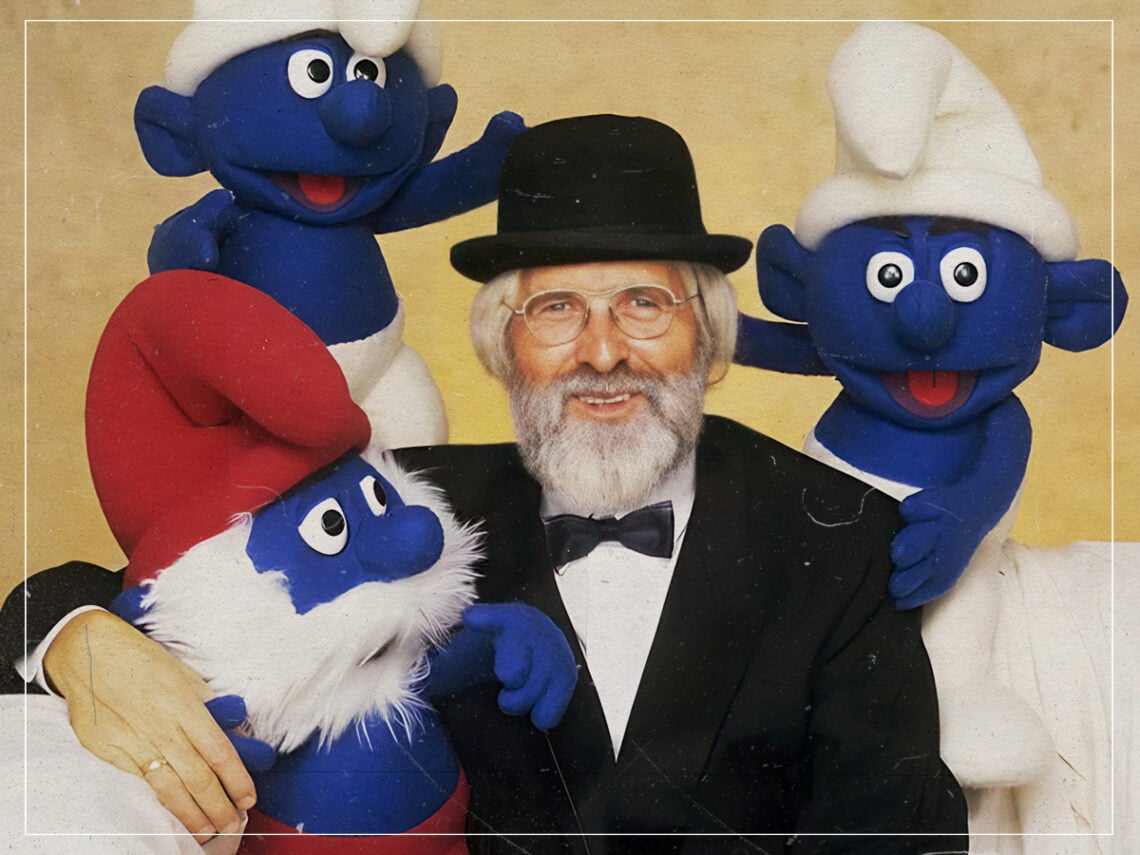
Pierre Kartner: the racist past of ‘The Smurf Song’ singer

The innocuous promotional song seems to be a relic of the past. A particularly fertile decade on this front was the 1970s, which was, as they tell us, a much simpler time. One of the most successful it produced was Pierre Kartner, better known as Father Abraham’s 1977 hit, ‘The Smurf Song’. A number-one in several countries, the track is famed for its easygoing Schlager style and the somewhat incomprehensible back and forth between the warmth of the musician and his tiny blue counterparts.
Reflecting just how questionable much popular music was back then, the track was kept off the top spot in the United Kingdom by Olivia Newton-John and John Travolta’s saccharine Grease duet, ‘You’re the One That I Want’. However, it broke the record for the most consecutive weeks in second place before it was equalled in 1991 by Right Said Fred’s ‘I’m Too Sexy’.
While the song was undoubtedly a highlight of many people’s childhoods, containing endearing conversational lines such as “Tell me why are Smurfs so small? / We’re not small, but you are tall”, it transpires that Father Abraham might not have been as amiable as his Dulcet tone, angelic white suit, beard, glasses and bowler hat suggest. Pierre Kartner was a right-wing nationalist.
Although the 1970s was the most fruitful time of Kartner’s career, he had committed to Dutch right-wing nationalism with his music. A terrible shame, this was underpinned by a tense social situation in the country due to an influx of overseas workers in light of independence movements and a shifting world.
It seems that out of all of the non-Dutch groups Kartner despised, it was the Arabs for whom he held a particular form of resentment. Reacting to the intensity of the 1973 oil crisis, Kartner teamed up with Farmers’ Party populist Hendrik Koekoek to record the duet ‘Den Uyl is in den Olie’ (Den Uyl is in the Oil). It blamed the social democrat prime minister Joop den Uyl and Arabs for the crisis, as the Netherlands was one of the five original countries the Organization of Arab Petroleum Exporting Countries (OAPEC) targeted with its embargo.
Then, in the midst of 1975’s carnival season, Kartner released ‘Wat doen we met die Arabieren hier’ (What do we do with the Arabs here?). Containing deeply racist lines such as “What shall we do with the Arabs here? They can’t be trusted with our pretty women here”, it openly voices the musician’s bigoted thoughts on his Arabian counterparts. An embarrassment to the record company, years later, they deleted the track from existence. It’s a wonder they released it at all.
However, it wasn’t just the Arabs that Kartner voiced his opposition to. In 1976, the year before he struck a markedly different tone with ‘The Smurf Song’, he released ‘Het Leger der Werklozen’ (The Army of Unemployed). This charming composition portrays the jobless as idle alcohol drinkers who waste their days in pubs – a classic right-wing sentiment.
Even well into old age at 67, Kartner wasn’t finished with his political efforts. In 2002, he recorded ‘Wimmetje gaat, Pimmetje komt’ (Wim goes, Pim comes) with the hottest right-wing prospect, Pim Fortuyn. This piece predicted that the politician could replace the left-wing Wim Kok as prime minister. However, Fortuyn was assassinated later that year.
Following this, in 2012, Kartner wrote ‘Beste Koning’ (Dear King) and in 2016, ‘Ik wil mijn gulden terug’ (I want the guilder back), with the latter a lament about the European Union. Despite his nationalistic music, he would not turn his back on Smurfland. In a display of the extent of his strange artistic reach, in 2005, he redid ‘The Smurf Song’ with the dance outfit Dynamite.
Listen to ‘The Smurf Song’ below.
