


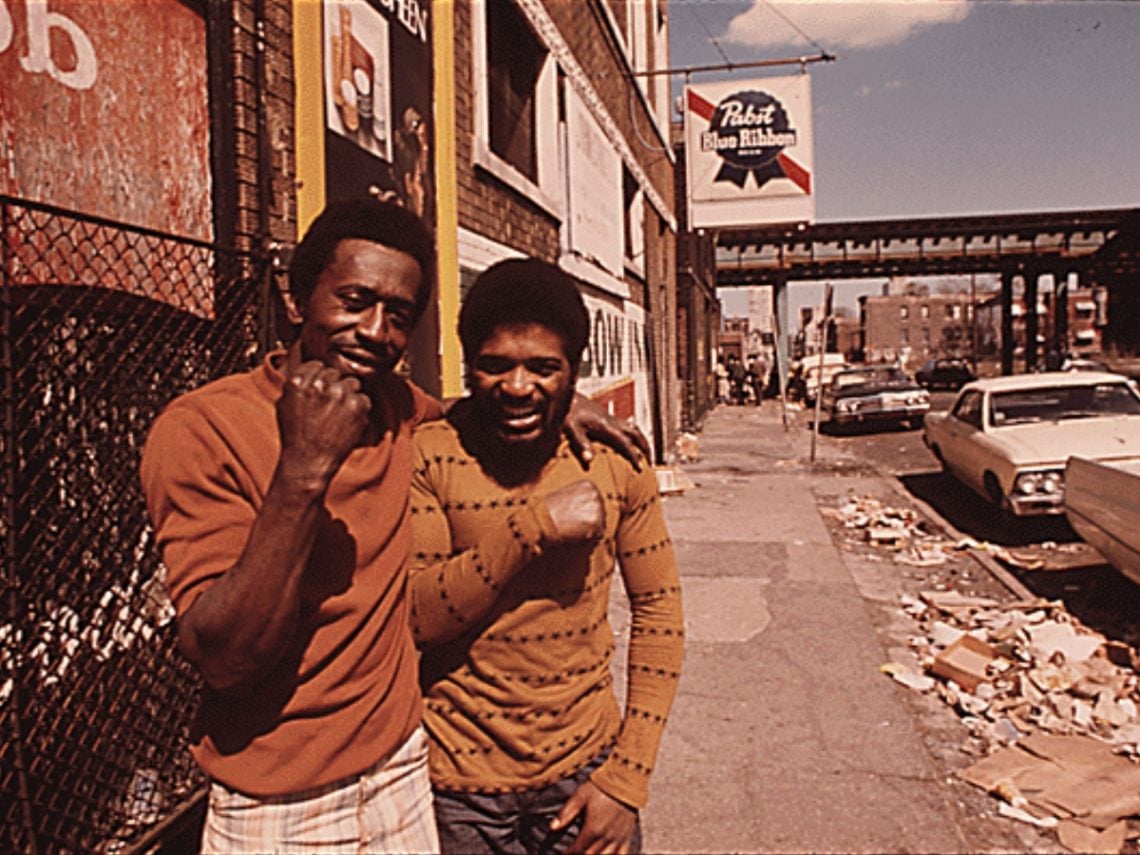
Exploring the hope and harshness of 1970s Chicago through John H. White’s photography

Over the 20th century, the US Civil Rights Movement saw gradual progress that blazed a trail of severe resistance and unspeakable atrocities. On January 1st, 1863, President Abraham Lincoln issued the Emancipation Proclamation, which declared that all persons held as “slaves” within rebellious states “are, and henceforward shall be free”. This was the first of a painfully slow reel of changes in perspective and moral values across North America, which moved faster in some areas than in others.
Entering the 20th century, African Americans were still perceived by many of their fellow white Americans as an inferior class. They were subjected to legislative segregation and limited resources, crucially in education and vocational fields. In the Southern States, discriminatory Jim Crow Laws ensured that the Black community was more directly and systematically disadvantaged.
Black communities found themselves predominantly marginalised by economic hardship in the poorer regions of major cities where high crime rates and unemployment fuelled a vicious cycle of dwindling prospects. By the 1950s, having endured nearly a century of segregation, discrimination, and unpunished acts of violence, stoic figures in Black communities began to rise up against oppression in the Civil Rights Movement.
By the early 1960s, hope was found in defiant leaders like Martin Luther King Jr. and Rosa Parks. Increased unity, confidence and white involvement in the cause saw a rise in boycotts, sit-ins, and nonviolent protests such as the 1961 Freedom Rides and the 1963 March on Washington for Jobs and Freedom.
In 1964, congress passed the landmark Civil Rights Act, abolishing segregation laws in public spaces and banning employment discrimination on the basis of race, colour, religion, sex, or national origin. In 1965, this was followed by the Voting Rights Act. The country had come a long way from the days of slavery, but a long, hostile stretch of road still lay before the Black communities of America.
Inching toward the 1970s, the assassinations of Martin Luther King Jr. and Malcolm X left a bitter taste on the palette of African American communities across the country. With economic oppression forcing a simulation of the pre-1964 segregation measures, the majority of Black people in major US cities found themselves confined to impoverished regions often labelled the ghettos.
As the Apollo 11 mission drove a star-spangled banner into the Moon’s crust in July 1969, 24.3 million people faced poverty throughout the United States. While the Civil Rights Movement had enjoyed giant leaps, the poverty rate for African Americans remained at around 31.1%, compared to 9.5% for whites. As with any journey, spirits rise with proximity to the destination, but nobody can be fully satisfied until the wheels are at rest.
Esteemed African American photojournalist John H. White was born in Lexington, North Carolina, in 1945 to humble foundations. During his school years, White recalls a teacher dowsing his dreams, telling him that he would grow up to work on a garbage truck with his apparent ineptitude for mathematics. His father, ever the guiding light, always told him to have the best in mind, to look for the best in others, and if he must work on a garbage truck, to ensure he was the driver.
White’s inspiration to pursue a career in photojournalism was ignited at the age of 14 when his local church burned down. His father, the pastor, assigned him the task of photographing the wreckage and the subsequent reconstruction of the building. The photographer has since fondly cited this as his first assignment.
After moving to Chicago in 1969, White worked as a photographer for the Chicago Daily News and quickly built up a reputation for his consistently evocative and socio-politically pertinent work. From 1973-74, he was commissioned by the Environmental Protection Agency’s DOCUMERICA project to photograph Chicago through the lens of its African American community on the South Side.
The project remains one of the most important of White’s career as he looked to communicate the unfiltered realities of Chicago’s African American community at a pivotal time in US history. The fruits of this salient project can be seen in the collection below.
From 1978 until his retirement in 2013, White worked at the Chicago Sun Times and was awarded the Pulitzer Prize for Photojournalism in 1982 for his “consistently excellent work on a variety of subjects.” White still teaches photojournalism classes today at Columbia College Chicago, having previously taught at Northwestern University.
View some of the most evocative photographs from White’s DOCUMERICA project in Chicago 1973-74 below.


