


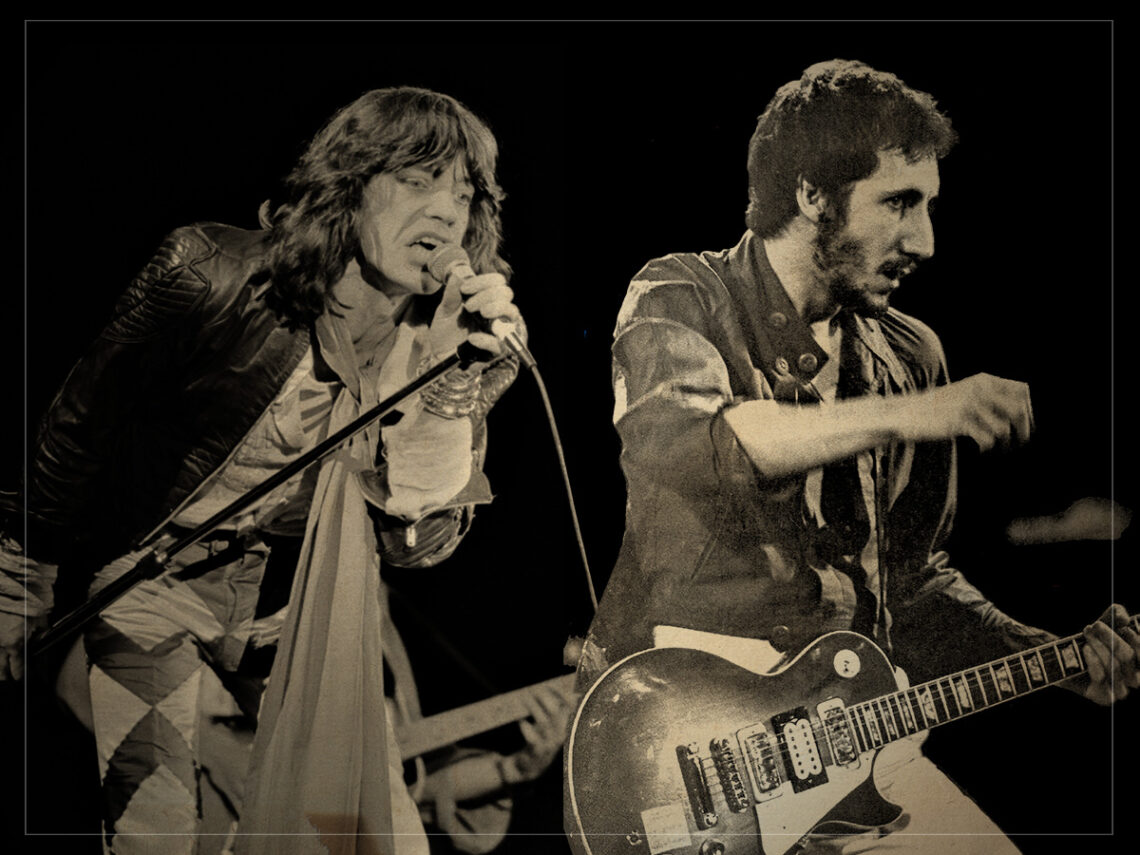
Pete Townshend believes The Rolling Stones never truly evolved: ““Mick himself would agree”

Some artists were born to evolve, and just as the first fish that crawled up onto land set off the chain reaction for the emergence of humanity, their musical innovations change the artistic landscape indefinitely.
There are also those, however, who are content to stay in their own corner of the industry, paying little heed to changing times and trends. For much of his career, Pete Townshend has straddled the fence between those two camps.
Back in 1965, when the first-ever 45 single by The Who hit record store shelves, Townshend’s songwriting mastery became immediately apparent. Not only did singles like ‘My Generation’ and ‘I Can’t Explain’ capture the spirit of Britain’s rebellious post-war youth and the fast living attitudes of the time, but a lot of The Who’s material – particularly on albums like The Who Sell Out – hinted at the guitarist’s artistic prowess, creating postmodern and pop art masterpieces which to this day are rarely given adequate credit.
One thing which Townshend did get credit for, however, was his ability to recognise that the 1960s weren’t going to last forever. While the vast majority of The Who’s early contemporaries stuck rigidly to that beat rock sound which had seen them command the hit parade of the mid-1960s, Townshend had a unique ability to look towards the future, shifting his focus onto ambitious and expansive rock operas and concept albums. In turn, albums like Tommy and Quadrophenia changed the game entirely, keeping The Who on top of the global rock scene for another decade.
Even after the tragic passing of Keith Moon – an event which The Who never truly recovered from – Townshend was still determined to evolve and develop into the neon hues of the 1980s. However, neither his solo material nor the few failed Who records recorded during that decade did much to bolster his reputation as a songwriter. In fact, it wouldn’t be egregious to say that they were pretty dreadful records, and aren’t looked back upon with much fondness by anyone, let alone Townshend himself.
Since then, The Who have seemingly committed themselves to endless farewell tours, greatest hits reissues, and cashing in on the strength of their 1960s and 1970s material. Sure, there have been subsequent album releases in the form of Endless Wire and Who, but they hardly challenged the quality of the band’s earlier work. So, how then does the artistic mind of Pete Townshend deal with what is ostensibly harking back to a period which ended half a century ago?
Speaking to Dean Goodman back in 2007, the guitarist shared his thoughts on that very topic. “My friend Paul Weller refuses to look back, and fights hard to stay in a new realm,” he cited. “I think maybe my sense of history itself, and the way it interpolates into my writing, makes the evolution of a piece, or a period, or a fashion we started, more intriguing.”
Townshend then took the opportunity to denounce his fellow 1960s heroes, The Rolling Stones, who, despite multiple attempts to reinvent themselves, are still best remembered for their earlier material. “The Stones are not a good eyeglass to use in order to study the evolution of pop and British post-war style,” Townshend declared, before somewhat self-righteously adding: “The Who are.”
“Mick himself would agree I feel sure, he’s something of a historian himself,” the guitarist continued. “I think Mick and Keith still love the music they discovered back in the ’60s. I love it too, but as much for where it led me as an ‘installation’ artist as for its beauty and soul.”
On the contrary, if you look back across the extensive discography of the Stones, you will find that the band incorporated much more in the way of new sounds, technologies, and genre conventions than The Who ever did, regardless of how successful those efforts were. From new wave to reggae, the Stones have rarely remained in one sonic place, even if their setlists are still largely stuck in 1965 – something which they have in common with Townshend himself.
