


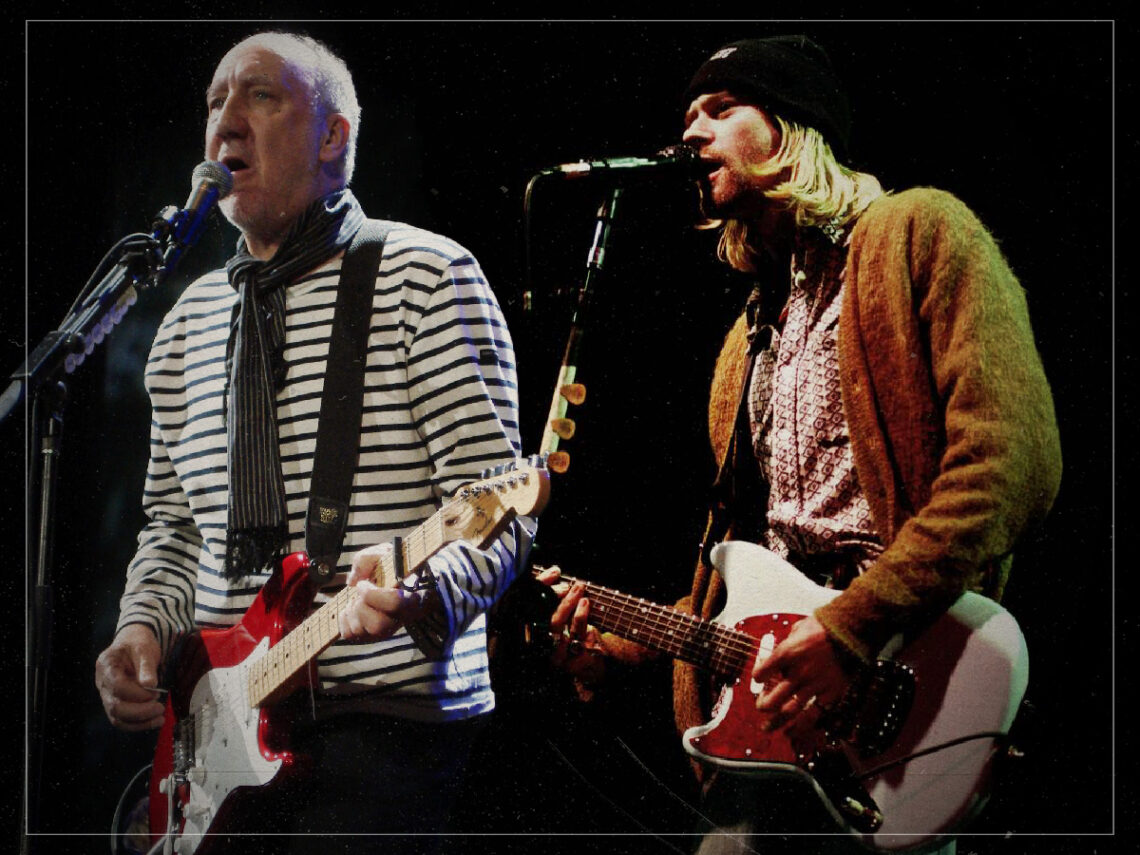
Pete Townshend always believed Kurt Cobain sent the wrong message

When the wailing, windmilling sounds of Pete Townshend and The Who first emerged from the mod nightclubs of 1960s London, they brought with them a message of youthful rebellion for an entire generation of Britain’s disenfranchised post-war youth – a message far nobler than many of the groups that have emerged in the decades since.
Rock and roll has always carried a message of some kind. Back in the 1950s, for instance, when rock made its first mark on the global airwaves, it represented an entirely new way of life for young people, separating them from the idea that their entire life should revolve around labour, and giving them the opportunity to flex their rebellious muscles. The Who were no different, and their uniquely amphetamine-fueled rock mastery helped to blow the cobwebs and grey skies from the rubble of post-war London.
That is not to say, however, that The Who’s message of hope and defiance always remained constant. Before too long, like many other rock titans of the 1960s and 1970s, they were elevated to another plane of existence, hailed as the kind of rock gods that will forevermore struggle to relate to the kids in their audiences.
Nevertheless, Townshend, from his position as a kind of elder statesman of rock and roll, still found himself disappointed with the prevailing message of rock as it progressed through the ages. While he was among the few figures of the 1960s who embraced punk rock when it rolled around, he couldn’t find much to be excited about when it came to the scene’s self-destructive tendencies.
“It is desperately sad for me to sit here, 57 years old, and contemplate how often wasteful are the deaths of those in the rock industry,” Townshend once declared, during a 2002 op-ed in The Guardian. The guitarist has certainty seen his fair share of rock and roll casualties over the years, most pertinently his bandmate and musical comrade, Keith Moon, whose famously anarchic lifestyle eventually caught up to him in 1979, at the age of just 32.
That particular quote, however, was written in response to Kurt Cobain, who, in his published journals, once wrote, “I hope I die before I become Pete Townshend,” a parody of The Who’s ‘My Generation’ lyric, “I hope I die before I get old.” Cobain, the likelihood is, was making a point about the rock establishment of which Townshend is a key figure, but in the end, his wish came true.
A 27-year-old Cobain tragically died in 1994, during a time in which Nirvana were at their peak, and his addiction to heroin was becoming increasingly crippling. It was years later when Townshend mused, “We find it so hard to save our own, but must take responsibility for the fact that the message such deaths as Cobain’s sends to his fans is that it is in some way heroic to scream at the world, thrash a guitar, smash it up and then overdose.”
Cobain’s death, along with countless others spanning the spectrum from Jim Morrison to Ian Curtis, did seem to romanticise the idea of living fast and dying young for swathes of audiences who entirely missed the point. Townshend is right; there was nothing particularly heroic or noble about the death of Kurt Cobain; it was a tragedy, and it likely did send the wrong message to his audience.
Then again, “scream at the world, trash a guitar, smash it up and then overdose,” wasn’t a million miles away from Townshend’s own output – so perhaps people in glass houses shouldn’t throw guitars.
