


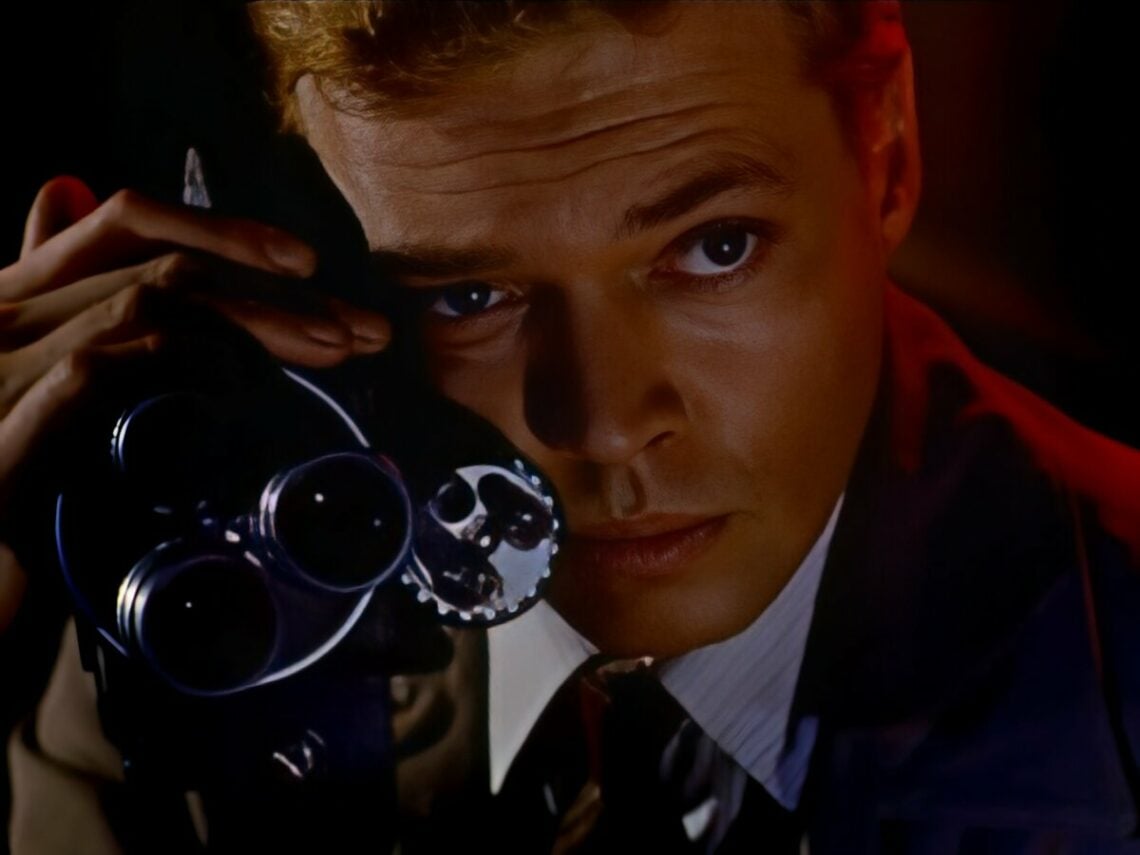
‘Peeping Tom’ and the voyeurism of the movie camera

Released back in 1960, Michael Powell’s classic film Peeping Tom serves as a landmark in the world of cinema. It made great strides into the deepest caverns of voyeurism, both as a theme within the narrative and also as a commentary of sorts of the medium of cinema itself. The British psychological thriller is a vital work that looks deeply into the unsettling yet alluring nature of voyeurism and asks questions about the power of the camera possesses.
Peeping Tom centres on Mark Lewis, played by Carl Boehm, a reclusive and somewhat shy man who works as a focus puller in a film studio by day and moonlights as a serial killer by night. His chosen weapon for his killings is a camera with a concealed dagger attached, and he uses it to film expressions of fear as he murders several helpless women.
The film examines Mark’s troubled mind and his obsession with capturing terror on film and works as a study of the inherently voyeuristic nature of the film medium. Mark’s camera is not only a tool; it’s also an extension of his desire and instinct as a predator. The camera’s lens – which generally serves as a window into the world – is subverted to become an object of harm and exposes Mark’s victims’ vulnerability.
Powell makes a potent commentary on the very act and art of filming and he puts forth the notion that the camera naturally transforms the audience into voyeurs by showing us lived moments that are not entirely our own. In Peeping Tom, the camera symbolises the power the person holding has to invade and expose the private lives of others, just as a ‘Peeping Tom’ does.
In his review of the movie, Roger Ebert also noted how the medium of cinema itself is wont to make audiences into voyeurs. He wrote, “The movies make us into voyeurs. We sit in the dark, watching other people’s lives. It is the bargain the cinema strikes with us, although most films are too well-behaved to mention it.” Peeping Tom, though, is indeed courageous enough to confront the voyeurism that cinema itself possesses.
When it was first released, Peeping Tom was met with widespread shock and criticism with some viewers considering it to be rather shameful and even perverted and Powell’s career thus suffered a considerable blow as a result. However, since then, the film has been reconsidered and is now recognised as a pioneering work in the psychological thriller genre. Its exploration of voyeurism, the gaze of the camera, and the darker side of the human psyche have earned it a well-considered place in the history of cinema.
Peeping Tom is a classic work of cinema that confronts the viewer with the unsettling reality of voyeurism, both within its narrative and through exploring just what it means to watch a film. Powell examines the duality of the camera, suggesting it at once a piece of technology for artistic expression and also an intrusive instrument, showing that cinema is not merely a form of entertainment. It is indeed a truly powerful medium that makes us confront our deepest and darkest desires and fears and asks us to consider the true meaning of the voyeuristic gaze.
