


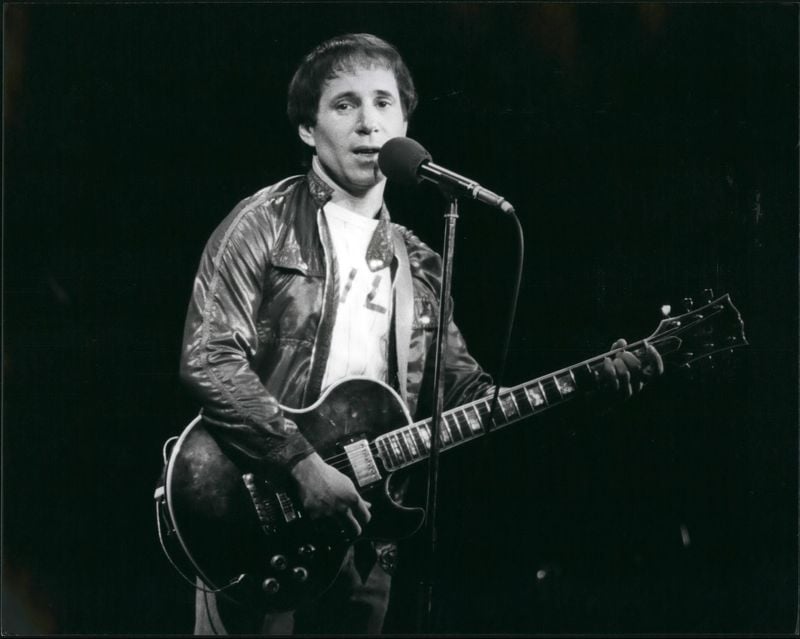
Paul Simon explains why he’s “second to Bob Dylan”

Though Bob Dylan was born and raised in Minnesota, his rise to fame as an aspiring folk artist depended on the bright lights of New York City. In the late 1950s, Dylan’s early infatuation with rock and roll artists like Little Richards and Buddy Holly made way for the more word-dense, acoustic stylings of folk.
This passion soon led him to New York City, where he met his idol, Woody Guthrie. Sadly, by the early-60s, Guthrie had been taken ill with the debilitating and congenital Huntington’s disease. The pioneering anti-fascist protest singer wasn’t without good company, though. Guthrie was joined at his bedside by his number one fan, who would play some of his folk covers and originals while gleaning as much wisdom as he could from the master.
Inspired by the age-old folk tradition, Dylan set about writing and recording, and by the time he released his second album, The Freewheelin’ Bob Dylan, in 1963, he was a world-renowned star. His early success owed most of its thanks to politically focused lyrics, which seemed to jump-start the imminent countercultural shift for which the decade is now famed.
Dylan subsequently migrated from the strict traditions of folk music as he pioneered folk-rock through the mid-60s – much to the disappointment of a few thousand folk purists at Newport Folk Festival. However, his early acoustic music struck a chord with countless aspiring musicians throughout the ’60s and beyond. One of the most prominent of Dylan’s first disciples was New Yorker Paul Simon, who modelled much of his early work alongside Art Garfunkel on Dylan’s early folk output.
Despite this early infatuation, Simon soon moved on to create his own sound and became irritated by Dylan’s domination. “I usually come in second to [Dylan], and I don’t like coming in second,” Simon told Rolling Stone in 2011. “In the beginning, when we were first signed to Columbia, I really admired Dylan’s work. ‘The Sound of Silence’ wouldn’t have been written if it weren’t for Dylan. But I left that feeling around The Graduate and ‘Mrs Robinson’. They [my songs] weren’t folky any more.”
“One of my deficiencies is my voice sounds sincere,” Simon continued, identifying some frustration over their differences. “I’ve tried to sound ironic. I don’t. I can’t. Dylan, everything he sings has two meanings. He’s telling you the truth and making fun of you at the same time. I sound sincere every time.”
Dylan and Simon joined each other for a tour in 1999, but when the latter requested the former to record a duet for ‘So Beautiful Or So What’, he apparently didn’t get a response. “I thought Bob could sing, put a nice voice on the verse from ‘So Beautiful Or So What’ that begins: ‘Ain’t it strange the way we’re ignorant/ how we seek out bad advice,'” Simon told Uncut in a 2011 interview. “I thought it would be nice if he sang that, since his voice has become so weathered, I thought he would sound like a sage. I sent it to him, but I didn’t hear back. I don’t know why.”
Hear Paul Simon’s ‘So Beautiful Or So What’ below.

Never Miss A Tale
The Far Out Bob Dylan Newsletter
All the latest stories about Bob Dylan from the independent voice of culture.
Straight to your inbox.