


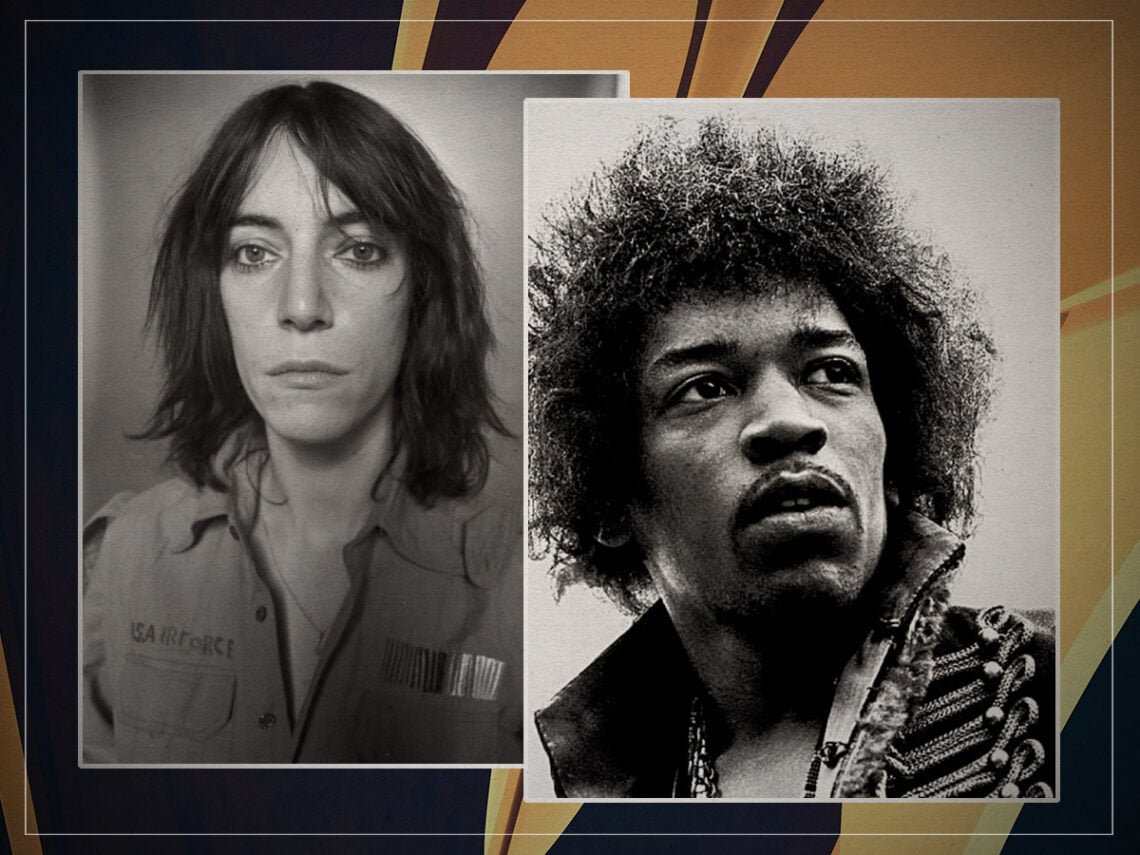
A heiress and a homage: Patti Smith’s reworking of ‘Hey Joe’

Everything in Patti Smith’s life led up to one moment.
She’s heard formative early records. She’s run away to New York. She’d watched The Doors perform live, having that first inkling that maybe she could do that too or at least she’d like to try. She’s embedded herself in a social scene of rock stars and writers, starting her poetry night and thinking maybe that would be enough, but no. Everything in Patti Smith’s life led up to one moment: November 1974, her first single.
It felt perfect because it was. Years prior, when Smith was beginning to become more embedded in the music scene, getting invited to the opening party of Jimi Hendrix’s studio, Electric Lady, she had a chance run-in with the man himself, one of her musical heroes.
“When I got there, I couldn’t bring myself to go in,” Smith wrote in Just Kids. Stuck outside and shy, Hendrix appeared. “When I told him I was too chicken to go in, he laughed softly and said that contrary to what people might think, he was shy and parties made him nervous.”
But Hendrix would die in 1970, a further loss that Smith would have to navigate in a period where all of her heroes seemed to be getting wiped out, one by one, to misadventure. It made her hyper-focused not to do the same and to make something for herself before then.
Four years later, that moment would come. In 1974, after finally taking the jump to making music and accepting that maybe all along that’s what she’d be moving towards, she returned to Electric Lady, now as the artist. “Before we started, I whispered ‘hi Jimi’ into the microphone,” she wrote, a simple way to reconnect with a hero who gave her bravery. She was there to honour him in two ways; the first was simply by being bold as he told her to at that party, and the second was by choosing to cover his song ‘Hey Joe’ for her first ever single.
But Smith’s version of ‘Hey Joe’ isn’t a straight cover. “The Patty Hearst kidnapping dominated the news that spring,” Smith wrote of where her head was at then. It was a famous case. Hearst was basically an heiress, a member of the family that dominated the publishing industry, but first earned their fortune in mining, meaning that they were very, very wealthy. In 1974, she was kidnapped by the Symbionese Liberation Army, and Smith, with a childhood fascination with cases like this, was hooked on every update, especially when Hearst was later caught on tape pledging her allegiance to her captors.
For Smith, this was inspiration, and with the words Jimi Hendrix had already written, her pen was ready. Smith’s ‘Hey Joe’ combines the two, asking Hearst directly, “And now that you’re on the run, what goes on in your mind?”
While Hendrix’s original is a song simply about violence and guns, Smith’s take is more complex, connecting the dots between these two odd chases, united only by conflict but from two polar opposite sides.
