


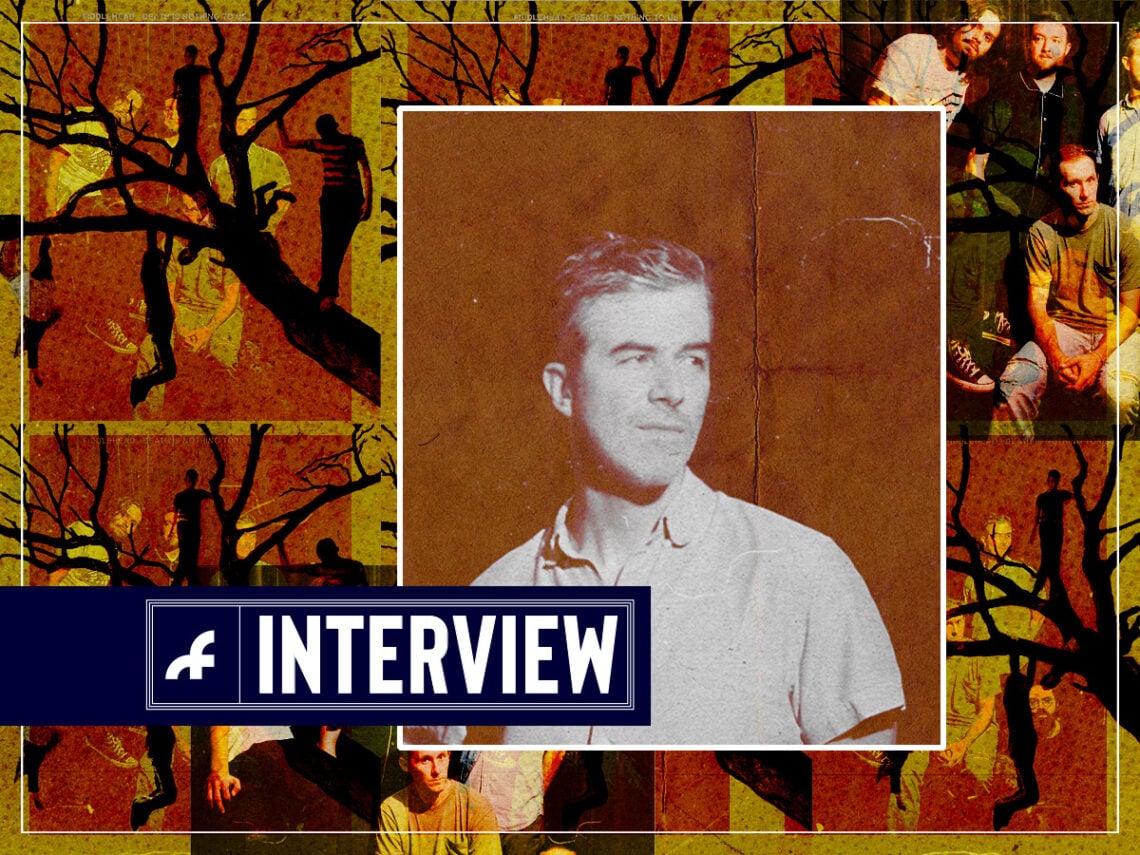
Patrick Flynn discusses the new Fiddlehead album, Have Heart, and the nature of life

Establishing himself as the frontman of seminal hardcore outfit Have Heart, Patrick Flynn now leads another group shaping up to be equally, if not more vital: Fiddlehead. Whilst their musical styles might differ, with Have Heart more aggressive than his current supergroup, there’s a common thread that unites them: the shared penchant for pushing the boundaries of their ostensible genre.
However obvious it might seem, the vocalist and the force of his performances play a significant role. With Have Heart, Flynn transcended the hardcore genre by delivering profound personal messages, and with his current group, he continues to provide such moments, but with increased emotional weight.
This time though, it’s atop a more diverse musical backdrop, pulling from a broader range of areas, not confined by any rigid sense of genre. Of course, Have Heart railed against some of the traditional hardcore tenets, but they still fit into that category. With Fiddlehead, it’s different; they’re certainly a punk band, but they’re tapping into the non-hardcore areas that Have Heart flirted with on a much grander scale. Regarding the frontman’s current form, you could say that the group features a more uninhibited version of his artistry.
Flynn has entered a new domain with Fiddlehead, with the heightened profundity of his lyrics underscored by a tweak in his approach to vocals. Although his delivery is now more melodic, it still packs a punch, and with his poetry at its most exhaustive yet, there’s a solid argument that the music is also now more affecting than it was. Whilst the previous two Fiddlehead albums are stellar, the band has refined their craft on their latest offering, Death Is Nothing To Us, which arrives on August 18th. Together, the band have constructed an album that fuses their respective influences and the emotional intelligence that has always made Flynn so compelling, capturing the ephemeral nature of life in all its forms.
Incisive tales of fatherhood, life, love, death and grief are told, ballasted by the verses of Roman poet Lucretius and the frontman’s breadth of real-life experiences. In addition to the music, which is more dynamic than ever, this batch of 12 songs pierces so immensely that as the last notes of the record ring out, you can’t help but feel incredibly seen, despite the music and lyrics being specific to the band’s own being.
I caught up with Flynn during his summer vacation. For the uninitiated, alongside being a widely influential figure in modern punk, Flynn is also a high school history teacher. It was late morning for him. His wife was mowing the lawn, and his two young children were busy watching television, so he had all the time in the world. “We don’t really watch a lot of TV, but my kids love it when I have to do an interview because it’s TV time for them… happy to meet,” he says.
After a slight mix-up with the time difference, Flynn mentions that he had recently discussed setting up an interview with someone in India. They conceded that the only time they could talk would be his midnight. This might normally have been an issue, but he wasn’t working in the school the next day, so he said, “Let’s just roll with it”. This was an exceptionally on-brand approach. After all, Have Heart toured the world, veering off hardcore’s beaten track in countries such as China and, most famously, playing for a school in South Africa.
“Yeah,” Flynn responds, “I think my years of playing music pretty relentlessly created a dexterity of just a rolling with the punches type of thing, making it work for people”. This angle prompted a reflection on his late father’s approach to life, which he deems similar to his own. However, the senior Flynn’s attitude was also influenced by the experience of being in the Vietnam War. Partaking in such a terrible conflict brought its specific characteristics, he notes.
Regarding his father’s approach to the day, Flynn continued: “But when it came to, like, existing in the day-to-day… If he could turn the air conditioner on when it was hot, he would turn it on. My mother would be like, ‘It’s not that hot.’ And he’d be like, ‘Oh, really? Well, last I checked, we have an air conditioner. Let’s use it.'”
Naturally, this attitude rubbed off in some areas. Relating this to himself, the Fiddlehead frontman said: “And so, like, I can sleep on the ground if I have to. But if I don’t have to, I want to be as fucking comfortable as I possibly can be. Because, for about seven years, I was sleeping in cars and on the ground. Seven years of doing that kind of scarred me to the point where it’s like, if I can be comfortable, I’m going to be comfortable.”
He added with a laugh: “If there’s a pillow over there, if the aeroplane has an extra pillow – give it to me.”
It might come as a surprise to hear such words from Flynn, but he’s not the youth that burst onto the scene with Have Heart. He’s older now and a husband, father, and teacher. His experiences since he broke out with the New Bedford band, not to mention losing his father, have impacted him tremendously. Together, these have fuelled the more intense maturity in his work with Fiddlehead, which is particularly apparent across Death Is Nothing To Us.
I wondered if this newfound predilection for comfort translates to when Flynn tours with Fiddlehead. “Yeah. It’s a slight issue now with Fiddlehead because we’re not a full-time situation,” he concedes. Notably, the band rarely participates in full-length tours due to the confines of Flynn’s job and members being in other groups, such as guitarist Alex Henery plying his trade in Ipswich’s Basement.
He explains that there was a “different drive” with Have Heart. As they were so young when they formed in 2002, part of their motivation was more in-line with the typical punk one of wanting to push the limits of where they could take themselves in the world through music – without wealth or financial privilege. They knew it was a “remarkable way” to see the globe, and given their situation – with the green trappings of their age a significant part of this – it didn’t matter if they were sleeping on floors. Unsurprisingly, Flynn is past that now. “I would say it’s a slightly less intense approach to travelling. With Fiddlehead, there’s less of the see where we can go based on just music,” he posits.

This doesn’t mean that Fiddlehead isn’t as genuine, however. They have other motivations, and they’re just as valid. Whilst travelling to new places is still a big part of it for Flynn, he explains that the live experience is what they’re really concentrated on. Making it as impactful as possible is the ultimate goal.
“Lyrically, it’s pretty intense material. It’s really about making those 45 minutes as filled with as much gravity as possible,” he explains. “And it was in the case of Have Heart; the shows had to be super intense, but it was made that much more intense because we were sleeping on cockroach-infested floors to get to the stage. But with Fiddlehead, the lyrical content is different than what it was with Have Heart, and so, to me, the stage time is that much more precious. The connective tissue between every member of Fiddlehead is really strong – we’re as tight as we can be. The point is that the five of us really want to connect on stage. We could have a set where not many people in the audience go off, but if we really felt it, that’s the mark of a great set. This is a long and drawn-out way of saying, if travel headaches get in the way of the live experience, to me, that’s the big tragedy.”
That’s the logic of a man with a wealth of experience being in bands and touring. “If we play too much, it might rub things a little bit raw from overuse. For me, it’s really important that everyone is rested. We get to the stage, and it’s not a chore. We’re not tired. We’re not dealing with internal attitude issues because we’re tired, because we’ve been playing too much. When morale is high, I think it can increase the chances of the live setting really connecting,” he adds.
Does Fiddlehead actually represent Patrick Flynn at a different stage in his life, then? “I think that’s about right,” he responds. “I’ve seen how those physical constraints can get in the way of the performance and the live experience.” Broadening the point’s scope, he said this is something he and close friend Ned Russin of the widely influential Title Fight agree upon. Even though he doesn’t know how shared this philosophy is outside the pair, he maintains that the live experience makes the music “totally worth it to us”.
The Fiddlehead frontman said: “I remember we were talking about the importance of how some people write music – like they tour to support the music. And this is a Fugazian, Ian MacKaye-style thing. But, the music becomes really special and unique in the live experience when you can tell it was to support the tour and the experience. And so, when Fiddlehead is writing, to me, it’s not simply just about how it translates to the listener on their headphones when they’re by themselves. But it’s very much, ‘How does this create gravity and atmosphere live?'”
He continued: “So, we’re making certain moves on certain songs, especially on this new record. That’s the cool thing about when bands do play out and tour. There can be an evolution brought on by a kind of unspoken, implicit conversation between the artist and the audience – not so much in terms of like, ‘Oh, they like this’ – but trying to make sense of a moment that is really indescribable, but undeniably impactful, and seeing how that translates. I always struggle with finding the right words to get there, and I think it’s fine that I can’t because there’s a magic to it. Some people don’t like to make musical writing decisions based on the audience.”
Maintaining that he wasn’t “telling tales out of school”, Flynn used his friend Ian Shelton of Militarie Gun as an example of not necessarily writing in the same way he does. As Shelton’s made clear in interviews, he’s got a pile of material already complete following their debut album, Life Under the Gun, which arrived in June. Following this, he tells me that the new Fiddlehead record is not just a gauge of what the people want but also a response to how they feel playing songs live – as well as a chance to fill in any musical holes. There’s no wonder, then, that Death Is Nothing To Us feels like the most distilled version of Fiddlehead and why each release from the group has felt like a building block.
Moving on to the origins of Death Is Nothing To Us, Flynn revealed that Fiddlehead started writing the music for the new album during the pandemic. Their second record, Between the Richness, was supposed to come out in May 2020 but was shelved for a year due to the pandemic wreaking havoc. Nevertheless, Flynn had just bought his house, which happened to have a barn. As none of the quintet were working on anything at the time, and everyone was still living in Boston, they met up frequently to write. “The great thing about this band is that when we come together, it’s never been faster in my entire life in terms of songwriting,” he says.
The conversation was a wide-reaching one. At one point, Flynn provided a clear example of how he has always trodden his own path in music. He explained that the Have Heart classic ‘Unbreakable’ from 2006’s debut, The Things We Carry, was written about his grandfather. What is the significance of this? In hardcore, writing about family was not popular at the time.
Ironically, despite being such a bold move, he admitted he has “no idea” why he chose to write such a personal song. However, he knew he liked it and wanted to explore more of this area. Flynn recalled that after the album had arrived, Have Heart played a show with fellow straight-edge outfit Down to Nothing in Richmond. The other band’s drummer, Daniel Spector, was so impressed by the track’s lyrical content that he informed the opposite vocalist: “I just want you to know I think it’s really great that you wrote a song about your grandfather,” or something along those lines. After this moment, Flynn felt he was onto something as more people praised his efforts.
Noting what makes hardcore and punk so unique, he asserted: “Hardcore and punk are not this pure ‘always go the way of the art’. And it’s not just about listening to the audience. In my experience, there’s a fine line to walk in acknowledging the importance of both, and you can’t cast out the other one. That’s a mark of complexity that I struggle to find in any other musical genre.”
“I have pretty eclectic tastes, contrary to popular belief. I’m not sitting around listening to Ten Yard Fight,” Flynn jests about his palette’s scope. He says much of this is due to the influence of his brother and sister, who he credits with helping him develop a broad taste outside of hardcore – something he feels very fortunate for. His siblings introduced him to the likes of Scratch Acid, Yo La Tengo, Nirvana, Sonic Youth and Weezer, and they all affected his musical development.
“Just hearing like discordant elements, it’s very subtle and strange…not that Weezer is the most obscure band,” he begins explaining how his development unfolded. Taking us on a whistle-stop tour of the history of Rivers Cuomo’s group, Flynn noted the splendour of their first two albums. Weezer blew up due to the verve of their 1994 self-titled debut. Then, they surprised everyone when they came out with the 1996 follow-up, Pinkerton, a record the Fiddlehead frontman describes as “the polar opposite” of its predecessor, and he’s not wrong. The Fiddlehead frontman remembers that Weezer were essentially “persona non grata” after they released their bleak second album, with it panned by critics and fans alike. However, his sister loved it, and so did he, and he found himself drawn to it more than their debut.
“It’s raw. It sounds like they just came in and plugged in. There’s essentially a complete ‘fuck you’ to anybody who would have liked the polished, bright-sounding release in the name of, ‘Hey, we’re trying to write what we like.’ To me, it’s a triumph.” Despite their differences, the first duo of Weezer albums are victories of humanity in Flynn’s opinion – “they’re just two perfect records”.
Relating this to Have Heart, he noted another classic by the band, ‘Watch Me Rise’, and its extended breakdown. He revealed that when they wrote it, he referenced Weezer’s ‘Only In Dreams’ from their debut and ‘Wind Below’ from Rage Against the Machine’s 1996 effort, Evil Empire. That might sound relatively innocuous, but when the band wrote it circa 2005/2006, it was not “cool” in any way, shape or form as a hardcore band to be inspired by “quote-unquote mainstream stuff”.
This didn’t matter, though. The lessons Flynn learnt growing up with a brother and sister that showed him music outside of hardcore proved pivotal. These were “records that don’t give a shit and really go towards what sounds good and what compels the human spirit”.

This brought us to one of the most critical junctures in the conversation: “The lesson I learned was, ‘Oh, the rules, these sonic sound rules of hardcore, those aren’t what makes punk and hardcore punk and hardcore.’ It’s really taking the rules, breaking them and creating something compelling – without this goal of fame and glitter.” It was a vital point that spoke to why hardcore is having such a prominent moment at present, with bands such as Turnstile pushing the traditional boundaries of the genre and reaping the artistic, critical and, ironically, commercial awards.
For one final point, early on in the conversation, Flynn had grabbed a book from his shelf. Yet, due to the meandering nature of the discussion, we hadn’t gotten around to it until the very end. “One last thing, I remember why I got this book out,” the Fiddlehead man says. It was 2011’s Pulitzer-winning The Swerve: How the World Became Modern by Stephen Greenblatt. It is a complex work that follows the story of the 15th-century papal emissary Poggio Bracciolini. He rescued the last copy of Roman poet Lucretius’s On the Nature of Things from near-terminal neglect in a German monastery, which Greenblatt argues, reintroduced important ideas that sparked the Renaissance and, thus, the modern era.
You might be wondering where this is going. Yet, a line in it says, “Death is nothing to us,” with Lucretius writing at a time when control was exerted through fear and death. In the opening pages, Flynn tells me that Greenblatt writes about how his grief-stricken mother, who was mourning the death of her husband, was kept in a paralytic state by grief, and while he was observing his parent in this condition, he found the poem by Lucretius which struck him. The Fiddlehead frontman found this fitting, given his own experiences and the essence of the line.
The book found its way into Flynn’s possession by pure chance. This was at the history department’s book swap in December, on the final school day before winter break. He thought, “Oh, I’ll check this out.” At the time of receiving it, he was finalising the lyrics for the new Fiddlehead record and was trying to stitch everything together for it. Then, he happens across the line, “Death is nothing to us,” which he describes as an “amazing little cherry on top”. After mulling over the significance of the line further, he sent it to Alex Henery and the rest of the band, who all agreed it had to be the album’s title.
“It’s totally different from our two other records in that our other records aren’t really clauses – this is just a statement,” he explains. “It was the perfect framing of what would become a type of lyrical mission for the band. In hindsight, what I’ve been striving for is not to be broken by the forces of grief. A statement like ‘Death is nothing to us’ is really not disparaging loss either; it’s saying life is where this is at.” The message of this line, in addition to the David Whyte poem Everything is Waiting for You, which he discovered early one morning when his son was born, “totally intersected” for Death Is Nothing To Us.
Flynn concludes: “So, that was the cool thing I’ve tried to go towards. It’s not how the world gives out signals and speaks to us, but to observe it closely, to see the fortuity, you could say, of randomly coming across this book at a book swap. I was like, ‘I think I’ve got to run towards this; there’s poetry to it.'”
‘The Wheel of Life’, the haphazard nature of being, whatever you want to call it, Patrick Flynn and Fiddlehead capture something incredibly fundamental on Death Is Nothing To Us – the essence of life in that it is worth living. A culmination of all their previous efforts and experiences, it’s fuelled a masterwork and another chapter in an already compelling story. Encapsulating what it’s all about, I’ll leave you with this portion of lyrics from lead single ‘Sullenboy’: “I got fire, I got light / They’re three feet tall and they smile bright / Their day is young and their future’s wide / And I’ll die before I don’t help them rise”.
