


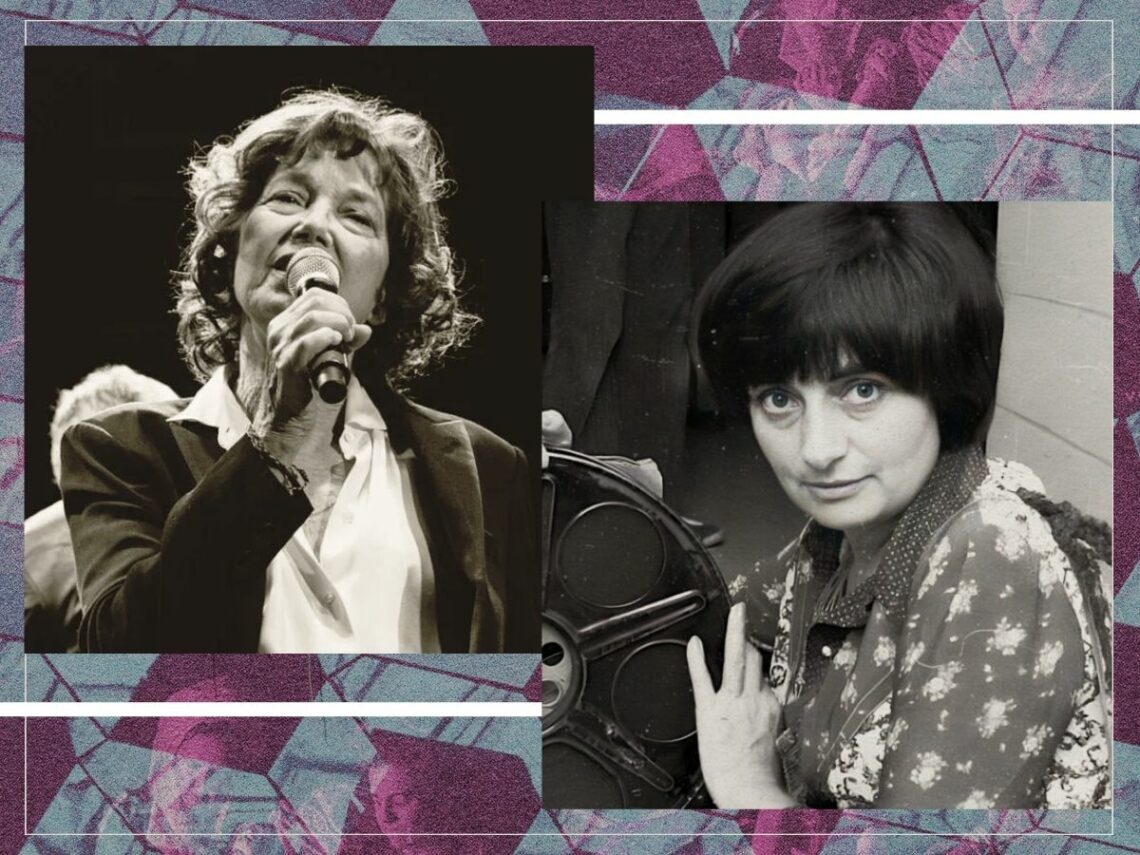
Inside the fruitful partnership between Agnes Varda and Jane Birkin

Before François Truffaut or Jean-Luc Godard had even made their first feature films, leading them to be declared the heroes of the French New Wave, Agnes Varda made La Pointe Courte. Her debut feature emerged in 1955, with the filmmaker using her background in photography as a starting point due to the fact she’d hardly seen any movies. Yet, within a few years, she’d become one of the most important figures of the nouvelle vague, making acclaimed movies like Cleo From 5 to 7 and Le Bonheur.
With politically-charged short films like Black Panthers and Women Reply emerging between bigger and equally socially-conscious features like One Sings, The Other Doesn’t and Daguerréotypes, Varda asserted herself as a filmmaker interested in uplifting the voices of marginalised people and exploring taboo issues. Her interest in feminism informed much of her output, and it served to inspire two movies made in collaboration with Jane Birkin.
The actor and singer grew up in London, soon marrying the older composer John Barry when she was just 18 and giving birth to a daughter, Kate, shortly after. Even though she was shy and insecure, Birkin had grown up around people involved in the industry, and she was attracted to it herself. Her marriage to Barry was marred by his infidelity and what seemed to be a lack of interest in her, leading her to feel incredibly unwanted.
Thus, she appeared nude in Blow-Up to prove to him that she had the guts after he said she didn’t – one of several instances in which the young Birkin made decisions that were predominantly down to feelings of insecurity. This was also the case when she began dating Serge Gainsbourg and only agreed to sing ‘Je t’aime… moi non plus’, a song he’s written for Brigitte Bardot, because she was jealous. She told Interview Magazine, “I said yes because I didn’t want anybody else to be singing it. […] I said, ‘Yes, yes, of course,’ just out of loving him and being scared stiff that he would be with some beautiful blonde.”
Still, she became an icon of the swinging sixties before being adopted by the French, appearing in movies like La Piscine and Don Juan, or If Don Juan Were a Woman. Birkin honed a successful music career, often duetting with Gainsbourg, but by the 1980s, she was getting fed up with the demands of performing. She decided to cut her signature hairdo and dress simpler, revealing in the same interview, “When I decided to sing for real at 40, I cut all my hair off and dressed up as a boy. I realized then that I was fed up with the rather sexy image that I’d played along with.”
This is where Varda enters the picture. “I’d been to Agnès’s house and met her a few times but I only really got to know her after I wrote to her about the film Sans toit ni loi, starring Sandrine Bonnaire, about a girl tramp, to ask who was responsible for this heartrending film. Agnès rang me to say she couldn’t understand a word I’d written because my handwriting was so bad and suggested we meet so I could read her the letter.”
When the pair met, they drafted out an idea for a film about Birkin, and this became Jane B par Agnes V. Released in 1988, the essay film explores the singer’s fears of aging as she hits 40, with Varda reassuring her that her life is far from ending. She places her in various scenarios, dressing her up as everyone from Joan of Arc to a woman from a classical painting. Varda says at the start of the film, “It’s a surprise portrait, in which Jane plays many roles, including herself, with a variety of partners. She was a good sport. She was funny, strange, magnificent, moving. It’s variations on a variable and varied woman.”
With this film, Birkin allowed herself to come face to face with her fears of getting older, freeing herself from the shackles of perfect beauty – exactly what she was known for in the ‘60s – and indulging in various fun and thought-provoking characters. Varda is the perfect guide, bringing something out of Birkin that she’d never shown before. It’s a vulnerable performance, using the portrait as a tool to explore the relationship between the director and the subject as well as just Birkin.
Using her subjects as a way to reflect upon her own creative process is something that Varda always did well, harnessing an engaging, self reflexive style by narrating her work and describing the difficulties she might have experienced along the way. So, not only does the film act as a form of portraiture, it’s also, in essence, a film about the act of filmmaking itself, bringing attention to the very nature of cinema’s artificiality.
After years of singing songs written by Gainsbourg or starring in many films that treated her as a sex object, Jane B par Agnes V feels like a true representation of Birkin’s unfounded potential and magnitude. Here she is totally herself – well, as far as she’ll let herself be while in front of the camera – and it’s joyous to watch.
While they worked on the film, Birkin tapped into her creative impulses perhaps more than ever before, because the result was her first screenplay – Kung Fu Master!. The film, which follows Birkin’s character, Mary-Jane as she falls for a 14-year-old boy, confronts the audience with a very uncomfortable narrative, but one that only Birkin and Varda could handle so eloquently. Highlighting Mary-Jane’s extreme lengths to recapture an essence of youth, the film sensitively tackles a controversial theme, and it remains the most daring thing Birkin ever did, forget her moaning on ‘Je t’aime…’.
It seems like this was a creatively enriching period for both parties, and these films offer up a side of Birkin that feels completely honest and unflinching. The pair cemented a true friendship, which lasted until Varda took her last breaths, with Birkin telling the Guardian: “I was with her the night she died. Her daughter Rosalie called and said she wanted to say goodbye to all the people she loved and who loved her, so we gathered at her home. She had the most marvellous end of life. If anything she was more loved, well known, honoured and celebrated in old age than ever before.”
