


‘No Other Choice’ movie review: Extreme but effective satire

Biting satire takes on the modern workplace in Park Chan-wook’s slightly unhinged comedy-drama, No Other Choice.
Park, multi-award-winning director of Oldboy, The Handmaiden, TV mini-series The Sympathiser, and Stoker, has produced a film that gleefully mocks corporate progress and job competition, placing bleak real-life scenarios beside fictional excesses as if daring us to see a difference.
It shares some of the comedy/horror/crime features of Bong Joon Ho’s Parasite, and the lighter satire found in Mike Judge’s Office Space, but with a flavour all its own. The script was adapted from Donald Westlake’s 1997 novel The Axe, by Park and a team of writers – originally co-written in English with his former collaborator from The Sympathiser, the very talented Don McKellar, then rewritten in Korean for the final version, set in South Korea.
Protagonist Man-Su (Lee Byung-hun of Squid Game) is introduced as a man living a perfect life. We are given a self-satisfied tour of his family’s luxurious home and impressive amenities, displayed in the manner of an upbeat TV commercial. Years of affluence and happiness end suddenly when the company that employs him is bought by an American firm, which immediately begins downsizing, and he is fired.
Confident of being able to find a new position quickly, Man-Su begins applying, but finds that most workplaces have reduced staff, and he is in a bitter competition with a growing number of unemployed office workers. He endures laughably dreadful interviews and a ridiculously useless unemployed support group, whose confidence-building mantras are often heard being muttered by the crowds of hopeless job-seekers. Months pass, and his wife Miri (played by South Korean superstar Son Ye-jin) stoically copes with their dwindling funds in an increasingly passive-aggressive manner, as they resort to selling their possessions.

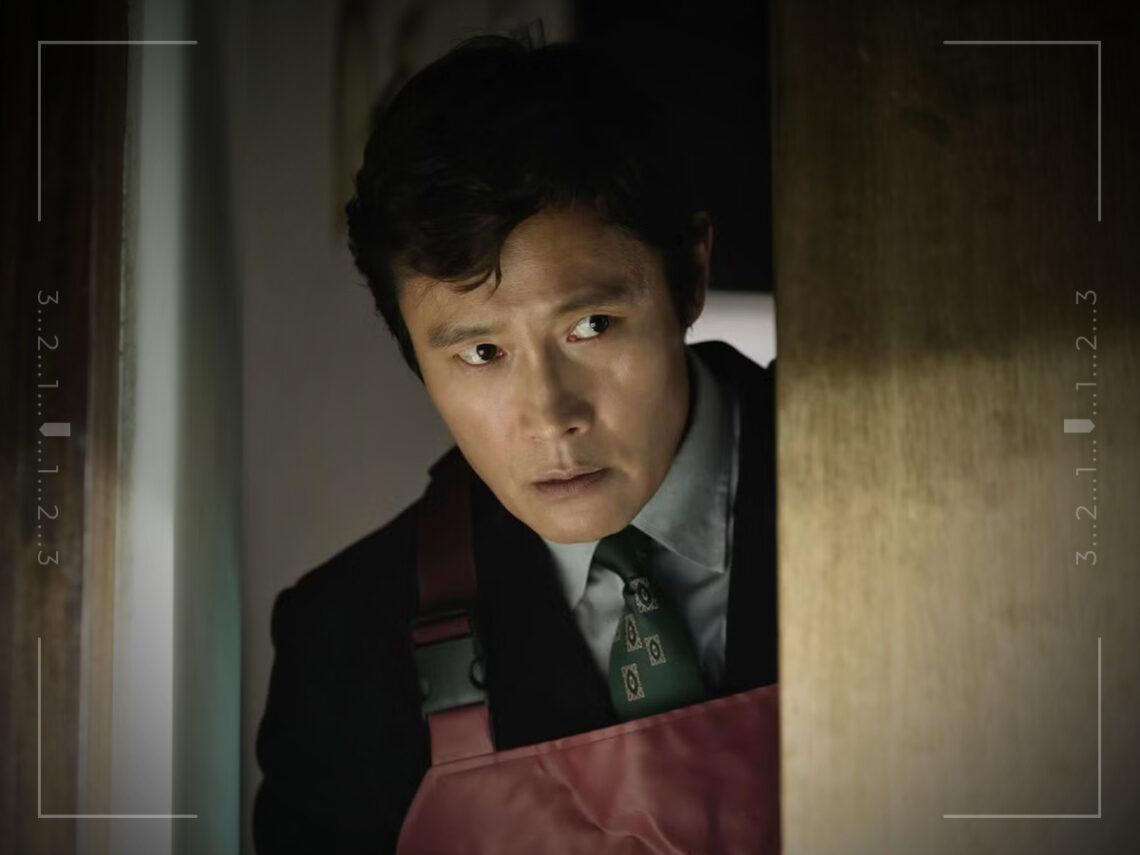
At last, Man-Su decides that a different approach is necessary, and the film diverges into a thriller in which he resorts to surveillance on his potential employers, stalking his employment rivals, and preparing to commit felonies as needed, approaching job competition as a battlefield in a too-literal sense.
His painstaking plans lead to an insane comedy of errors, involving as many cover-ups as successful actions, even as he tries to maintain relations with his impatient and dissatisfied wife. His relentless quest for a coveted job with a major paper company becomes a horror story told as a light comedy, and is as funny as it is chilling.
The story gets both darker and funnier as the goal of employment comes into view, including a series of tense close calls and Man-Su’s fatalistic nightmares. His family becomes unavoidably involved in his campaign, adding a new level of danger.
The conclusion, seen by Man-Su as a happy ending, becomes an intense storm of irony and cynicism, in which everything good is tainted in one way or another, and the meaning of the title, used repeatedly throughout the movie to glibly justify corporate decisions, takes on a new and darker meaning.
Visually, the film is amazing. Cinematographer Kim Woo-hyung takes the story to another level, using the camera almost as a detached narrator, to change the tone or even the meaning of each scene, adding tension even to comedic scenes, and sarcasm to serious ones. The script avoids attacking corporate culture directly, merely providing a slightly exaggerated version of reality and taking it to one arguably logical conclusion, making the criticism all the more severe.
The performances of the central characters are excellent, Lee in particular capturing the way a job title can become a source of confidence and even identity, and the humiliation and desperation connected with unemployment. The satire is extreme but effective, never too grim to not be funny, and never quite absurd enough to fail in hitting its target.
