


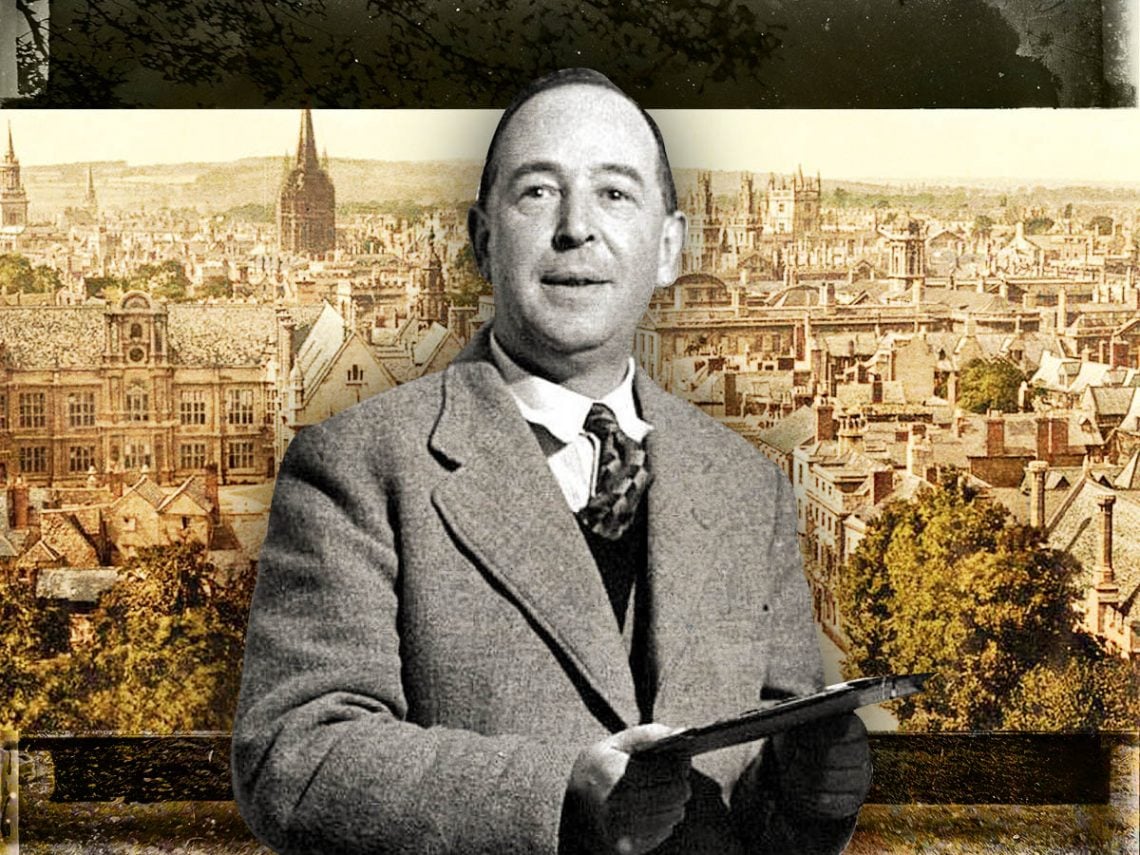
Walking Oxford in the footsteps of C.S. Lewis

Author of more than 30 books in total, C.S. Lewis remains one of the most influential and divisive children’s authors in the English language. Like his close friend J.R.R. Tolkien, Lewis’ lost his mother when he was still a child, an experience that would come to shape his writing and inform his fascination with faith, philosophy and myth.
A voracious reader with an impressive intellect, Lewis was once called the “best read man in England” and, in the 1950s, found success as the author of the Narnia series, books which have introduced countless children to the dizzying world of fiction.
Join us as we take a trip around the city that C.S Lewis called home from 1917 until his death in 1963: the medieval University town of Oxford.
A student at Oxford
C.S Lewis arrived in Oxford filled with a sense of the holy. The year before, he’d read George MacDonald’s, Phantaste, a text that powerfully “baptized his imagination”. He may well have been filled with a sense of the eternal too. Some scholars think Oxford University was established around 1096, making it the second oldest university in the world. By 1167, it was an important centre of learning, thanks, in part, to an influx of English students who would otherwise have studied at the University of Paris. It wasn’t until the 13th century, however, that the first colleges were introduced. The oldest of these colleges, University Balliol and Merton Colleges, were established between 1249 and 1264 and are still standing today. To give you a sense of scale, the temple of Machu Picchu was built in the 14th century, making Merton and Balliol older by some 200 years.
To Lewis, Oxford would have seemed strangely empty, many of its male students having been sent to France to be cut down in a haze of machine gun fire. By this point, The First World War had already been raging for three years, and things were looking distinctly grim. Lewis, like so many before him, was quickly enlisted at Keble college and billeted for officer training. Within months, he was marching through the war-torn landscape of the Western front. By September 25th, the day of his 19th birthday, his battalion reached the front of the Somme Valley, where he received his first taste of trench warfare.
Return From The Western Front
Having buried countless friends in the fields of Northern France, C.S. Lewis returned to Oxford, where he finished his studies and began to write in earnest. He found himself living with the mother of one of his fallen comrades, Mrs Jane King Moore, who Lewis had come to regard as a sort of surrogate mother. Together, they rented two houses on Windmill Road, Headington, a residential district dispersed with medieval churches. Lewis remained Mrs Moore’s lodger for many years, with the pair eventually moving into The Kilns, a rose-tangled cottage in Risinghurst, in 1930.
The house made quite an impression on Lewis, who, after his first visit, described the eight-acre garden as being “such stuff as dreams are made of.” Recalling that first visit in his diary, Lewis wrote: “To the left of the house are the two brick kilns from which it takes its name – in front, a lawn and hard tennis court – then a large bathing pool, beautifully wooded, and with a circular brick seat overlooking it: after that a steep wilderness broken with ravines and nooks of all kinds runs up to a little cliff topped by a thistly meadow, and then the property ends in a thick belt of fir trees, almost a wood: the view from the cliff over the dim blue distance of the plain is simply glorious.”
Tolkien and The Inklings
After a stint as a philosophy lecturer, Lewis was appointed a fellow of Magdalen College in 1925, though he’d still failed to publish anything in the way of lasting literature. The following year, Lewis became acquainted with a fellow scholar called J.R.R Tolkien. It was during one of their long conversations that the young academic became convinced of his faith in God. Together with Hugo Dyson, Tolkien and Lewis set out by motorcycle from Oxford to Whipsnade Zoo. “When we set out, I did not believe that Jesus Christ was the Son of God,” he wrote in a subsequent letter, “and when we reached the zoo I did.”
Around this time, Lewis, Tolkien, Dyson, Charles Williams and Owen Barfield were meeting for regular meetings at Lewis’ college rooms, where they would read and discuss material they were working on. The group, known as The Inklings, would often gather for informal lunchtime gatherings at Oxford pubs such as the Eagle and Child. Home to the sacred “Rabbit Room”, a private lounge at the back of the pub, this particular watering hole became a crucial aspect of The Inkling’s weekly meetings. Indeed, It was during one of these lunches at The Eagle and Child that, in 1950, Lewis unveiled his working manuscript for The Lion, The Witch & The Wardrobe, the first of his Narnia books. When the Eagle was renovated in 1962, the sacred privacy of the Rabbit Room was destroyed, at which point the group decamped to the Lamb & Flag on the other side of St Giles Street. The cosy enclave remained the site of The Inklings’ meetings until Lewis’ death in 1963.
If you’re planning a trip to Oxford and would like to explore some of Lewis’ old haunts, make sure you check out our interactive map below.
- Keble College, Oxford University, Oxford OX1 3PG
- 54 Windmill Road, Headington, Oxford OX3 7BX
- The Kilns, Lewis Cl, Headington, Oxford OX3 8JD
- Magdalen College, Oxford University, Oxford OX1 4AU
- The Eagle and Child, 49 St Giles’, Oxford OX1 3LU
- The Lamb & Flag, 12 St Giles’, Oxford OX1 3JS
