


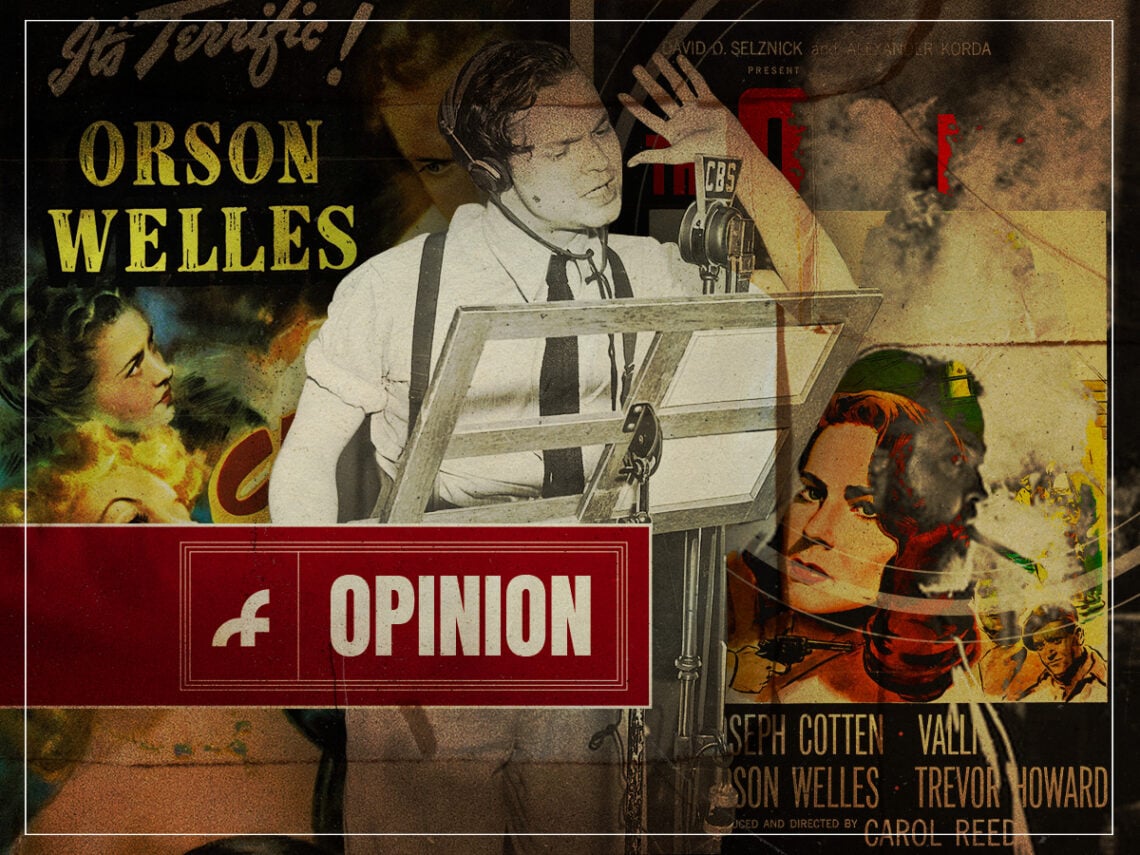
Hear Me Out: Orson Welles is the most underrated actor in cinema history

I know what you’re thinking: how can Orson Welles—a staple of film school curricula, a permanent fixture on the when discussing some of cinema’s greatest artists, the rotund master of the chat show, and the self-financed auteur—be underrated?
It’s certainly a bold claim to make about a man who, in his mid-20s, directed what is widely considered the greatest film of all time, won the Palme d’Or for Othello in 1951, received the AFI Life Achievement Award in 1975, and whose final completed feature, F for Fake, is credited by many with creating the video essay genre. As a director, Welles has been canonised, if not practically deified. Yet, as an actor, I believe he doesn’t receive the full recognition he deserves.
Welles himself is partly to blame for this underappreciation. One of his peculiar idiosyncrasies was an obsession with fake noses. Disliking his own, he often insisted on wearing a prosthetic. If he had stopped there, it might have been fine, but Welles’ fondness for excessive makeup sometimes overshadowed his best performances. In The Immortal Story, for example, Welles plays Mr Clay with the grotesque bitterness the role demands, but any subtlety in his performance is buried beneath heavy makeup.
Additionally, Welles didn’t fully recognise his own acting talent. He declined an on-screen role in The Magnificent Ambersons, even though the part of George Amberson—a reckless young man facing a fall from grace—seemed tailor-made for a young Welles. This reluctance to embrace his gifts as an actor may have contributed to the lack of recognition he receives in that capacity.
More significantly, Welles was often overlooked for roles where he could have truly shone. Early in his career, he was typecast as villains and kings, which, while limiting, was far better than the roles—or lack thereof—that came later in life. Offers for substantial parts simply dried up. Welles once remarked that he would have “sold his soul” to play Vito Corleone in The Godfather, but instead, he was relegated to smaller roles like a cameo as Cardinal Wolsey in A Man for All Seasons and an (admittedly iconic) appearance in The Muppet Movie. His talent far exceeded the opportunities he was given in his later years, leaving a gap in the recognition he deserved as an actor.
It’s a great shame because when Welles did find the right role, he excelled. Believe it or not, Welles’ character Harry Lime only appears in The Third Man for about ten minutes, yet in that brief time, he completely transforms the film. In Touch of Evil, despite starring Charlton Heston, Janet Leigh, and Marlene Dietrich, it’s Welles’ portrayal of Hank Quinlan that lingers in your memory. His physicality on screen is unmatched—Welles looms and sweats over every frame, his imposing bulk perfectly embodying the force, corruption, and depravity of his character, a crooked, bigoted, and drunken cop. Few actors have used their physical presence so effectively to convey such moral decay.
The secret of Welles’ triumph in these particular roles is that they magnified some part of the director’s own complex personality and psychology. Harry Lime – witty, persuasive, dangerously clever and looking down on the world and its ‘dots’ from an elevated position – is not far from Welles in 1949, the prodigious genius whose personality attracted and alienated simultaneously. By 1958, Welles had – at least in the eyes of the world – started to resemble Hank Quinlan, a bloated colossus whose actions seemed to invoke a tragic feeling of waste.
Welles found his true cinematic double in the role of Sir John Falstaff, the embodiment of Shakespeare’s underclass of rogues and bawds, and a symbol of Merrie England. While Welles might have rejected comparisons between himself and characters like Harry Lime or Hank Quinlan, his personal identification with Falstaff is undeniable. Falstaff, who appears in Henry IV Part I and II, and The Merry Wives of Windsor, was a lifelong companion to Welles. At just 15, Welles staged a school production of Shakespeare’s Henriad focused on Falstaff. He revisited the idea in 1938 with the Mercury Theatre and again in 1960, telling actor Keith Baxter that the production “was only a rehearsal for the movie”. Finally, in 1966, Welles brought his vision to life with Chimes at Midnight, completing his long-standing tribute to the character.
Of all his films, Welles confessed it was his favourite, describing his Falstaff as a “gloriously life-affirming good man” who represented a “loss of innocence”—an essential Wellesian theme. In the penultimate scene of the movie, where a newly crowned Henry V betrays his friend and substitute father Falstaff, Welles is heartbreakingly powerful, conveying deep depths of suffering with a single betrayed look. By the lifelong cultivation of a single role, Welles achieved one of the greatest performances ever captured on screen.
