


How ‘Oppenheimer’ is connected to ‘There Will Be Blood’

Christopher Nolan, the mind behind cinematic masterpieces like Inception and The Dark Knight, has once again captured audiences with what may well be his magnum opus: the explosive and devastating Oppenheimer.
Renowned for his ability to craft intricate narratives, bolstered with unprecedented advances in practical effects that leave viewers both awed and introspective, a new Nolan film will always send shockwaves throughout the cinematic landscape.
His recent foray into the life of J. Robert Oppenheimer, the “father of the atomic bomb”, is no exception: from its staggering central performance from Cillian Murphy, its exquisite IMAX photography and its physical reproduction of a ‘nuclear’ explosion, to sit in the theatres and watch Oppenheimer is a cinematic experience like no other. What you may be surprised to learn, however, is that the film has a connection to another titan of cinema, one from over 15 years ago: Paul Thomas Anderson’s own opus, There Will Be Blood.
In a recent video for Konbini‘s Vidéo Club to promote his new feature along with Murphy, Nolan was given free roam in an extensively catalogued library. The purpose of these videos is usually to follow a prominent actor or director on a journey through their own viewing experiences, singling out certain movies that speak to them. With Nolan, it was no different, and it was particularly telling that the very first project he goes for is There Will Be Blood. “An excellent film,” Nolan calls it, further clarifying, “I think Paul’s best.”
He continues, suddenly revealing a particularly pertinent connection between his new film and Anderson’s 2007 western epic: “So Ruth De Jong, our designer on Oppenheimer, was an art director on it – working for Jack Fisk”. Now, you wouldn’t be blamed for dismissing this as one of countless examples of heads of department and crew working on other movies. It’s true – it’s their job, after all. But if you inspect the visual identity of Nolan’s new project closer and combine it with his very vocal admiration for There Will Be Blood, it seems like the connection deepens.
While De Jong was the visionary behind the designs of Oppenheimer, from the lecture halls of Oxford University to the very shell of the first atom bomb, her journey in cinematic design was heavily influenced by a stalwart in the field – the aforementioned Fisk. Fisk, perhaps one of the greatest production designers still alive today, was behind the design of such films as Days of Heaven, The Thin Red Line, Eraserhead, Carrie, The Revenant, and dozens more.
Working closely under Fisk during the making of There Will Be Blood, De Jong procured a specific aesthetic and design philosophy that she would later bring into her own projects, which range from Manchester By The Sea, the third series of Twin Peaks and the middle-American supershow, Yellowstone. Fisk’s visionary designs, combined with De Jong’s budding brilliance, helped Anderson’s film paint a vivid picture of Daniel Plainview’s tumultuous journey in the early 20th-century oil rush – and in Oppenheimer, De Jong incorporates what she learned.
Oppenheimer borrows visuals from There Will Be Blood
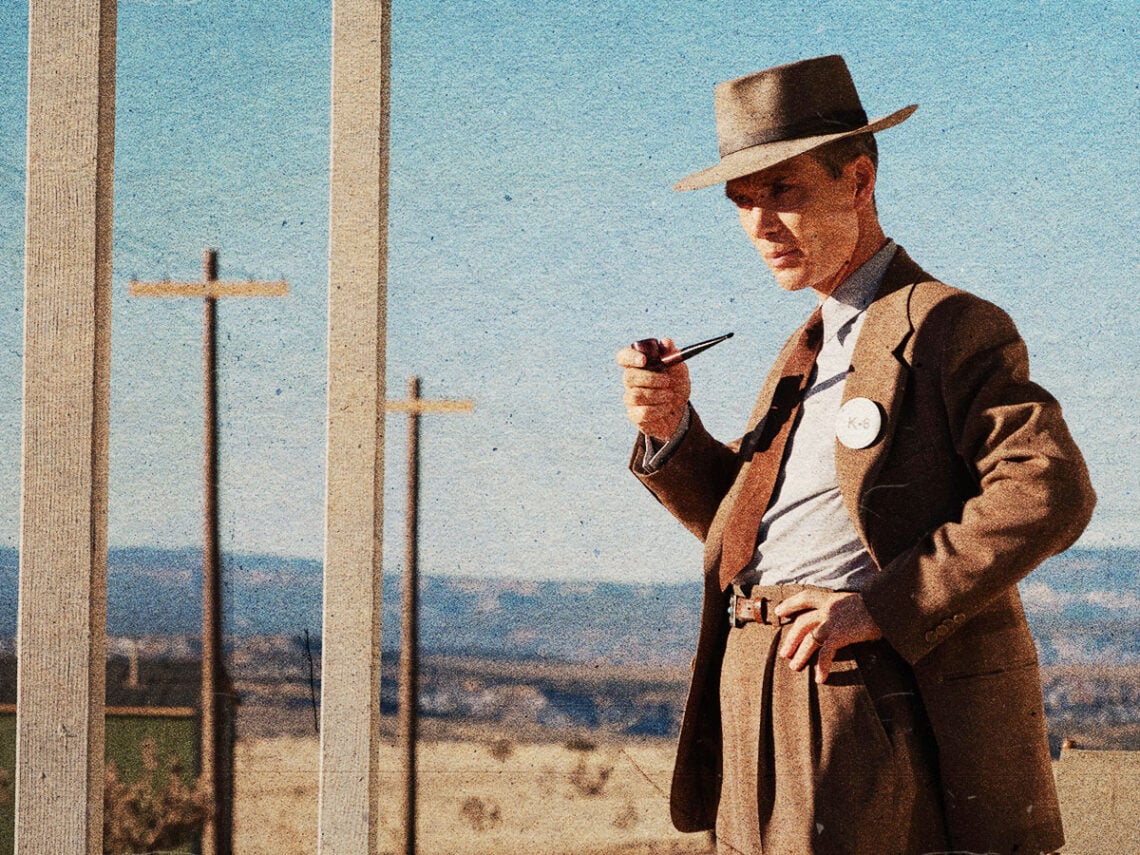
Most visibly and significantly are the similarities between Los Alamos, the land seized by the US Government and converted into the secret ‘Trinity’ testing base in Oppenheimer, and the town of Little Boston in There Will Be Blood. Both are ramshackle, temporary, cobbled-together bits of infrastructure that look like a single match could (and probably would) set the whole thing ablaze. In fact – Anderson’s film even has its own explosion set piece.
Then there are the sequences where Oppenheimer sets off from his New Mexico ranch on horseback, camping out in the desert, drinking liquor in his tent and staring up at the clear cosmic vistas, searching the stars. Anyone that’s seen There Will Be Blood will know that at least half the movie has Daniel Day-Lewis camped around some fire in the barren wilderness of the Colorado Desert. Both were shot on glorious, grainy celluloid film. Clearly, for these moments, at least, Nolan has taken very direct cues.
Now, while There Will Be Blood is centred around the early days of the American oil industry and Oppenheimer delves deep into the complex psyche of the physicist behind atomic oblivion, the thematic parallels are evident. Both films deal with ambition, moral dilemmas, and the lengths to which individuals will go to achieve their objectives. De Jong’s understanding and interpretation of these themes, perhaps subtly influenced by her time with Fisk, provide a consistent and atmospheric bridge between the two.
