


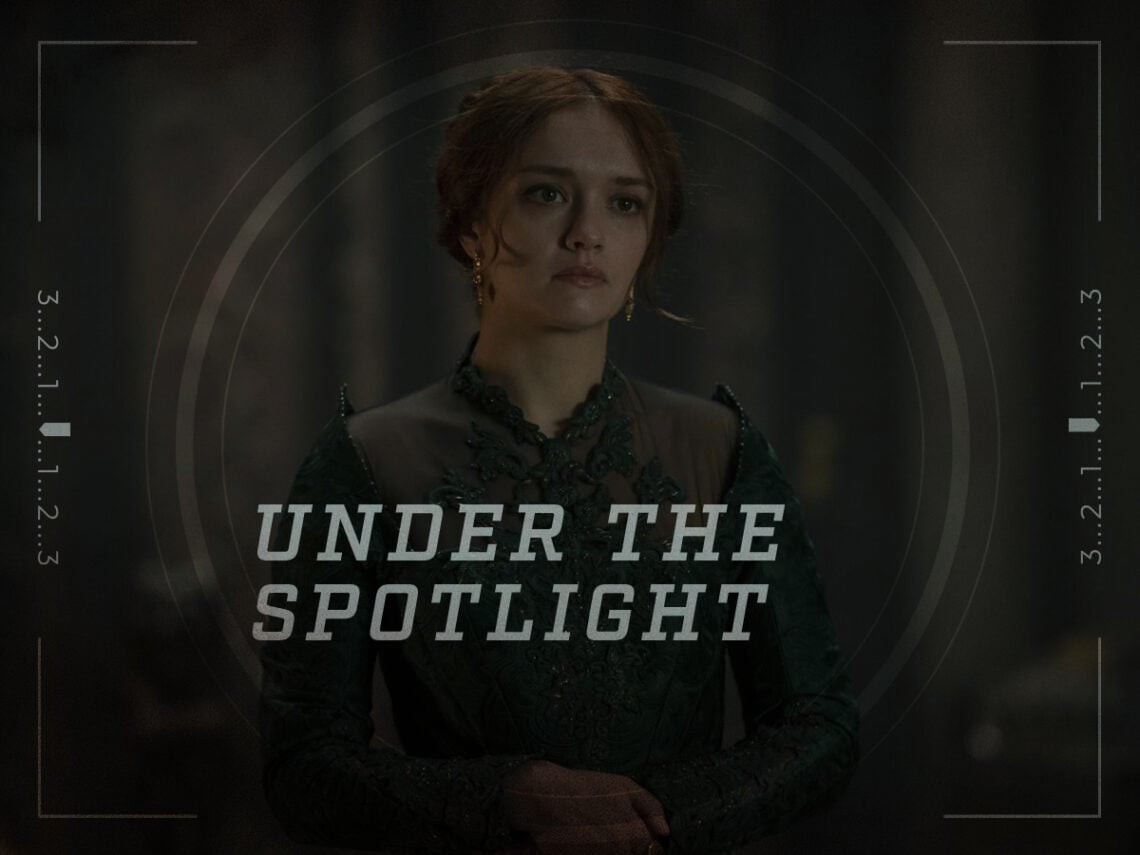
Under the Spotlight: Olivia Cooke as a tragic and introspective queen in ‘House of the Dragon’

It was a surprise to me when the news broke that Olivia Cooke would be taking on a lead role in the Game of Thrones prequel series House of the Dragon. My image of the actor at the time was rooted in teen coming-of-age thrillers and grungy, melancholic dramas, and I couldn’t see her in this epic high fantasy setting. But two seasons in, audiences know how very wrong I was.
Cooke first appears in House of the Dragon in the sixth episode of season one, taking over the role of Queen Alicent Hightower from Emily Carey following a time jump that brings the character into adulthood. Carey gives a stunning breakout performance of Alicent’s tragic teen years, showing her repressed sadness and numbness as a premature wife and mother. When the series begins, Alicent has a bright-eyed, rule-abiding innocence, and as she reflects years later, she would have always done and married what and whom she was told.
Cooke’s portrayal has a steelier elegance, with many more years for Alicent to fortify herself. Still, she exhibits a barely restrained anger when she points out Princess Rhaenyra’s missteps, expecting that she will be held to the same standards, and yet, nothing ever happens. The queen finally snaps when tensions boil over among the two women’s children, resulting in Alicent’s son losing an eye. Alicent lunges for Rhaenyra’s son with a knife, and Rhaenyra catches her. Alicent shakes in desperation, voice breaking when she asks why she is never given justice. In a way, Rhaenyra is right when she says it must have been so exhausting for Alicent to hold back her true self.
If it is even possible, Cooke reaches new heights in season two (I was shocked that she didn’t get a Golden Globe nomination along with Emma D’Arcy). Alicent spends much of the sophomore outing diplomatically trying to manage affairs until her sons and their male advisors shut her out of power, and she starts to dissociate. Cooke breezily steps into a new on-screen demeanour as Alicent pesnively drifts through the story, finally reckoning with where her choices have brought her.
Her sons don’t seem to need her, and even if they win the war against Rhaenyra, Alicent will never be happy. These thoughts bring Alicent to the Westerosi woods, floating away as she forms a new plan. I’ll forever be disappointed that they didn’t throw in a shot of Emily Carey floating in the lake, momentarily replacing Cooke, during the sequence where Alicent goes for a swim to clear her head. Rhaenyra’s younger actor, rising movie star Milly Alcock, got to come back for season two!
Alicent then goes to Dragonstone to negotiate one last time. After delicately suggesting to her daughter that they just leave in another scene, Alicent has to work out the logistics with Rhaenyra and explains how she thought there was security in following the rules. She is clearly heartbroken throughout this scene, but becomes mournfully resolved as they discuss what it will take for Alicent, her daughter, and granddaughter to go into exile.
House of the Dragon is a back-and-forth between Alicent and Rhaenyra; the never-ending cycle of one being afforded power or mistakes the other isn’t. D’Arcy gives a spectacular performance, conveying humility but also a true desire to be a good queen. But as Alicent says simply in the end, “I am at last myself with no ambition greater than to walk where I please and to breathe the open air. To die unremarked and unnoticed and be free.”
Even Rhaenyra smiles at that. Though it is destined for more tragedy, Cooke tells a beautiful story about a woman who never had any ambition to rule herself, and after so long letting others pursue their aspirations through her, can bear the horrible consequences if it means being at peace.
