


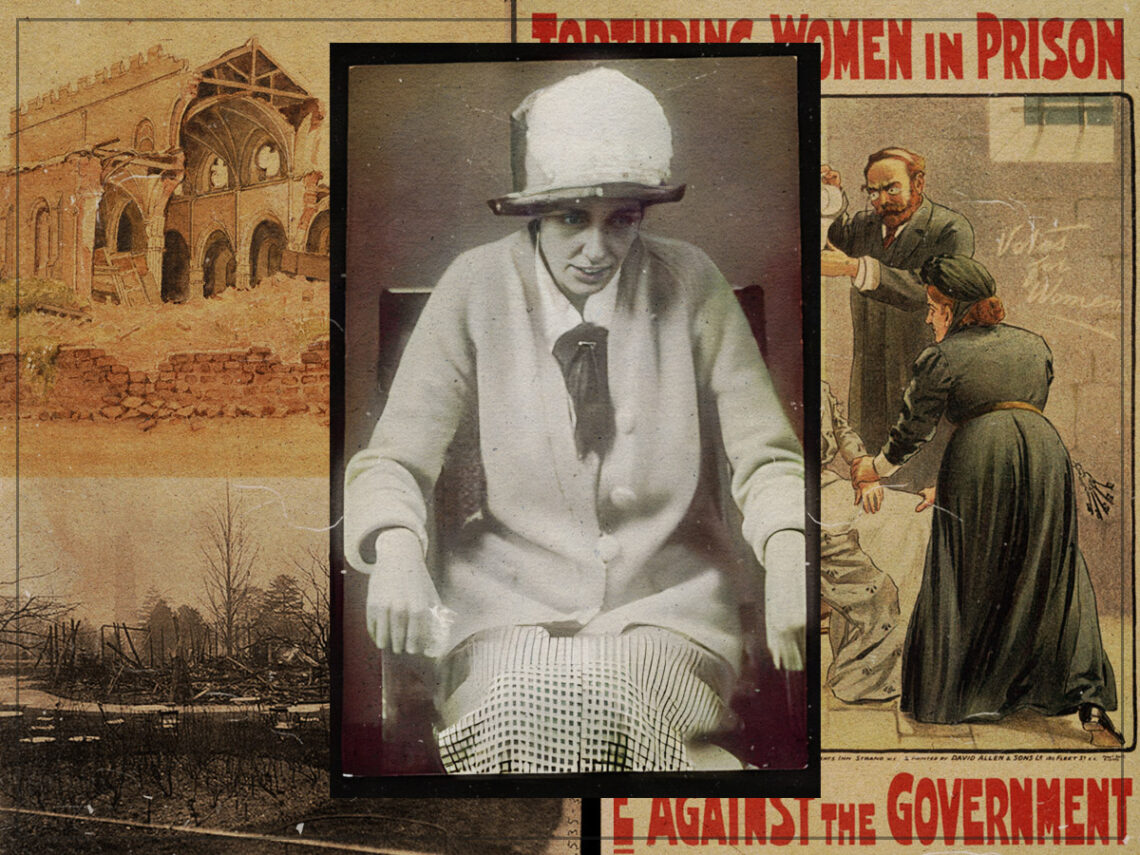
Olive Wharry: artist, arsonist and feminist icon

The gentle watercolours of Olive Wharry are beautiful. Done with delicate brush strokes, her quaint thatched cottages were a picturesque take on British life. But contemporary revaluations of her work find far more enduring relevance in her act of arson rather than her art. Wharry, a dedicated suffragette, endured force-feedings and countless prison sentences but always used art to further her feminist message, and while her watercolours were pretty, her prison scrapbooks were poignant.
Wharry’s first arrest came just three years after graduating from the Exeter School of Art. Born into a middle-class family, her active membership in the Church League for Women’s Suffrage and the Women’s Social and Political Union (WSPU) was almost unfathomable. A quiet, smouldering resentment about gender politics might have been commonplace, but Wharry was bold enough to physically act on it.
Formed by Emmeline Pankhurst in 1903, the WSPU were militant in their goal to get women the vote, insisting they’d rather “broken windows than broken promises”. Wharry was arrested for her part in a WSPU window-smashing campaign and sentenced to two months in prison.
During this time, she didn’t abandon her ideals or her art. She took to making a prison scrapbook, which included the signatures of other Suffragettes imprisoned with her. It was featured in a British Library Exhibit, Taking Liberties, in 2008, a dazzling show of will while she was shown unimaginable cruelty. Her prison hunger strikes were met with force-feeding, and most of the time, she was dismissed as clinically insane. But she continued scrapbooking, collecting signatures, and refusing to relent.
In one prison spell, she even managed to smash her cell windows.
Wharry’s most infamous arrest, however, came in 1913. She and Lilian Lenton were sent to Holloway Prison for setting Kew Gardens’ tea pavilion on fire. While the pair had checked nobody was inside before they sent it up in flames, they had caused £900 worth of damage. Wharry smiled demurely at the trial, calling it a “good joke”, likely knowing the controversy meant more exposure for the Suffragette message. She thought the pavilion belonged to the monarchy and wanted its two female owners to understand that women were fighting a war and that in times of war, even civilians must suffer.
The judge didn’t take kindly to this tact, however, and she was sentenced to 18 months in prison and demanded to pay the costs. “I refuse to do so,” she declared from the dock. “You can send me to prison, but I will never pay the costs”. Her Holloway hunger strike lasted for 32 days, during which time she lost nearly 20kg.
Her scrapbook charted all of her prison experiences and functioned as a good defence when doctors deemed her insane. She wrote witty, satirical poems about her oppressors, sketched out her prison environment, and fastidiously collected the names of other suffering women. She recorded her weight loss and kept newspaper clippings of every arrest. A photo of her and Lenton sitting in the dock sits proudly on one page. It was almost as if she knew history would look kindly on her efforts, and went to great lengths to document the Suffragette struggle, and that was always going to be more interesting than some watercolours.
