


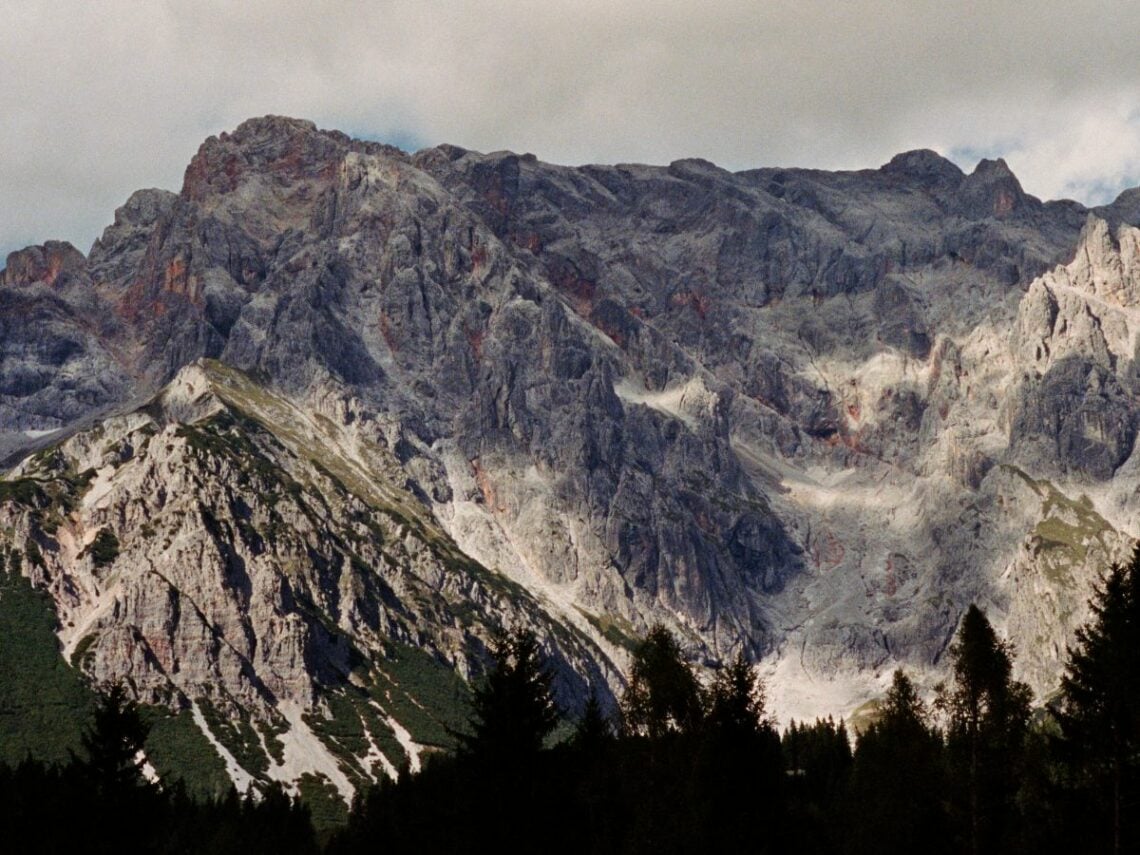
‘Octopus’: Exploring the force and frailty of the mountain landscape

It wasn’t the romance but the complexity of mountains that drew Steve Harries above the cloudline. For ten years now, he’s been visiting mountain ranges all over the world in an effort to capture these landscapes on their own terms: as living entities at once powerful and immensely vulnerable.”I have a morbid fascination with seeing how it’s changed,” Harries says of the Grossglockner glacier. Located on Austria‘s tallest mountain, this great mass of ice has retracted by about two kilometres in the 15 years since he first photographed it.
Back then, Harries had no grand vision for his photos. “The pictures were never meant to be shown in sequence,” he says. “In all the places I visited, the intention was only ever to shoot them in isolation.” On rediscovering a 1924 poem by Marianne Moore, however, Harries began looking at his work with new eyes, prompting him to reorganize a decade’s worth of photographs and compile them in his latest book, Octopus, published by RVB.
“It all began with that poem,” Harries says of Moore’s long-ignored surrealist-pastoral poem ‘An Octopus’, which sees the poet capture the enormity of a mountain vista from its “shifting snow-dunes” to the “dots of cyclamen-red and maroon on its clearly defined pseudo-podia.”
Harries is equally fascinated by the unique textures of the mountain landscape. Octopus juxtaposes vast, forest-swathed panoramas with still-life portraits of shimmering metamorphic rock, rupturing our sense of mountains as dead or petrified. These mountains are alive. They have flesh, and Harries sees how they remould themselves as the sun moves from east to west. We caught up with Steve to discuss his new photobook and the travels that inspired it.
Far Out: What was the motivation behind Octopus?
Steve Harries: “I’ve always been attracted to that landscape. I love being in the mountains, and I love shooting pictures of mountains and glaciers. One of the joys of visiting mountain landscapes is that you can be completely free. I work professionally as a still-life photographer, and that’s all about trying to find geometry. In the mountains, you can revel in the randomness of the landscape. It just gives you so much freedom. That said, it was never like: ‘right, I’m gonna embark on this ten-year odyssey’. It was that poem, really, that pulled it all together”.
So this is Marianne Moore’s 1924 poem ‘An Octopus’. When did you discover it?
“God, it must have been three or four years ago now. It was a real light bulb moment, you know? It had this kind of subconscious appeal. When you first read it, even on a very basic level, it’s so beautiful. The way she describes the landscape; her use of metaphor; the way she uses her imagination; the way she leaves so much of it to your imagination. I just loved that sense of mystery and the curiosity she provokes in the reader.
“I felt this immediate connection, so I went into research mode to uncover a bit more about the poem and about Marianne’s life. That was the point it really started making sense. She wrote the original draft on the back of a national parks rules and regulations document when she visited Mount Rainier in Washington, and it’s this real collage of language. She appropriated language from overheard conversations; she quotes phrases from the rules and regulations pamphlet; she quotes from National Geographic. And I suddenly realised, you know, ‘oh god, this is the literary equivalent of all my different studies of this landscape. Had I not read the poem, I would never have thought of putting the pictures together. She gave me the license to combine and choreograph the images by setting and layering them with this sort of blissful randomness. It felt like I didn’t need to conform. The way in which the images fell and the way they intersected one another just added more of a textual element to the whole project.”

You mention Moore’s use of imagery. Why do you think mountains have been mined as a source of symbolism and metaphor for so long?
“I think it’s the mystery. Mountains have this visual impact because of the light, because of their form, because of the silhouette, the texture. But I think we’re also drawn to them because it’s just so hard to perceive how long they’ve been there – how they’ve formed and changed. It’s no wonder they’re revered; they have such resonance. Marianne described her mountain as being like the tentacles of an octopus, the way it moves and the way it sort of encompasses the landscape. I mean, that’s such a beautiful concept. The mountain is a beautiful place, but it’s also a scary place because there’s this huge sense of strength and power.”
Were there any moments you found yourself in danger?
“No, not really. There were a couple of locations where it was impossible to hike, so I had to get a helicopter. There was one moment in the Canadian Rockies where the pilot was like, ‘we have to go because there’s a weather system coming in’. But in a way, that was helpful.
“When you’re somewhere you know you don’t have a lot of time, you’re open to seeing so much more because you know you won’t be able to capture all that much. On that particular occasion, I was shooting on a large format camera, so it was a slow process to find how to compose and shoot the picture. I stayed for as long as I possibly could, and then we had to go. I wasn’t scared, but there was definitely a sense of being up against the elements.”
These shots are of mountains from all over the world. Where did your travels take you?
“That one in the Canadian Rockies was called the Ipsoot Glacier, which was an amazing place. But there were other places elsewhere in Canada: Sulphur Mountain, the Banff National Park. Then in Europe, there were several visits to Austria. There’s the Dolomites on the Italian side of the border as well. There’s also a glacier on the border with Chile and Argentina. So it was a mixture, but several of the shots were taken during repeat visits, where I’d gone back for a second or third time”.
What drew you to these landscapes? Usually, these things link back to some childhood obsession.
“I’ve always been fascinated by mountains, but I never had an obsession. I always had more of an obsession with the city – with skyscrapers, architecture, geometry, balance, and structure. And I think that might be why mountains appealed to me later in life because they have all of those same things. They have strength and prowess, but there’s also no need to force a sense of geometry and composition. It’s just there in front of you, and you have to find the picture within it.”

Were there any locations that were particularly rewarding to photograph?
“They were all wonderful places to shoot, but I definitely enjoyed visiting locations where it felt like more of a discovery. A lot of these places, you research them before you go, and because of social media, you can get a 360-degree view before you even get there. And sometimes, I deliberately chose not to do that because it’s so much better to be surprised when you visit these places. And so much of it is to do with light. I know that’s a cliche coming from a photographer, but it is. You can go to one place and stay there for five hours and get five hours of different images where it looks like a different place in each one.
“For me, it was never about these broad, epic landscapes; it was always much more focused on details. I love that sense of almost abstracting the images so that you’re focusing on a specific point and you can’t quite see what it is when you take it out of context. I much prefer that to taking tourist snaps of the vista. So it was always exciting because there was always the challenge of finding something that appealed to me or something that might make this beautiful thing that’s been captured ten million times look different and strike the viewer in a different way.”
Finally, you made a deliberate choice to leave out mountainous flora and fauna in these photos. Why did you decide to focus solely on the mountain itself?
“I think I just wanted it to feel strong. I wasn’t really interested in the romance of that landscape, and I think I wanted to try and find a language of simplicity. As I said, this was never meant to be a sequence of pictures, and I was never trying to find a thread to tie all these locations together. But I guess I was drawn instinctively to certain elements. With that landscape, I just love the way the light changes. When I did the edit, I felt the viewer didn’t need anything to distract or interrupt that landscape. I’ve got plenty of pictures of beautiful flora. I love flowers; I’ve made a whole book on them. But they just felt like too much of a distraction.”
Thanks to Steve for taking the time to talk about his new book, Octopus. The special edition is available from the RVP bookshop.


