


‘No Sunshine’ and the nightmarish surrealism of Bjørn Melhus

For many of us lost souls trying to find our way in the world, the transition from childhood to adolescence is one of the trickiest steps to take. Suddenly, one must abandon the safety net of youth for a volatile life beyond the nest, forced to cook their own meals, pay their own taxes and drive their own car. Music, movies, and art, in general, have long evocatively expressed the difficulty of such a time, speaking to the joys and struggles of getting out of the trappings of childhood.
Rob Reiner’s 1986 classic Stand By Me remains one of the coming-of-age genre’s greatest tales, with the Stephen King adaptation speaking to one idyllic day in the life of four best friends, which switches when they discover a dead body. While Reiner’s film defines a definitive endpoint of childhood, Frank Perry’s 1968 classic The Swimmer suggests that, for some, nostalgia can imprison people in a torment of their own making.
Such entertaining expressions of the adolescent transition are explored, albeit in an entirely surreal fashion, in Bjørn Melhus’ 1997 short film No Sunshine, which was originally created as a looping art installation. Ever since, it has claimed minor cult status online, with viewers flocking to the film thanks to its nightmarish take on the death of childhood and the embrace of adolescence, in the eyes of the media at least.
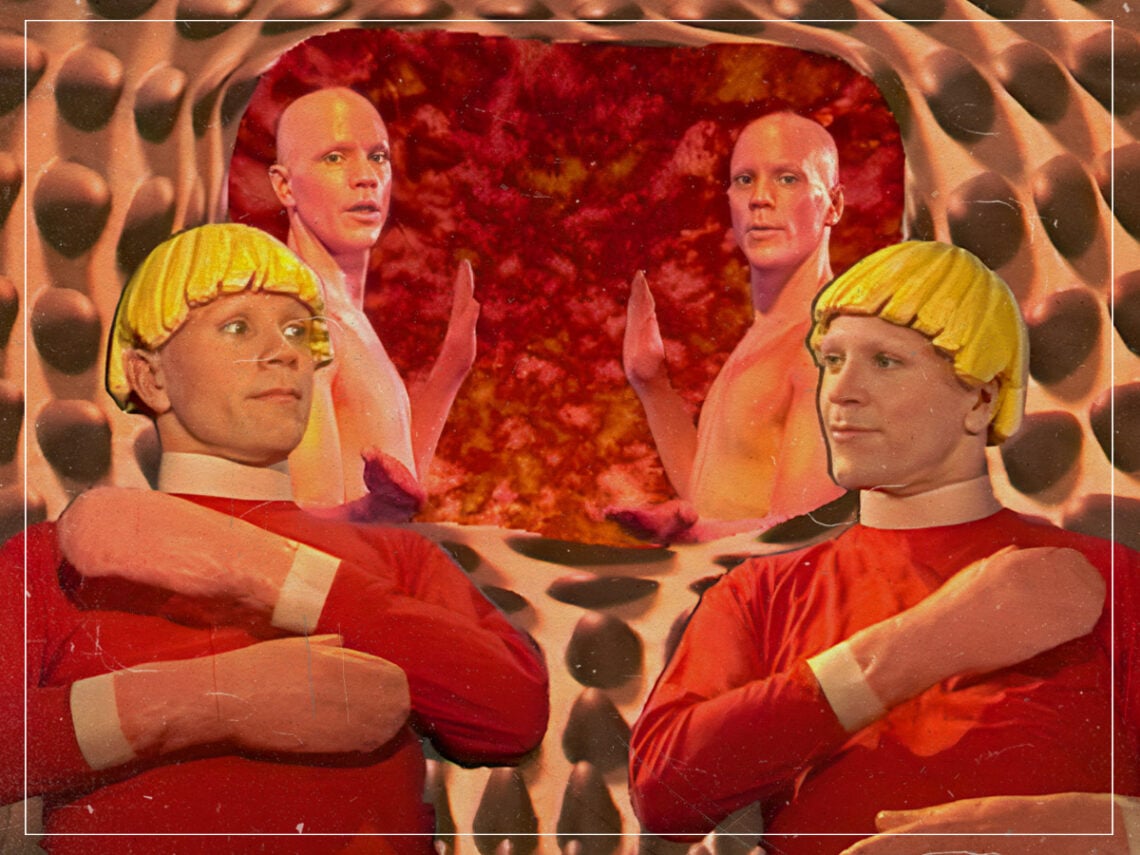
Perhaps ‘surreal’ is an understatement, too, with the film beginning by zooming into some sort of organism or human cell, in which two Playmobil-looking humanoids float in empty space and communicate using only sound bites from early Stevie Wonder and Michael Jackson songs. Made to the rhythm of an odd occupying beat, No Sunshine initially feels like the product of an over-ambitious and slightly unhinged young experimental musician.
Suddenly, stringed instruments take over and build to a grand crescendo, and we zoom into a fleshy television behind the two figures where a pair of pink humans perform some sort of ritualistic dance. Explaining the remainder of the film feels needless as eerie surrealism takes hold. Melhus seems to let himself frolic in boundless creativity, reaching into the subconscious of his childhood to bring No Sunshine to life.
Supposed to represent this complex emotional period of adolescent transition, the two central Playmobil figures float in the red dystopia of the human body itself as idealistic, infantile representations of childhood. Such figures “set the stage for the perception of the world and the playful coming to terms with it for many children,” as detailed in Melhus’ portfolio.
An experimental art installation in the best way possible, Melhus also describes his work as a “tragicomedy” and isn’t against the idea that, for some, his expression of what a child is and is expected of them in respect to social norms, is quite bafflingly humorous. Indeed, when the pink humanoid breaks out in song towards the end of the short, it’s difficult not to totally double over in laughter at the sheer audacity of the film’s surrealism.
Yet, deep down in the cells of the abdomen, it seems to access something strangely profound, almost like one’s inner child is singing and boogying along to the nonsense. While some viewers may connect with Stand By Me or The Swimmer, for all of us lost souls, No Sunshine might just strike a chord.
