


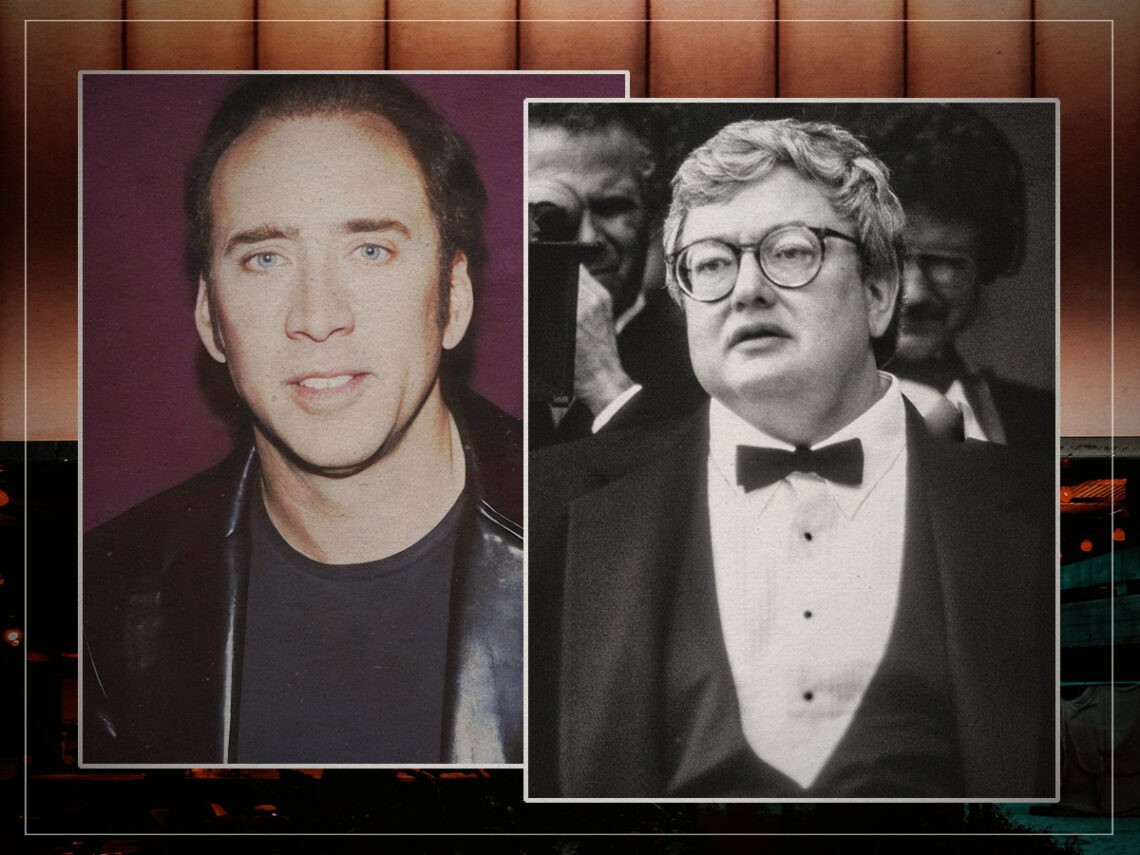
The Nicolas Cage comedy Roger Ebert hated with a passion: “This movie is dead in the water”

Famed Chicago Sun-Times critic Roger Ebert was always known as a big Nicolas Cage fan. If there was one critic likely to give the average Cage flick a fairer shake than most, it was Ebert. That said, he was honest—if Cage released a dud, he wouldn’t sugarcoat it. In fact, his scathing reviews sometimes hit harder because of how much he usually loved the eccentric star. In the early 1990s, for example, Ebert tore into a disastrous Cage comedy, and the result was brutal.
In the early ’90s, Cage was on the precipice of superstardom, but hadn’t yet made that leap to true A-list status. In 1995, he starred in Leaving Las Vegas, which notched him his sole Academy Award, and he followed that win with three action classics in a row: The Rock, Con Air, and Face/Off. These films solidified him as an icon forever, but before their release, he was still scrambling around to discover what kind of movie suited his unique talents the most.
To illustrate the point, a quick glance at Cage’s pre-Leaving Las Vegas decade reveals an erratic set of choices, to say the least. Yes, he made the classic Wild at Heart with David Lynch, the excellent neo-noir Red Rock West, and the charming rom-coms Honeymoon in Vegas and It Could Happen to You. However, he also made curious, mostly forgotten failures like Amos & Andrew, Fire Birds, Zandalee, Deadfall, and Trapped in Paradise, the woeful 1994 anti-comedy that Ebert despised so thoroughly.
In Cage’s defence, the Christmas-set crime comedy probably sounded like a good idea when he signed on the dotted line. The concept of three ex-con brothers robbing a small-town bank on Christmas Eve, only to become trapped in the town after they crash their car in the snow, sounds rife with comic potential. Cage would also bring the laughs alongside two comedic forces audiences loved from Saturday Night Live: Wayne’s World star Dana Carvey and A League of Their Own’s Jon Lovitz. Surely, a rib-tickling hit was on the cards?
Unfortunately, the resulting film was anything but a hit. It made a paltry $8 million at the box office and was included on many critics’ lists of the worst movies of the year. What went so wrong, you might ask? Well, according to Ebert, pretty much everything. “This movie is dead in the water,” the iconic critic grumbled. “I knew the movie was in trouble by about the second scene.”
Ebert admitted that he was on board in the movie’s first scene, but that was only because it solely featured Cage, and he counted that as “a hopeful sign”. However, as soon as Carvey and Lovitz entered proceedings, the whole enterprise fell off a cliff. “We cut to their parole hearing, where one brother, played by Jon Lovitz, is imitating a pterodactyl. The other brother, played by Dana Carvey, speaks in a high-pitched, twerpy squeak, and I knew it was going to be a very short time before I grew very tired of it.”
Perhaps, if Cage had enjoyed access to a crystal ball, he’d have seen that neither Carvey nor Lovitz could ever transfer their SNL sketch comedy charms to lasting movie stardom. Instead, he wound up in a laugh-free movie with both of them mugging for the camera and doing oddball schtick, which forced Cage to be the straight man – something he’s never exactly excelled at.
Ultimately, Ebert condemned the film as an act of creative desperation that the Library of Congress should enshrine, a put-down so specific that it can only be applauded. “It plays like a documentary about a group of actors forced to perform in a screenplay,” he concluded, “That contains not one single laugh, or moment of wit, or flash of intelligence, or reason for being.”
