


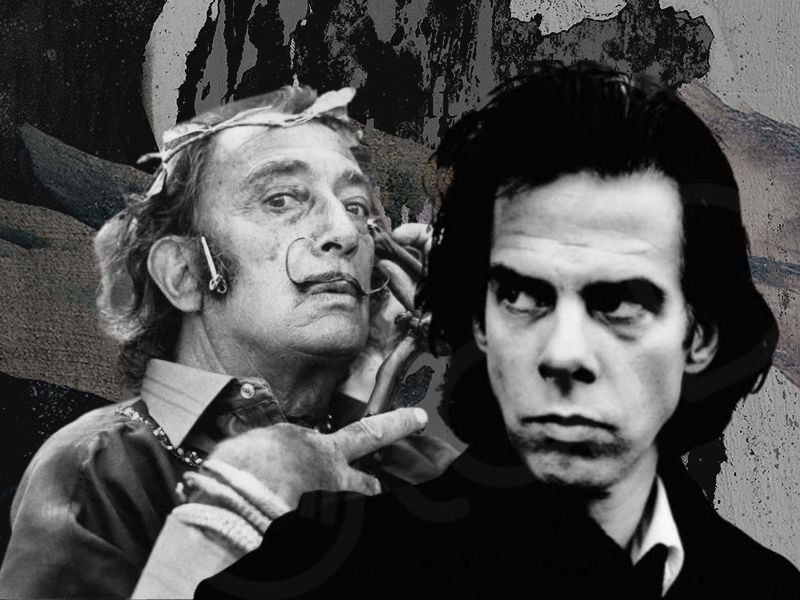
The artistic ties between Nick Cave and Salvador Dalí

Nick Cave’s back catalogue is a wandering affair. His muse is untethered from any particular genre, style or sensibility. The mausoleum he has crafted over the years contains an outsider odditorium with exhibits from the manic realm of The Birthday Party, literary dirges from the Murder Ballads, and maudlin tales of lost love, celebrations of salvation and every other pasture where his muse has chosen to picnic.
Salvador Dalí, however, always remained steadfastly surreal. Nevertheless, a twisted world is still a fruitful one and despite the prevalence of persistent melting clocks, when you strip away the surrealism, he too crafted a unique cornucopia of wayfaring delights. Hell, the moustachioed madman even abandoned the canvas completely when he cooked up a surrealist recipe book.
All that being said, both artists had a singular obsession that their muses simply couldn’t look away from. Whether Nick Cave is writing ballads, bloody thunderous rock ‘n’ roll, or epic poems, three things are always close at hand: birds, bloody loads of fucking birds, women’s hair, and botanica. And as for Dalí, his obsession resides with, well, it’s obviously melting clocks, isn’t it?
Why is it that they can’t escape these creative tethering stones despite being so singular in their approach? Well, perhaps there is a school of thought that these recurrent whims are exactly why both creators are so brilliant. The inescapable touchstones are insights into their creative processes. They prove that they are operating from a very personal space and their proud individualism has always imparted profundity.
This is a message that Cave has always supported. In 1999, he delivered a lecture on love songs in which he dusted off and donned the old Spanish word ‘Duende’, which was defined by poet and (perhaps) purely platonic love interest of Salvador Dali, Frederico Garcia Lorca, as exalted emotion unearthed from within, “a mysterious force that everyone feels and no philosopher has explained. The roots that cling to the mire from which comes the very substance of art.”
66 years earlier, when Lorca was fresh from graduating with Dalí, he delivered a very similar lecture himself. His oration was titled: Theory and Play of The Duende. In it he proclaimed: “I don’t want that terrible blowfly of boredom to enter this room, threading all your heads together on the slender necklace of sleep, and setting a tiny cluster of sharp needles in your, my listeners’, eyes. In a simple way, in the register that, in my poetic voice, holds neither the gleams of wood, nor the angles of hemlock, nor those sheep that suddenly become knives of irony, I want to see if I can give you a simple lesson on the buried spirit of saddened Spain.”
Continuing: “Whoever travels the bull’s hide that stretches between the Júcar, Guadalfeo, Sil and Pisuerga rivers (not to mention the tributaries that meet those waves, the colour of a lion’s mane, that stir the Plata) frequently hears people say: ‘This has much duende’. Manuel Torre, great artist of the Andalusian people, said to someone who sang for him: ‘You have a voice, you understand style, but you’ll never ever succeed because you have no duende’.”
In the Coen brothers film The Man Who Wasn’t There, there is a scene whereby a pretentious French piano instructor dismissively explains, in roundabout terms, ‘I don’t know what it is, but she hasn’t got it’. On the surface, this mystic je ne sais quoi of artistry may well seem like the sort of elitist tripe that has allowed trashcans to sell for millions at the Museum of Modern Art and resulted in tremendous artists being scoffed at for not having the right haircut, but I’ll be damned if there isn’t more than a grain of truth to it.
Transcendence is a word that Cave uses more than just about any other human, but you can’t watch him perform without understanding why—just as you can’t stand in front of a Dalí exhibit without thinking, ‘Yeah, there’s something to this madness’. Like them or loathe them, the beauty of their art is that it always proves hard to ignore. And that is because it has the unbridled individualism of expression or as Dalí’s old stablemate Lorca asserted, Duende.
Thus, with all that in mind, you might also not be too surprised to see a giant red right hand feature in the centre of Dalí’s 1930 painting ‘Simulacrum of the Night’. Borrowed originally from John Milton’s Paradise Lost, the duo also share a viewpoint that the fuel of Duende can be siphoned from other masters to boot. It’s about cloaking the inspiration in your own oeuvre, and Cave and Dalí’s is one that proves worlds apart.
As Lorca concluded: “Manuel Torre, a man who had more culture in his veins than anyone I’ve known, on hearing Falla play his own Nocturno del Generalife spoke this splendid sentence: ‘All that has dark sounds has duende.’ And there’s no deeper truth than that.”
